
Composite vs. Wood Docks: The Best Decking for Saltwater Canals
Capped composite or marine wood for your Southwest Florida dock? Here's how each holds up to salt, UV, and summer heat — and what we recommend.
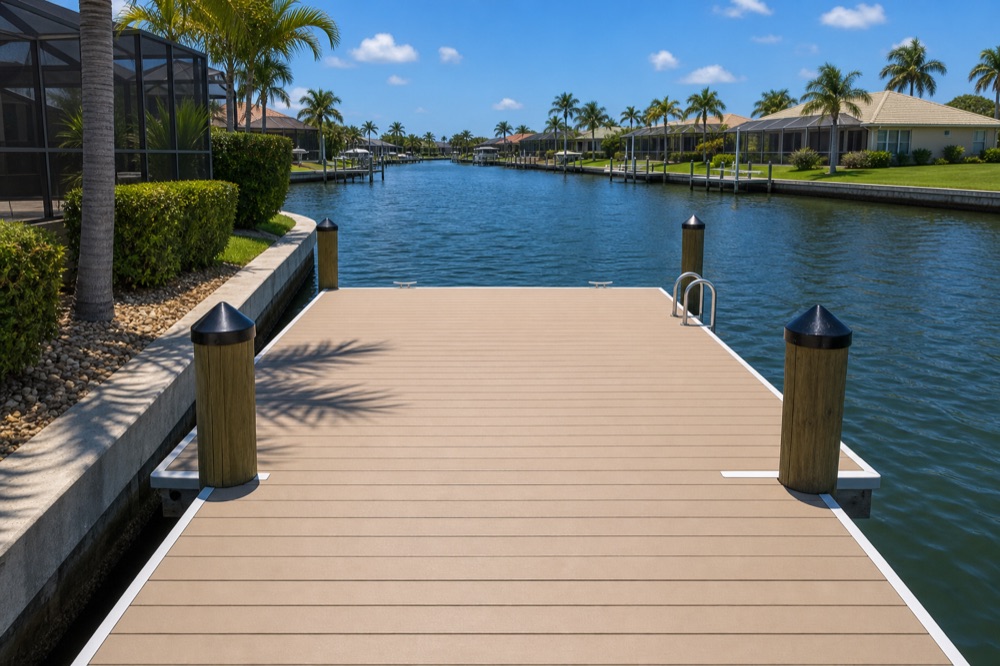
Key takeaways
- Capped composite (TimberTech/Trex) is UV-stable, splinter-free, cooler underfoot, and needs no annual sealing.
- Marine wood costs less up front but needs ongoing maintenance and lasts less long in salt water.
- The framing and 316 stainless fasteners underneath matter as much as the deck surface.
- For most SW Florida docks we recommend capped composite; wood is available where preferred.
Decking is the part of your dock you actually live on. It’s what your bare feet hit on the way to the boat, what your guests stand on at sunset, and the surface that takes the full beating of Southwest Florida salt, sun, and summer storms day after day. So when you’re planning a new dock, the choice between capped composite and wood is one of the most important — and most expensive to get wrong.
Here’s a straight, plainspoken comparison of how each performs on a saltwater canal in Cape Coral, Fort Myers, Naples, and up into Charlotte Harbor, plus what we recommend after building a lot of docks in this climate.
The short version
Both materials can make a great dock. But our coast is brutal on building materials — relentless UV, salt-laden air, high humidity, and the occasional storm surge. That environment is exactly where the two materials separate.
- Capped composite (brands like TimberTech and Trex) is engineered to ignore all of that. It won’t rot, splinter, or fade like wood, and it never needs sealing or staining.
- Wood costs less up front and gives you that classic natural look, but it asks for steady maintenance and won’t last as long in salt and sun.
Composite vs. wood at a glance
| Capped composite | Marine / pressure-treated wood | |
|---|---|---|
| Up-front cost | Higher | Lower |
| Lifespan in salt + sun | Decades | Shorter, with upkeep |
| Annual maintenance | None | Seal/stain yearly |
| Splinters | None | Yes, worse over time |
| Fading | UV-stable color | Fades and grays |
| Heat underfoot | Cooler (light colors) | Hot, especially dark stain |
| Rot / insects | Resistant | Vulnerable |
| Look | Modern, uniform | Classic, natural grain |
| Cost over the life of the dock | Lower | Higher |
Why capped composite wins on most SW Florida docks
The word that matters is capped. A capped composite board has a hard polymer shell bonded around a composite core. That cap is what stands up to our environment:
- UV-stable color. It holds its color for years instead of bleaching out and graying the way wood does in the Florida sun.
- Splinter-free. No slivers in bare feet, ever — a real difference on a dock kids and barefoot guests use all summer.
- No annual sealing or staining. A wood dock needs to be cleaned, sanded, and re-sealed on a regular schedule to survive the salt. Composite just needs an occasional rinse.
- Rot- and insect-proof surface. Salt water, humidity, and boring insects don’t get a foothold the way they do on bare wood.
- Decades of life. Built on proper framing, a capped composite deck simply outlasts wood in this climate.
The trade-off is real: composite costs more up front. But because you skip yearly maintenance and replace the boards far less often, it typically costs less over the life of the dock. You’re paying once instead of paying every season. Because the boards are only one call among many, it helps to see where the choice sits, and our complete guide to custom docks in Southwest Florida puts the whole arc in order.
Where wood still makes sense
Wood isn’t wrong — it’s a different set of trade-offs, and some owners genuinely prefer it. The pros are straightforward: a lower up-front cost, that warm, classic natural look, and the fact that it’s easy to source and repair with standard marine lumber.
The cons are just as real on a saltwater canal. Wood fades and grays, it splinters as it weathers, and it carries an ongoing maintenance commitment — cleaning and re-sealing on a schedule to fight the salt and UV. Skip that upkeep and the boards check, cup, and wear out years sooner. If you love wood and you’re willing to maintain it, we’ll build you a beautiful wood dock. We just want you going in with eyes open.
The framing underneath matters just as much
Here’s something a lot of decking comparisons miss: the boards you walk on are only half the dock. What holds them up takes an even harder beating, because it sits closer to the water and stays wetter.
That’s why we build the structure to last no matter which decking you choose. Every dock we build uses .80 CCA marine-grade framing — pressure-treated to a heavy retention rating made for ground and water contact — fastened with 316 stainless hardware that won’t rust and bleed streaks down your boards. Cheap fasteners are the first thing to fail on a saltwater dock; the right stainless is the difference between a dock that holds tight for decades and one that loosens up in a few seasons. If your current dock is wobbling or streaked with rust, that’s usually a framing-and-fastener problem — see our dock repair page.
What about heat underfoot?
Every dock surface warms up in direct Florida sun — there’s no magic material. But it’s not all equal. Quality capped composite in a lighter color is engineered to reflect more heat and stays noticeably cooler than older composites or a dark-stained wood deck, which can get genuinely hot by midday. If barefoot comfort matters to you, go composite and choose a lighter board. It’s one of the easiest ways to make your dock more usable in the summer.
Our recommendation
For the large majority of Southwest Florida docks, we recommend capped composite — the maintenance you’ll never do, the splinters you’ll never get, and the decades of life make it the better value over time, even with the higher up-front cost. If you want the natural look and don’t mind the upkeep, we’ll build you a great marine-wood dock instead. Either way, it goes on framing and hardware built specifically for salt water.
We won’t put a hard dollar figure on your dock from a blog post — too much depends on size, layout, water depth, and your decking choice. For real numbers, see our custom dock cost guide, and remember that decking is just one piece; permitting and the structure factor in too. We handle the permits in-house so you’re not chasing paperwork.
Ready to compare composite and wood for your own canal? We give free on-site estimates seven days a week across Cape Coral, Naples, and the rest of the coast. See everything we build on our custom docks page, or call (239) 397-3400.