
What Size Boat Lift Do I Need? A Southwest Florida Sizing Guide
Sizing a boat lift comes down to one number — your fully-loaded weight — not your boat's length. Here's how to find it and pick the right capacity.
Key takeaways
- Size the lift to your boat's fully-loaded weight (hull, engines, fuel, water, gear) plus a margin — not its length.
- A 22–26 ft center console or bay boat usually needs ~10,000 lb; larger cruisers ~16,000 lb; offshore boats 24,000 lb+.
- Both undersizing (unsafe) and oversizing (overspending) are mistakes.
- We confirm exact capacity at a free on-site measurement.
The most common boat-lift question we get in Southwest Florida is also the one most people answer wrong: what size do I need? Almost everyone reaches for boat length — “I’ve got a 24-footer, so I need a 24-foot lift.” But a lift isn’t rated in feet. It’s rated in pounds. And the pounds that matter aren’t what your boat weighs on the dealer’s spec sheet — they’re what it weighs sitting in your canal with the tank full and the cooler loaded.
Get that one number right and everything else falls into place. Here’s how to find it, what to add to it, and which lift typically matches your boat.
Size to your fully-loaded weight — not your hull
A boat lift has to carry your boat at its heaviest, which is almost never the number in the brochure. The figure that matters is fully-loaded, real-world weight:
- The hull (dry or “published” weight from the manufacturer)
- Engines — outboards, especially twins, add serious weight that’s often left out of dry specs
- A full tank of fuel — gasoline runs about 6 pounds per gallon, so a 100-gallon tank adds roughly 600 pounds
- Fresh water in any livewell, baitwell, or freshwater tank
- Batteries — two or three group-31 batteries add up fast
- Gear — anchors, tackle, coolers, a full T-top of electronics, the dinghy on the bow
Add all of that to the hull and you’ll often find your “24-footer” is one to two thousand pounds heavier than the number you started with. That’s the weight your lift carries every time it picks the boat up out of the salt.
How to find your boat’s real weight
Start with the manufacturer’s dry or published weight. You’ll find it on the original spec sheet, the builder’s website, or a quick search of the make, model, and year. Read the fine print — some “dry” weights include the engine and some don’t, and that difference alone can be 500 pounds or more.
From there, build up to loaded weight: add your engine package if it isn’t already in there, add fuel at 6 pounds per gallon for your tank size, add water, batteries, and the gear you actually keep aboard. Then add a realistic safety margin — we plan for roughly 20 to 30 percent over loaded weight. That margin covers the stuff you forget, future repowering, a heavier tank than you think, and the simple fact that a lift living its whole life in salt water should never be running at the edge of its rating.
Common boat-to-lift matches in Southwest Florida
Every boat is a little different, but after enough installs across Cape Coral canals, the Caloosahatchee, and Charlotte Harbor, the patterns are clear. Use this as a starting point, not gospel:
| Your boat | Typical lift capacity |
|---|---|
| Jet ski / PWC | Dedicated jet-ski lift |
| 22–26 ft center console or bay boat | ~10,000 lb |
| Larger cruisers, walkarounds, deck boats | ~16,000 lb |
| Offshore dual-engine, big center consoles | 24,000 lb+ |
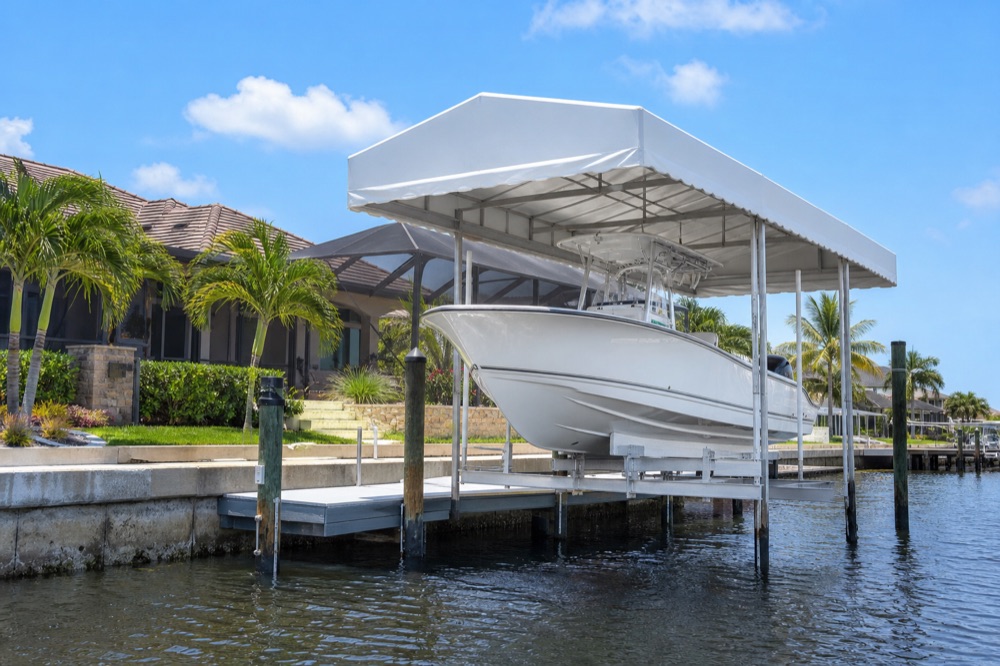
The 10,000 lb lift is the regional workhorse. It fits the boat you see on nearly every Southwest Florida canal — a 22 to 26 foot center console or bay boat with a full tank and a day’s worth of gear. Step up to a larger cruiser and you’re usually into 16,000 lb territory; run a serious offshore boat with twin or triple outboards and you’ll want 24,000 lb or more, with the heavier bracing that comes with it.
For a personal watercraft, you don’t need a full boat lift at all — a purpose-built jet-ski lift is cheaper, lighter, and a cleaner fit.
Why undersizing and oversizing are both mistakes
It’s easy to assume “bigger is safer,” but both directions cost you.
Undersize the lift and you run it at or over its rating every trip. Cables, motors, and the frame all work harder than they should, the lift ages faster, and you’ve put an expensive boat on hardware that isn’t truly rated to hold it. In a place where salt is already working against every component, that’s a gamble you don’t want to take.
Oversize the lift and you’ve simply spent more than you needed. A bigger lift means a bigger price tag, and a wider cradle isn’t automatically a better match for a smaller hull — it still has to support the boat at the right points and fit your slip. The smart move is the right capacity plus a sensible margin, which is exactly what the loaded-weight math gives you. (If budget is what’s driving the question, our boat lift cost guide breaks down pricing by capacity.)
Beam, length, and piling spacing
Capacity is the headline, but it isn’t the whole story. Two more things have to line up:
- Beam and length determine how the cradle supports your hull and whether the boat sits balanced and stable when it’s up. A lift rated for your weight still has to physically fit your boat’s footprint.
- Piling spacing decides whether the lift drops cleanly between your existing pilings or whether new ones are needed at the right spread and depth for your canal bottom.
This is where a lot of online “lift calculators” fall short — they’ll spit out a capacity but they can’t see your seawall, your slip width, your water depth, or how your pilings are set. Those details are exactly what make a lift fit your dock instead of a generic one. Even the right capacity can be the wrong lift for the water it hangs over, which is the case we make in boat lifts in Estero, where depth and clearance come before capacity.
We confirm the exact size on site
You can get close on your own with the loaded-weight math above, and you should — it’s the right way to think about it. But the final capacity, the cradle setup, and the piling plan all depend on your specific boat and your specific waterfront. That’s what a free on-site estimate is for. We look at your boat, your slip, your pilings, your canal depth, and your power, and we spec the lift that actually fits — sized for the salt, the surge, and decades of real use, not just today’s boat on a calm day.
Not sure where your boat lands? We give free on-site estimates seven days a week across Cape Coral, Fort Myers, Naples, and the rest of the coast. See everything we build on our boat lifts page, or just call (239) 397-3400 and we’ll get you a real answer.