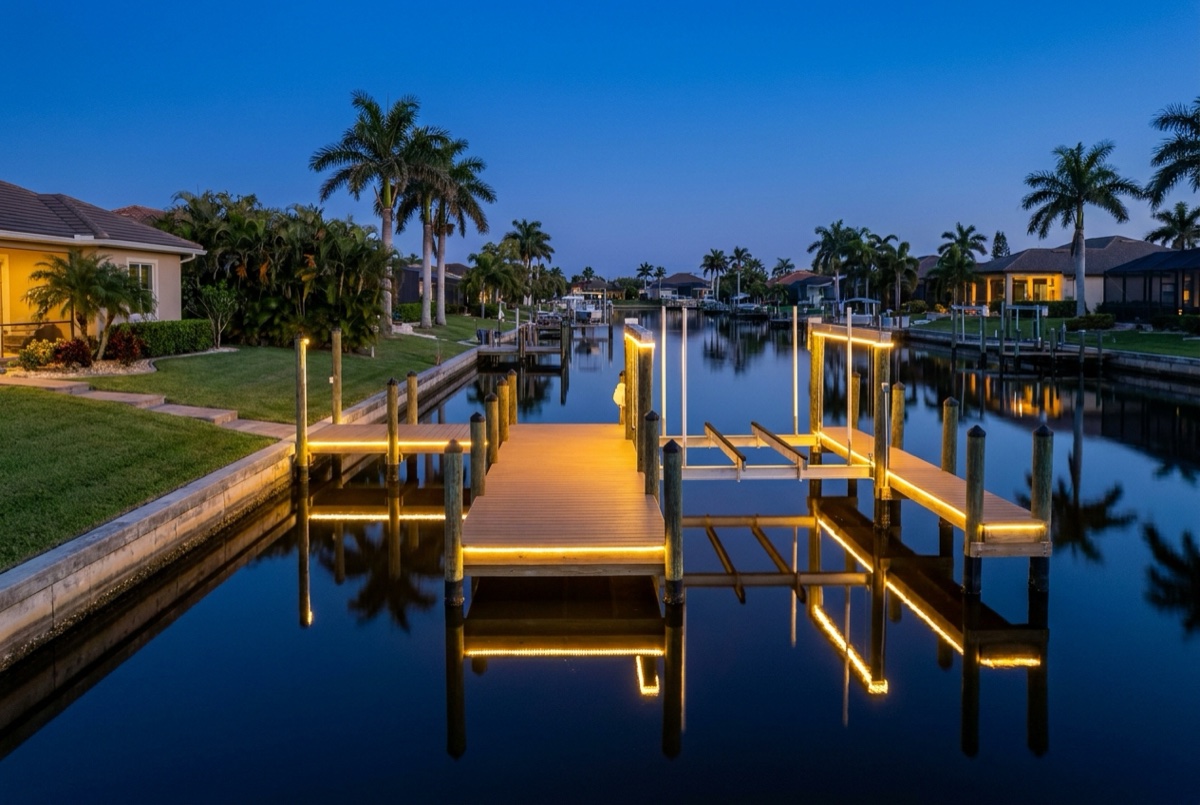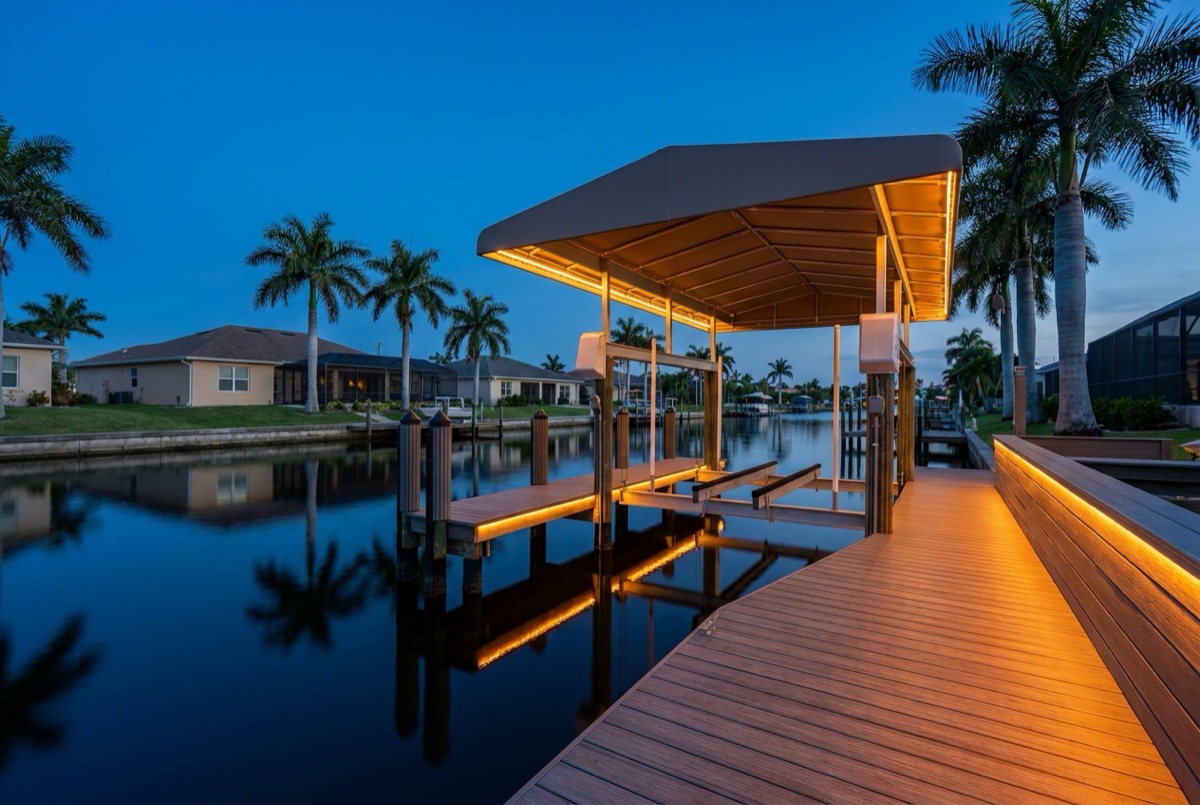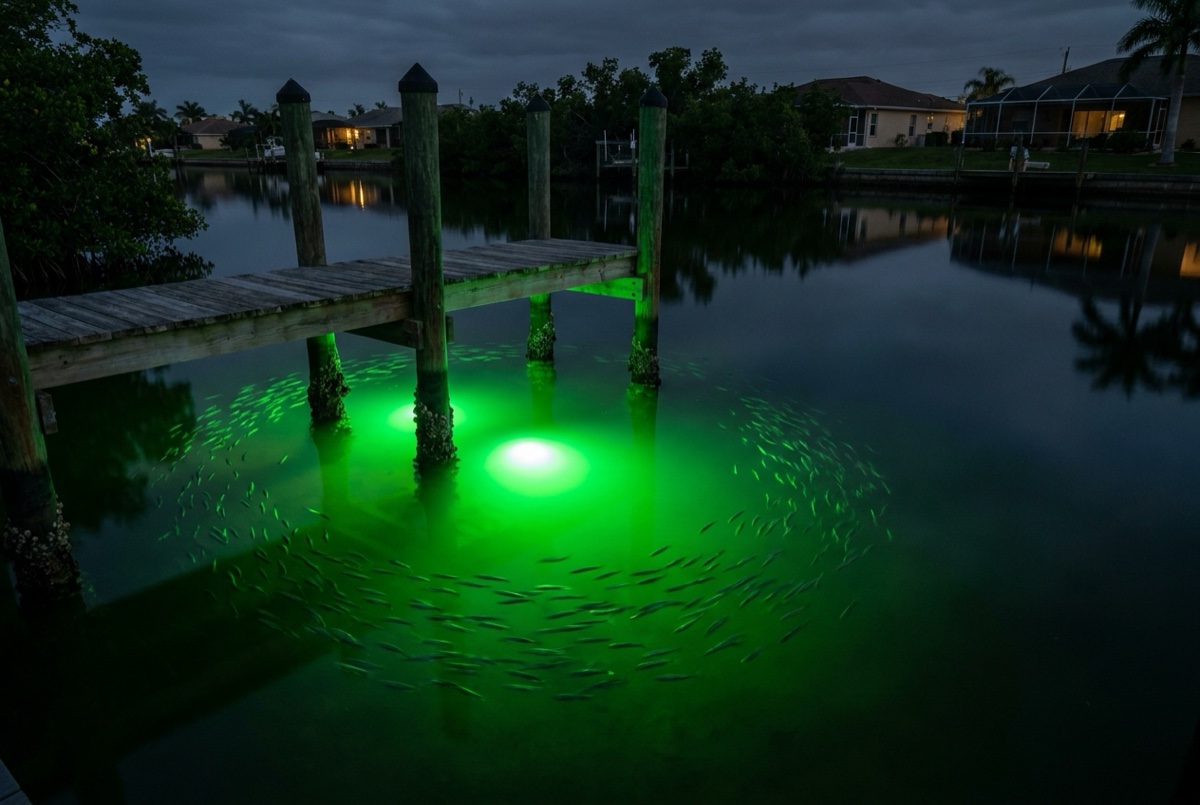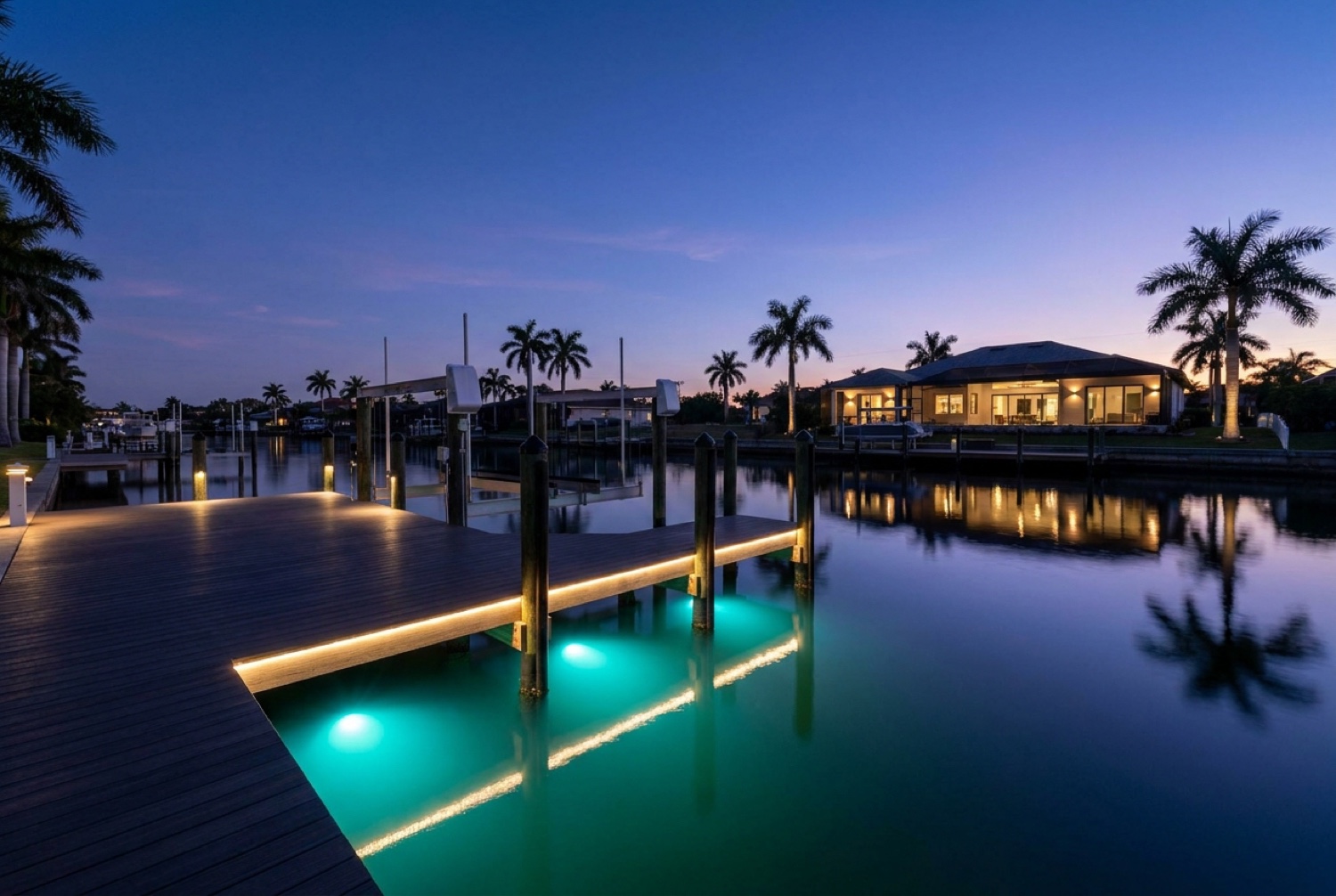
Florida docks live in the harshest environment you can wire: salt, sun, storm surge, and constant movement. Done right, your electrical system protects people (and wildlife), survives everyday splash and storms, and stays compliant when inspectors visit. This guide explains how to set up safe dock power and lighting in Florida, with plain‑English takeaways on GFCI vs. ELCI vs. GFPE, bonding/grounding basics, turtle‑friendly lighting along the coast, and underwater LED do’s and don’ts. We reference the National Electrical Code (NEC) requirements used in Florida today and highlight where local practice and sea turtle ordinances add rules. This is practical guidance—not legal advice. Always confirm details with your local authority having jurisdiction (AHJ) and use licensed, marine‑savvy electricians.
Table of Contents
Toggle- Florida code context (what’s enforced here)
- Safety fundamentals: GFCI vs. ELCI vs. GFPE (what each one does)
- Bonding and grounding on docks (what inspectors look for)
- Wiring and hardware that survive Florida
- Turtle‑friendly dock lighting (coastal Florida)
- Underwater LEDs on docks: safety & compliance
- Planning for nuisance‑trip reduction (without compromising safety)
- Permit & inspection notes (Florida)
- Field‑ready spec tips (what we write into drawings)
- Dock Electrical & Lighting Safety Checklist (Printable)
- FAQs
- Closing note
Florida code context (what’s enforced here)
- Florida currently enforces the 8th Edition Florida Building Code (2023), which incorporates the 2020 NEC statewide. Some jurisdictions may begin the process to move toward 2023 NEC, but as of 2025 the Florida code set still references NEC 2020; always verify with your AHJ before you design
- Article 555 (Marinas, Boatyards, Docking Facilities) governs many dock installations (especially multi‑slip and marina‑like facilities). Residential single‑slip docks often follow Chapters 1–4 plus selected Article 555 practices as required by local AHJs. The scope of Article 555 covers fixed/floating piers and docking facilities; local enforcement determines how much of 555 applies to single‑family docks.
Bottom line: Design to NEC 2020 as a baseline in Florida, monitor local amendments, and ask your building department how they apply Article 555 to your specific dock type.
Safety fundamentals: GFCI vs. ELCI vs. GFPE (what each one does)
| Device | Where it lives | Typical trip level | Purpose in plain English |
| GFCI (Ground‑Fault Circuit Interrupter) | On receptacles/breakers feeding dock outlets and lighting | ~5 mA | Personal protection: trips quickly on small leakage to prevent shock. Required for 15/20‑A dock receptacles. |
| ELCI (Equipment Leakage Circuit Interrupter) | On the boat, at the shore‑power inlet/main | ~30 mA | Whole‑boat leakage protection: trips if a vessel leaks hazardous current into water/ground. ABYC E‑11 calls for it to reduce electric shock drowning risk. |
| GFPE (Ground‑Fault Protection of Equipment) | On feeders/branch circuits serving docks per Article 555 | 2020 NEC commonly at ≤30 mA; 2023 NEC adjusted feeder GFPE to ≤100 mA | System‑level leakage protection: limits larger leakage that could energize water/structures without being a person‑level device. Florida’s statewide code still references the 2020 NEC; confirm with your AHJ. |
Why this matters:
- GFCI saves people at the receptacle/load level.
- ELCI reduces boat‑side leakage that can trigger dock trips and create Electric Shock Drowning (ESD) hazards.
- GFPE is the upstream “net,” catching dangerous leakage the downstream devices miss. (Feeder setpoints differ by NEC edition; Florida is on NEC 2020 unless amended.
Bonding and grounding on docks (what inspectors look for)
- Bond all non‑current‑carrying metal parts likely to become energized (ladders, metal frames, handrails, metallic raceways, metal parts in contact with water) to the equipment grounding bus, using properly sized copper conductors and listed connections.
- Equipotential plane: Where shore‑power equipment serves dock loads, an equipotential plane reduces step/touch voltage risk; bond accessible metal in the work area per Article 555 provisions and your AHJ’s interpretation.
- Signage: Post permanent “No Swimming – Electrical Shock Hazard” signs at docks and marinas as required/appropriate; this is a recognized mitigation for ESD risk in Article 555.
- Keep gear above the electrical datum plane and out of splash: mount receptacles and equipment at least 12 inches above deck and not below the datum plane on fixed piers; use listed marina power outlets in weatherproof enclosures.
Wiring and hardware that survive Florida
- Raceways & cable: Use wet‑location conductors (e.g., THWN‑2/XHHW‑2), sunlight‑resistant jackets, and corrosion‑resistant fittings rated for damp/wet/salt environments. Provide expansion fittings and flexible sections where hinges or movement occur between shore and floating docks.
- Enclosures & devices: Prefer NEMA 4X/corrosion‑resistant enclosures, in‑use covers, and stainless (316) hardware.
- Heights & flood: Elevate panels/disconnects above base flood elevation where required.
- Power pedestals: Use listed marina power outlets; avoid mixing residential boxes outdoors in marine splash zones. Receptacles supplying boats must be in listed enclosures suitable for the environment.
- Maintenance reality: Salt + sun ages GFCIs. Plan periodic testing/replacement and a schedule to re‑torque lugs and inspect corrosion.
Turtle‑friendly dock lighting (coastal Florida)
Florida’s coasts protect nesting sea turtles. Many counties and cities enforce sea turtle lighting ordinances derived from the state’s model rule (Chapter 62B‑55). Where your dock lighting is visible from the beach, expect it to be regulated. The FWC three rules for wildlife lighting are: Keep it Low, Keep it Shielded, Keep it Long (wavelength)—that means low‑mounted fixtures, full cutoff shielding, and amber/long‑wavelength LEDs (generally ≥560 nm) so light is less disruptive to turtles.
Practical steps that pass inspections and respect wildlife:
- Choose amber LEDs specifically labeled as wildlife/turtle‑friendly, with full cutoff shielding so the source is not visible from the beach. Aim fixtures downward onto the dock only.
- Use timers/motion so lights are off when not needed, especially during nesting season.
- On beachfront parcels, verify if your municipality has a turtle lighting ordinance and map; many Southwest Florida cities and counties do.
Note: Even away from open beaches (in bays/canals), the same “low‑shielded‑long” philosophy helps reduce skyglow and neighbor glare.
Underwater LEDs on docks: safety & compliance
Underwater lights can be great fish attractors and visual accents—but they’re electrical equipment immersed in water. Treat them with the same rigor you would a pool fixture:
- Use only luminaires listed for continuous immersion under UL 676 (Underwater Luminaires and Submersible Junction Boxes)—no DIY submersion of landscape or strip lights.
- Low‑voltage, isolated power is preferred; follow the listing instructions for isolation transformers/power supplies and overcurrent protection.
- All circuits GFCI‑protected and in wet‑location wiring methods with submersible junction boxes where required by the listing.
- Routing & strain relief: Provide drip loops and mechanical protection; avoid chafe points at pilings.
- ESD awareness: Never encourage swimming near energized docks. Maintain GFCIs, boat ELCIs, and feeder GFPE so leakage is detected before it becomes a hazard.
- Wildlife/ordinance check: In beachfront turtle zones, underwater light spill that’s visible from the beach can still be an issue. Confirm locally.
Planning for nuisance‑trip reduction (without compromising safety)
- Start with the boat: A leaky boat will trip dock protection. Ensure the vessel has an ELCI and a clean bill of health (insulation/leakage test) before chasing dock wiring.
- Segregate loads: Put pumps, lifts, lighting, and outlets on dedicated breakers; isolate problem circuits during troubleshooting.
- Quality devices: Use listed marine‑rated pedestals and high‑quality GFCI breakers; receptacle‑type GFCIs in harsh environments fail faster.
- Document leakage: An electrician with an AC leakage clamp can quantify milliamps by circuit to identify offenders (common culprits: heaters, chargers, aging luminaires).
Permit & inspection notes (Florida)
- Permits: Electrical work on docks typically requires a local electrical permit; significant lighting visible from beaches may also be reviewed for turtle‑friendly compliance.
- Article 555 items inspectors sample on docks: GFCI at receptacles, GFPE at feeders (per adopted NEC), bonding jumpers to metal in contact with water, equipment mounting relative to datum plane, listed marine outlets, in‑use covers, and signage.
- Edition check: Ask your AHJ if they’re enforcing NEC 2020 or have adopted NEC 2023 provisions for marinas/docks (notably GFPE setpoints). In most of Florida, 2020 NEC remains the reference inside the 2023 FBC cycle.
Field‑ready spec tips (what we write into drawings)
- Conductors: Copper, wet‑location rated, sunlight‑resistant; tinned marine cable where permitted and helpful for corrosion resistance.
- Hardware & enclosures: 316 stainless fasteners; NEMA 4X enclosures; in‑use covers; anti‑seize on threads; UV‑stable gaskets.
- Heights: Receptacles/pedestals ≥12″ above deck, not below datum plane on fixed piers; raise above flood elevation where required.
- Protection devices: GFCI for 15/20‑A receptacles; GFPE per Article 555 (edition‑specific); boat ELCI urged.
- Underwater lights: UL 676 listed, low‑voltage isolation, submersible boxes, GFCI, and labeled disconnect.
- Wildlife‑friendly lighting: Full cutoff shielding, amber LEDs (≥560 nm), low mounting, timers/motion in nesting season.
Dock Electrical & Lighting Safety Checklist (Printable)
Use this at the dock with a pen, seasonally and after major storms.
Power & Protection
- □ GFCI test at all dock receptacles and lighting circuits (press TEST/RESET)
- □ Feeder/branch GFPE present and labeled per AHJ/NEC edition
- □ Boat shore‑power protected by ELCI (verify test)
- □ “No Swimming—Electrical Shock Hazard” signage posted and legible
Bonding & Grounding
- □ Bonding jumpers from panel to all non‑current‑carrying metal (ladders, rails, frames)
- □ Connections clean, tight, and corrosion‑free; listed lugs/connectors used
- □ Equipotential plane provided and bonded where shore‑power equipment serves dock loads (if required)
Wiring Methods
- □ Wet‑location conductors and fittings; no open splices; expansion/flex where hinges move
- □ Enclosures/pedestals NEMA 4X; in‑use covers intact; cords strain‑relieved
- □ Equipment heights: ≥12″ above deck; not below datum plane on fixed piers
Lighting (General)
- □ All fixtures listed for damp/wet locations; no bare lamps; glare shielded away from water/neighboring lots
- □ Photocells/timers/motion working; any failed lenses/gaskets replaced
Turtle‑Friendly (if visible from beach)
- □ Amber/long‑wavelength LEDs; fully shielded (source not visible from beach)
- □ Aiming downward, low mounting, minimal lumen output; timers set for nesting season
Underwater LEDs
- □ Fixtures listed to UL 676; low‑voltage isolated power per listing
- □ Submersible junction boxes and GFCI protection present
- □ Cables protected from abrasion; no damaged insulation
Corrosion & Housekeeping
- □ No green/white corrosion bloom on terminations; re‑torque per manufacturer
- □ All covers closed; gaskets intact; debris removed from pedestals and boxes
Action Items
- □ Replace failed GFCI/GFPE devices
- □ Add bonding jumper(s) at: __________
- □ Service/replace underwater LED at: __________
- □ Adjust turtle‑friendly shielding/aiming at: __________
- □ Schedule licensed electrician inspection by: __________
FAQs
1) Do single‑family residential docks have to meet all of NEC Article 555?
Local practice varies. Article 555 covers marinas, boatyards, and docking facilities; many AHJs apply portions of it to residential docks (especially where shore power is present). Expect inspectors to enforce GFCI, bonding, proper mounting heights/datum plane, listed pedestals, and signage consistent with 555’s intent. Ask your AHJ how they apply 555 at single‑family docks.
2) What’s the difference between GFCI, ELCI, and GFPE—and do I need all three?
They serve different layers. GFCI protects people at receptacles; ELCI protects the boat from leaking current to water; GFPE protects dock feeders/branches at higher leakage levels. Together they reduce shock risk and electric shock drowning hazards. In Florida, plan for GFCI and GFPE at the dock per the adopted NEC, and use ELCI on the boat per ABYC best practice.
3) Why do my breakers trip when I plug in my boat?
Your boat may have leakage that an ELCI/GFCI/GFPE detects. Have a marine electrician test the boat with a leakage clamp and inspect on‑board chargers/heaters. Dock circuits should be segregated so you can isolate the problem circuit.
4) Are underwater LED lights legal?
Yes—when they are listed for continuous immersion (UL 676) and installed per their listing (isolation, GFCI, submersible boxes). In turtle‑protected zones, ensure the light is not visible from the beach or violates local ordinances.
5) Do I need special lighting because of sea turtles?
If your lights are visible from the beach, many Florida jurisdictions require turtle‑friendly fixtures: low, shielded, long‑wavelength (amber) with strict aiming. This reduces disorientation of nesting turtles and hatchlings.
6) What height should receptacles be on a fixed pier?
Mount them at least 12 inches above the deck and not below the electrical datum plane, and use listed marina power enclosures. Your inspector will check this.
7) Is it ever safe to swim around my dock if the power is off?
No. Stray current can exist from neighboring docks or boats. NFPA and safety groups advise never swimming near docks or marinas. Post signage and keep protection devices maintained.
8) Which NEC edition should I design to in Florida right now?
As of 2025, Florida’s 8th Edition FBC references NEC 2020 statewide, with some jurisdictions exploring 2023 NEC adoption. Always verify with your AHJ at permit intake.
Closing note
Safe Florida docks start with layered protection (GFCI + ELCI + GFPE), solid bonding/grounding, corrosion‑proof components, and wildlife‑friendly lighting. Build those into your plans up front, and your dock will be safer for people, neighbors, and sea turtles—without constant nuisance trips or premature failures.