
Above-Water vs Underwater Dock Fishing Lights: Which Is Better?
The most-debated fish-light question, settled. Underwater lights stack the tightest bait but fight barnacles and algae; above-water floods need zero underwater upkeep and still pull snook. Here's how to choose for your canal.
Key takeaways
- Underwater fish lights light the entire water column and pull the tightest bait stack, but they grow barnacles and algae and must run dusk to dawn so they don't overheat in air at low tide.
- Above-water floods need zero underwater maintenance, last longer, draw less power, and still pull snook to the surface — the pull is just shallower and a bit less concentrated.
- Tide swing is the deciding factor: big low-tide exposure favors above-water; deep, steady water favors underwater.
- Many SW Florida owners run both off one low-voltage system, or choose by how much underwater cleaning they're willing to do.
- Both are sealed, marine-rated, low-voltage fixtures on a dusk timer; both retrofit onto an existing dock or seawall.
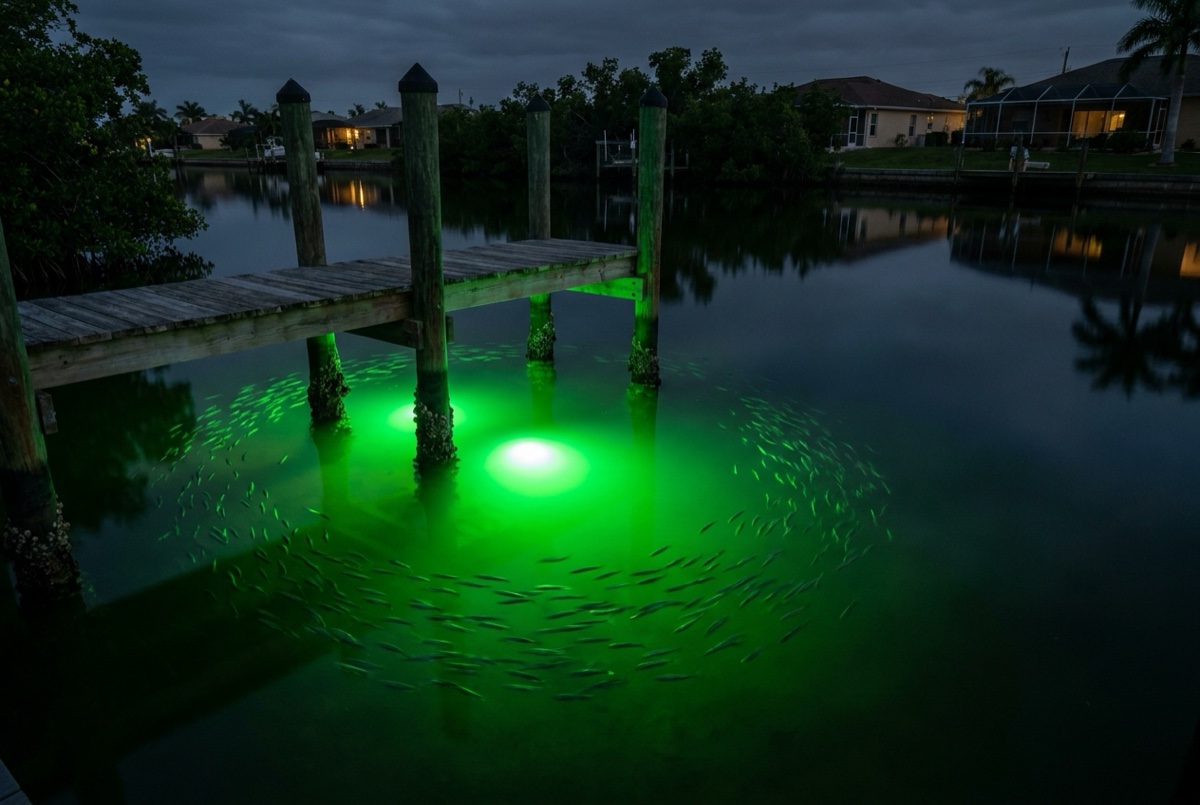
Walk any lit-up canal in Cape Coral or Fort Myers after dark and you’ll see two very different setups doing the same job. Some docks glow from below — an emerald pool radiating up through the water with bait shimmering inside it. Others throw a bright flood down onto the surface from a piling or the dock edge, lighting a sheet of water you can sight-cast across. Both pull fish. So the question every waterfront owner ends up arguing about is the one that actually matters: above-water or underwater — which is better?
The honest answer is that neither wins outright. They’re two tools with different trade-offs, and the right call comes down to your tide swing, your water depth, and how much underwater scrubbing you’re willing to do. Plenty of SW Florida owners settle the debate by running both. Here’s the head-to-head so you can pick the setup that fits your canal.
What’s the difference between above-water and underwater fish lights?
The short version: underwater lights sit submerged and light the whole water column from below, while above-water lights mount on a piling or the dock and flood the surface from above. Both are marine-grade LED fixtures wired to a low-voltage transformer on a dusk timer.
A fish light is any light deliberately aimed at the water to trigger the night-feeding food chain — plankton gathers in the glow, baitfish move in to eat the plankton, and snook, tarpon, trout, and redfish slide in to ambush the bait. (If you want the full food-chain breakdown, see our underwater fish lights guide.) The two styles just deliver that light from opposite directions:
- Underwater fish lights are sealed fixtures mounted to your seawall or pilings below the waterline. The light radiates out in every direction through the water itself.
- Above-water fish lights are floods or fixtures mounted above the surface — on a piling, under the dock, or off a post — angled down to light a patch of water.
That single difference in mounting drives every trade-off that follows: attraction, maintenance, lifespan, and look.
Which one attracts more fish?
Underwater wins on raw concentration. A submerged light pushes glow through the entire water column, so it stacks the tightest, deepest bait ball and pulls gamefish that hold down deep — but a well-aimed above-water flood still draws plenty of fish to the surface with none of the underwater hassle.
Here’s why the underwater fixture has the edge on pure pull. Light traveling through water reaches bait at every depth, from the surface down to the bottom in our canals. Snook and trout will get right up against a submerged fixture, and you’ll see the bait ball form into a dense, glowing cloud. On the deeper Caloosahatchee-connected canals and along Charlotte Harbor seawalls with real water under them, that full-column light is hard to beat.
An above-water flood lights the surface and the top of the water column. Bait still gathers on the lit sheet, and predators — snook, ladyfish, trout, the occasional tarpon rolling through — absolutely work that light line. The pull is shallower and spread over a wider, softer patch rather than one intense pillar. For a lot of owners who fish the surface anyway, that’s all the attraction they need. The fish are there; they’re just feeding higher in the water.
What’s the maintenance difference?
This is where above-water lights win decisively. Underwater fixtures live in the salt and grow barnacles and algae on the lens, so they need regular cleaning to stay bright — above-water lights never touch the water, so there’s no underwater scrubbing at all.
Anything submerged in SW Florida salt water becomes a reef. Within weeks, an underwater lens fogs with algae and slime in the warm months, and barnacles will crust the housing — and a dimmed light stacks less bait, so a fogged fixture quietly stops doing its job. Keeping an underwater light working means a wipe of the lens every few weeks through the warm season and an occasional barnacle scrape. It’s not hard, but it’s a real, recurring chore, especially if your dock is your weekend escape and you’d rather fish than scrub.
Above-water floods skip that entirely. Mounted in open air, they collect nothing but the occasional salt haze you’d hose off any dock fixture. There’s no leaning over the seawall, no diving, no growth to fight. For snowbirds who are away half the year, or anyone who just wants to flip a switch and fish, that maintenance gap is often the whole decision.
Why do underwater lights need to run dusk to dawn?
Because most underwater fixtures rely on the surrounding water to cool them. If the light runs while it’s left high and dry at low tide, it can overheat and burn out early — so running dusk to dawn keeps it submerged through the tide cycle and keeps the bait pattern building every night.
This is the part of the underwater debate that trips people up, and it ties straight back to our tides. On a SW Florida canal the water can drop a foot or more between high and low. A fixture mounted to catch the deeper water can end up partly exposed to air at low tide. Run a heat-producing light in air and it loses its cooling — that’s how submerged lights die young.
The fix is simple and standard: run the fixture dusk to dawn on a timer rather than flipping it on for a couple of hours. Across a full night the tide cycles, the fixture stays wet enough, and as a bonus the bait pattern sets in faster because the food chain builds without interruption. It does mean the light is on all night, every night — though LED fixtures sip power, so the cost is small. Above-water lights have no such rule; air is exactly where they’re built to live, so you can run them however you like.
Above-water vs underwater fish lights: side-by-side
Here’s the head-to-head on the factors that actually decide it:
| Factor | Underwater fish lights | Above-water floods |
|---|---|---|
| Attraction | Lights the whole water column; tightest, deepest bait stack | Lights the surface and top of column; wider, softer pull |
| Underwater maintenance | Lens cleaning + barnacle removal every few weeks in warm months | None — fixture never touches the water |
| Run requirement | Dusk to dawn so it stays cooled and doesn’t overheat at low tide | Run anytime; no submersion needed |
| Lifespan | Strong with upkeep, but salt and growth are constant | Typically longer — no submersion, no marine growth |
| Power draw | Low (LED), but runs all night | Low (LED), and only when you want it |
| Tide swing tolerance | Best on deep, steady-water canals | Better where big low tides expose the seawall |
| Look | Glowing emerald pool from below — the showpiece glow | Bright lit sheet on the surface; lights the dock too |
| Cost | Quoted free on-site (factors below) | Quoted free on-site (factors below) |
How do I choose for my canal?
Let your tide swing and your maintenance tolerance decide. Deep, steady water and an owner who’ll keep the lens clean point to underwater; big low-tide exposure and a hands-off owner point to above-water. When you can’t choose, run both.
A few simple guidelines we use when we walk a dock:
- Big tide swing or shallow seawall edge? Lean above-water. If your water drops far enough to leave a submerged fixture exposed, the floods sidestep the whole overheating problem.
- Deep, steady water and you love to fish? Lean underwater. That full-column glow and tight bait stack is the real show, and the upkeep pays you back in snook.
- Away a lot, or you just want to flip it on and go? Above-water. No diving, no scrubbing, longer life, less to think about.
- Want the best of both? Run both. The underwater fixture gives you the deep stack; the floods cover the surface and light the dock with zero added maintenance — and we wire the whole thing on one dock lighting system and one timer.
There’s no wrong answer here, only the one that fits how you use the water. Both styles retrofit cleanly onto an existing dock or seawall, and both are part of the same sealed, low-voltage backbone — so adding them later, or adding the second style down the road, is straightforward.
Built for the salt either way
Whichever direction you go, the fixtures have to be built for this coast, because hurricane-season storm surge, year-round UV, and relentless salt are hard on anything on the water. Everything we install is marine-grade: sealed IP68 LED fixtures rated to live in or over salt water, low-voltage transformers so the system is safe and efficient, and dusk timers so it runs itself every night. Underwater or above, it’s the same quality wiring that feeds the rest of your dock — one clean install, not a novelty you toss in the water. (For the broader fixture rundown, see our guide to the best dock lighting for SW Florida salt water.)
Still torn between the two? That’s exactly what an on-site look settles. We’ll check your water depth, your tide swing, and how you fish, then lay out whether underwater, above-water, or both is the right call for your dock — and quote it on the spot. Florida Lifts & Docks has been lighting up SW Florida docks since 2008 with our own local crew, in-house permitting, and a 5.0-star track record across 18 coastal cities from Cape Coral to Naples. See the full setup on our fish lights page, or call (239) 397-3400 for a free on-site estimate seven days a week.