
The Best Dock Lighting for Saltwater Docks in Florida (2026 Buyer's Guide)
How to spec dock lighting that survives years on a saltwater canal — fixture materials, IP68, low-voltage wiring, and where each light type actually belongs.
Key takeaways
- The best saltwater dock lighting is low-voltage (12V) LED in 316 stainless or marine-grade aluminum, rated IP68 below the deck, wired with tinned copper.
- IP68 is non-negotiable for any fixture at the waterline, on a step, or underwater; IP65+ is enough for protected above-deck lights.
- Big-box dock lights usually fail in one to three salt seasons because of 304 stainless, untinned copper, and weak gaskets — not because LEDs wear out.
- Match the fixture to the location, pathway, piling cap, step, or underwater each calls for a different rating and beam.
- Mount the transformer in a dry, ventilated spot well above storm-surge reach and keep every connection out of standing water.
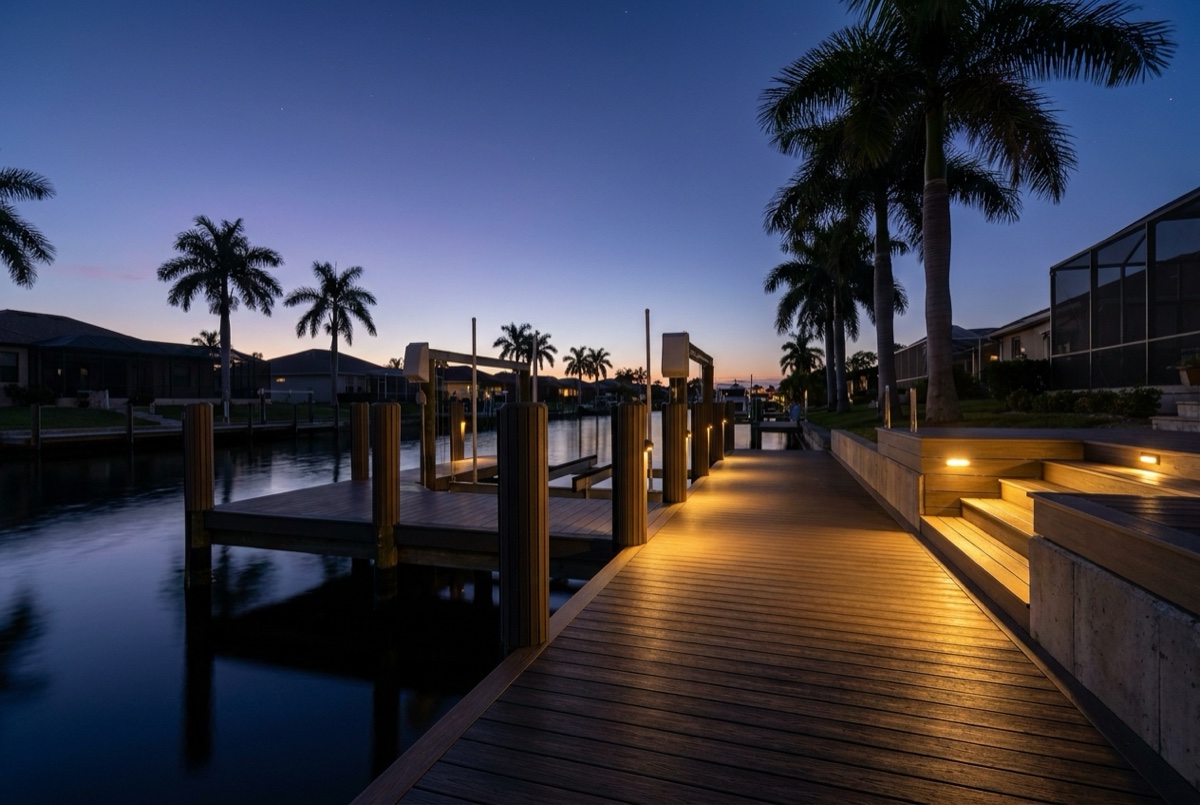
Good dock lighting does three jobs at once: it gets you and your guests safely from the seawall to the boat after dark, it makes the whole backyard waterfront feel finished, and — done right — it lasts for years instead of corroding into a junk-drawer of dead fixtures. On a Southwest Florida canal, that last part is the hard part. Salt air, blistering UV, summer humidity, tide swings, and hurricane-season surge will find every weak gasket and every cheap screw on a dock light. The good news: you do not need a custom fabrication shop to get a system that survives. You need to spec the right parts.
This is a no-fabrication framework for choosing the best dock lighting for saltwater living. We will define what actually makes a fixture marine-grade, decode the IP rating that does the heavy lifting, explain why low-voltage wins on a dock, and lay out exactly which light type belongs where — pathway, piling cap, step, or underwater. If you fish, you will also want underwater fish lights, but those are a different tool with a different job (more on that below).
What makes a dock light “saltwater-grade”?
A saltwater-grade dock light is one built from corrosion-proof materials, sealed to a high IP rating, and wired with tinned copper so the whole system — not just the bulb — survives years in salt air. The fixture is only as good as its weakest link.
“Marine-grade” gets stamped on a lot of boxes that have no business near a canal, so here is what the term actually has to mean on the water:
- Corrosion-proof housing and hardware. That means 316 stainless steel (the grade with added molybdenum that resists salt-water pitting) or marine-grade aluminum with a sealed anodized or marine powder-coat finish. Plastic and composite lenses are fine and often preferred, but every screw, bracket, and clip you can see should be 316 stainless.
- A real gasket, not a smear of glue. The seal between the lens and the body is where water gets in. Quality fixtures use a compression gasket or potted (fully resin-filled) electronics.
- Tinned copper wiring. Bare copper turns green and brittle in months on a Florida dock. Tinned copper — copper strands coated in tin — is the marine standard and resists the corrosion that travels up untinned wire and kills the connection from the inside.
- Sealed connections. Heat-shrink butt connectors with adhesive liner, or gel-filled connectors, keep moisture out of every splice.
That spec is the same philosophy we build everything to. Our docks use 316 stainless hardware, marine-grade aluminum, and capped composite decking (TimberTech / Trex) for exactly this reason — the Gulf coast eats anything less.
Why do big-box dock lights fail so fast here?
They fail because they are built for a lake, not the Gulf. The LEDs themselves rarely wear out; what dies is the cheap metal, the thin gasket, and the untinned wire around them.
Walk almost any older canal in Cape Coral or Fort Myers and you will see the evidence — fixtures weeping rust streaks down the piling, lenses fogged with condensation, half a string dark. The usual failure modes:
- 304 stainless instead of 316. It looks identical in the store. Within a season or two in salt air it develops surface rust (“tea staining”) and pitting, and the screws seize.
- Raw or untreated aluminum. It oxidizes into a chalky white crust and bleeds aluminum oxide onto your decking.
- Untinned copper wire. Corrosion wicks up the conductor, resistance climbs, and the light dims and then dies — even though the fixture looks fine.
- Weak gaskets. One hot, humid Florida summer of expansion and contraction breaks the seal, water gets in, and the driver shorts.
- No surge planning. A fixture mounted low gets dunked during a storm-surge event in hurricane season and never recovers.
None of those are LED problems. They are materials-and-wiring problems, which is exactly why the right spec up front pays for itself.
Should dock lights be low-voltage or line-voltage?
For almost every dock, low-voltage (12V) LED is the right call. It is safer around water, dramatically easier to expand later, and runs off a single transformer you can tuck into a dry, protected spot. Line-voltage (120V) belongs only to specific high-output fixtures and always on a GFCI circuit.
Low-voltage has become the default for a reason. A 12V system steps household power down at one transformer, then sends safe low voltage out to the fixtures. You can add a piling cap or a step light next season by tapping the existing run instead of pulling new conduit. And around water — where stray current is a genuine safety concern — 12V is simply far more forgiving than 120V.
| Low-voltage (12V) | Line-voltage (120V) | |
|---|---|---|
| Safety near water | Excellent — low shock risk | Requires GFCI, careful design |
| Ease of adding fixtures | Easy — tap the existing run | Harder — conduit, junction boxes |
| Wiring | Tinned marine cable, buried/secured | Conduit, licensed install |
| Best for | Pathway, piling, step, accent, most underwater | A few high-output flood/fish setups |
| Transformer/panel | One transformer, dry mount | Dedicated GFCI circuit |
Whichever you choose, anything 120V on or near a dock should be installed by a licensed electrician and protected by GFCI — and if you ever feel a tingle in the water near your dock, kill the power and have it checked immediately. Electrical safety on the water is not a DIY corner to cut.
Which dock light belongs where?
Match the fixture to the job. A pathway needs a soft downward wash; a piling cap can take a brighter post light; a step needs a low glare-free marker; and anything at or below the waterline needs to be sealed to IP68. Here is the placement framework.
This is the heart of a no-fabrication system — you are not building custom anything, you are putting the correct off-the-shelf fixture in the correct spot:
| Location | Fixture type | Rating to look for | Why it belongs there |
|---|---|---|---|
| Walkway / decking edge | Recessed deck lights or low path lights | IP65+ (IP68 if flush in deck) | Lights the walking surface without blinding you |
| Piling caps / posts | Post-cap or piling-mount lights | IP65+ (above splash) | Defines the dock outline; great ambient glow |
| Steps / seawall edge | Low recessed step markers | IP68 (gets splashed/dunked) | Prevents the most common after-dark fall |
| Under the dock / waterline | Submersible LED fixtures | IP68 (continuous submersion) | Safe ambient light; resists wave action |
| Fishing (under water) | Dedicated underwater fish lights | IP68, higher output | A different tool — see below |
A few placement rules that matter on a SW Florida dock:
- Aim light down, not out. Downward, shielded fixtures light the deck and water without throwing glare across the canal into a neighbor’s lanai.
- Warm white reads as “finished,” cool white reads as “utility.” For ambiance most owners prefer a warmer tone; we break the trade-offs down in warm white vs. cool white dock lights.
- Keep fixture count sane. A handful of well-placed lights beats a runway of them. Even spacing along the walkway plus piling-cap accents is usually plenty.
What is an IP68 rating — and where do you actually need it?
IP68 means a fixture is fully sealed against dust and rated for continuous submersion in water. On a dock, you need IP68 for anything at the waterline, on a step, or underwater — and IP65 or better is enough for protected fixtures up on the deck and pilings.
The IP (“Ingress Protection”) code has two digits. The first is dust (6 = fully dust-tight). The second is water, and that is the one that matters on a canal:
- IP65 — protected against water jets from any direction. Fine for a piling-cap light or a path light up where only rain and spray reach.
- IP67 — can handle brief, shallow immersion. A reasonable minimum for step lights near the splash zone.
- IP68 — sealed for continuous submersion. This is the number to demand for any fixture mounted at the waterline, on a low step, or underwater, where tide and wave action mean the light spends real time wet.
The mistake we see most often is an IP65 fixture installed low on a seawall or step, where the next king tide or boat wake submerges it. It was never rated for that, water gets in, and it is dead within a season. On the water, when in doubt, go IP68.
What about underwater fish lights?
Underwater fish lights are a related but separate system — they are high-output submersible lights designed to draw bait and gamefish to your dock, not to illuminate a walkway. If fishing off your dock is the goal, plan them as their own circuit.
Plenty of owners want both: a clean low-voltage system for getting around safely and the look, plus dedicated fish lights for the after-dark show under the dock. They share the same marine-grade DNA — 316 stainless, IP68 sealing, tinned wiring — but fish lights run brighter and are specced around color and output rather than pathway lighting. Color choice (green, aqua, white) and how the whole food chain works is its own topic; start with our underwater fish lights guide and our fish lights service page if that is your goal.
How to spec a system that lasts
Pull it together and a durable saltwater dock-lighting system comes down to a short checklist:
- Fixtures: 316 stainless or sealed marine-grade aluminum; LED; IP68 anywhere it can get wet.
- Wiring: tinned (marine-grade) copper throughout, with adhesive-lined heat-shrink connectors.
- Power: a single low-voltage transformer for most of the dock, mounted in a dry, ventilated spot well above storm-surge reach — never in a low box that floods.
- Connections: keep every splice out of standing water; seal them all.
- Placement: the right fixture for each location, aimed down, evenly spaced.
Do that and you have a system that shrugs off salt air, UV, and hurricane season for years. Cut corners on any one of those — the metal, the wire, the seal, or the transformer location — and you are back to weeping rust streaks and dark strings within a couple of seasons. (Keeping a good system clean is easy; see our dock lighting maintenance guide and the real-world cost breakdown when you are budgeting.)
Want lighting that is designed and wired to last on your canal — not pieced together from big-box parts? Florida Lifts & Docks has been building waterfront the right way out of Cape Coral since 2008, with our own local crew (never subbed) and in-house permitting. We give free on-site estimates seven days a week across Cape Coral, Naples, Fort Myers, and the rest of Southwest Florida. See what we build on our dock lighting page, explore a full custom dock, or call (239) 397-3400.