
How Much Does Dock Lighting Cost in Southwest Florida? (Price Factors)
Why two docks get two very different lighting quotes — the real cost drivers behind SW Florida dock lighting, and how to ballpark your own scope before the estimate.
Key takeaways
- Dock lighting is quoted free on-site because price is driven by scope — dock and seawall length, fixture count and type, and how far power has to travel — not a flat per-light rate.
- Fixture type sets the tier: pathway and step lights are the entry point, recessed piling-cap lights cost more per point, and underwater fish lights are a separate, heavier system on their own transformer.
- The biggest hidden cost driver is the wiring run from your panel to the dock — a long run across the yard or down a seawall adds trenching, conduit, and a larger transformer.
- A retrofit on an existing dock is often cheaper than people expect (no fixtures means open framing), but fishing wire through a finished, capped-composite dock takes more labor.
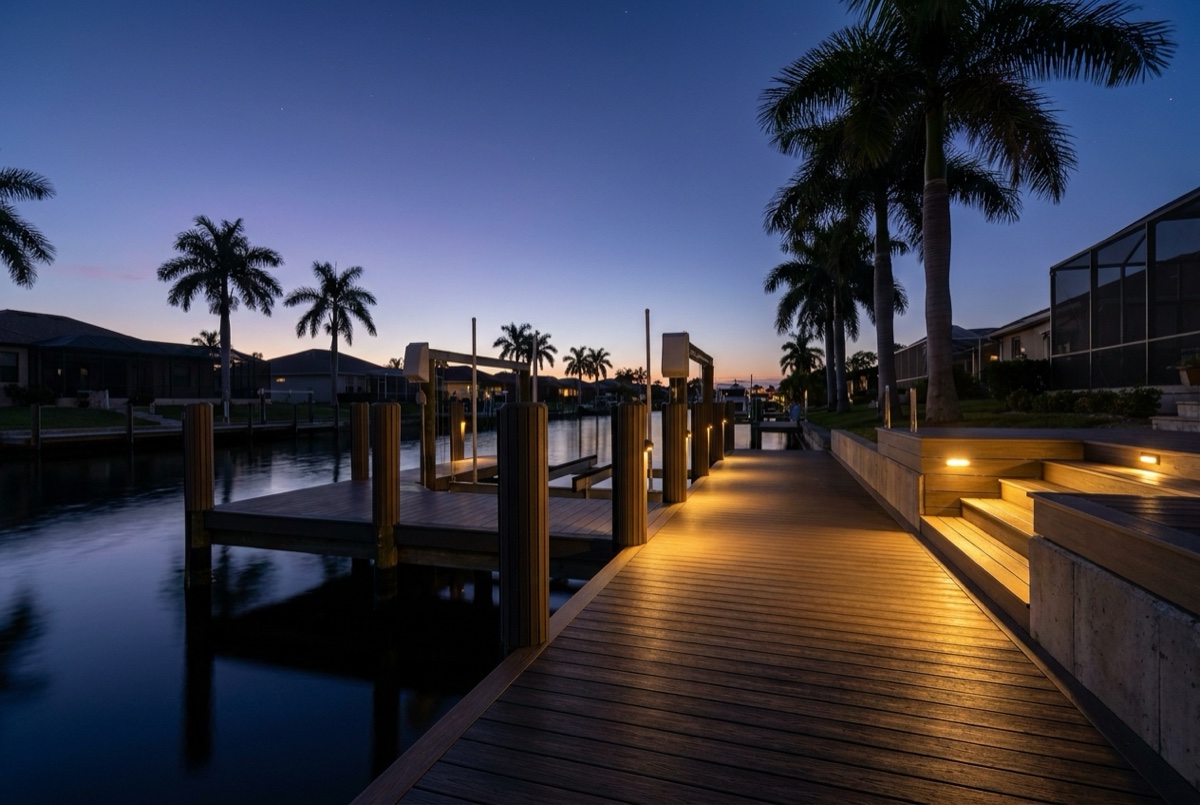
Good dock lighting changes how you use the water. It turns a black canal into a place you’ll actually walk after dark, makes loading the boat at 5 a.m. safe instead of sketchy, and — done right — quietly raises the whole look of your waterfront. So the first question every owner asks is the obvious one: what does dock lighting cost?
Here’s the honest answer up front: there is no flat per-light price, and anyone who quotes you one over the phone is guessing. Dock lighting is quoted free on-site because the number is driven almost entirely by scope — how much dock you’re lighting, what kind of fixtures you want, and how far the power has to travel to reach them. The good news is those drivers are easy to understand, and once you do, you can ballpark your own project and walk into the estimate knowing exactly why your quote looks the way it does.
What counts as “dock lighting” — and what drives the price?
Dock lighting is the system of low-voltage fixtures that light the deck, edges, steps, and pilings of your dock so it’s safe and beautiful after dark. The price is driven by four things: how much dock there is to light, how many and what type of fixtures you choose, how far power has to run, and whether it’s a new build or a retrofit.
Think of it as a system, not a shopping list of bulbs. Every fixture has to be wired back to a transformer, and that transformer has to be fed from your home’s panel. The fixtures themselves are often the smallest line item — the labor to get power to them, safely and to code in a saltwater environment, is where the real cost lives. Underwater fish lights are a related but separate system; we cover those in their own guide.
How does dock and seawall length affect the cost?
The longer your dock and seawall, the more the lighting costs — more linear footage means more fixtures, more wire, and a bigger transformer to power it all. Length is the single biggest scope driver.
A 20-foot dock off a short seawall is a handful of fixtures and a short wire run. A long captain’s walk or an estate dock that wraps a wide lot needs lights spaced along its whole length, plus enough cable to reach the far end without voltage drop dimming the last fixtures. On a typical SW Florida canal lot, the things that add up are:
- Dock decking length — how many feet of walkway need pathway or recessed lighting
- Seawall length — many owners light the cap of the seawall too, which adds fixtures and wire
- Number of pilings — piling-cap lights are priced per piling
- Steps and grade changes — every step down to a floating dock or lower deck is a place a step light goes
You can ballpark your own scope right now: walk your dock, count the pilings, pace off the deck and seawall length, and note every step. That list is most of what we’ll be looking at.
Which fixture types cost more — and why?
Fixture type sets the price tier: pathway and step lights are the entry point, recessed piling-cap and deck lights cost more per point, and underwater lights are a separate heavier system. What you choose matters as much as how many.
Here’s how the common fixtures stack up, lowest to highest cost per point:
| Fixture type | What it does | Relative cost per point |
|---|---|---|
| Pathway / post lights | Light the walking surface and edges | Lower |
| Step / riser lights | Mark every step and grade change | Lower–moderate |
| Recessed deck lights | Flush dots set into the decking itself | Moderate |
| Piling-cap lights | Cap each piling with a downlight; great looking | Moderate–higher |
| Underwater fish lights | Submerged marine fixtures that draw bait and fish | Separate system, higher |
Recessed and piling-cap fixtures cost more per point not because the fixture is wildly expensive, but because of the labor to set them cleanly — coring a capped-composite deck for a flush light, or fitting and sealing a cap fixture on each piling, takes time and a tidy hand. Warm-white LED is the standard for the deck and pathway in our climate; it reads as inviting rather than industrial and sips power. (For the full warm-vs-cool and saltwater-fixture rundown, see best dock lighting for saltwater Florida.)
How much does the wiring run from your panel add?
The distance from your electrical panel to the dock is the biggest hidden cost driver — a long run across the yard or down a seawall means more wire, conduit, possible trenching, and a larger transformer. This is the number-one reason two near-identical docks get different quotes.
If your home has power right at the seawall or a nearby exterior outlet, the run is short and cheap. If the panel is on the far side of the house and the dock is 100-plus feet away across a lawn, that low-voltage cable has to be run in conduit, often trenched, all the way out — and the longer the run, the more voltage drop you fight, which can push you to a heavier transformer to keep the far fixtures bright. Other run-related drivers:
- Trenching across landscaping, hardscape, or a pool deck adds labor and restoration
- Routing around or under a seawall cap to reach piling and edge fixtures
- A dedicated GFCI-protected circuit at the panel if one isn’t already there
- Transformer sizing — total fixture wattage plus run length sets the transformer, and a bigger system needs a bigger (and sometimes a second) transformer
None of this is exotic, but it’s the difference between a half-day job and a two-day one — and that’s exactly why we measure the run on-site instead of guessing.
Does smart control or a retrofit change the price?
Yes — smart controls add modest cost, and retrofitting an existing dock can cost more or less than a new build depending on whether wire can be fished through finished framing. Both are common asks, and both are easy to scope once we see the dock.
Smart control — putting your dock lights on a timer, a photocell that switches them at dusk, an app, or a smart-home system — is a small add on top of the base system, mostly the controller and the wiring to it. Most owners think it’s worth it: lights that come on at sunset and off at midnight on their own, every night, year-round.
Retrofit vs. new build cuts both ways, and it surprises people:
- New build is the cheapest time to light — with the framing open and the dock not yet decked, we set fixture locations and run conduit with almost no extra fuss. If you’re planning a new custom dock or adding a boat lift, bundling lighting in is the smart move.
- Retrofitting an older open-framed wood dock is often easier than owners expect — there’s room under the deck to run wire and mount fixtures.
- Retrofitting a finished, capped-composite dock takes more labor, because we’re fishing cable through a sealed structure and coring for recessed fixtures without tearing it up. That’s craft work, and it’s reflected in the quote.
Whatever the dock, we never sub the crew out — the same local team that builds docks does the lighting, so the wiring, sealing, and fixture work is done to marine standard the first time. (To pin down how many fixtures your dock actually needs, start with how many dock lights do I need.)
Why salt water makes the spec — and the quote — matter
In a saltwater canal, the cheap lighting kit is the expensive one, because salt air and spray destroy anything that isn’t built for it. The fixtures, wire, and connections all have to be rated for marine use, and that’s baked into how we scope every job.
Cape Coral, Fort Myers, and Naples canals are brutal on hardware. Salt spray off the Caloosahatchee and the bays creeps into every connection, UV bakes plastic housings brittle, and summer storm surge from June through November can submerge fixtures that were never meant to get wet. A bargain set of big-box landscape lights will corrode, fog, and fail within a season or two on the water. Marine-grade fixtures, sealed connections, and properly rated low-voltage cable cost more up front and last for years instead of months — which is the whole point of doing it right once.
How to ballpark your own dock lighting scope
You can get close to your own scope before we ever arrive. Pull these four things together and you’ll understand your quote before you see it:
- Footage — pace off your dock deck length and seawall length
- Fixture wish list — count pilings (for caps), steps (for step lights), and decide if you want recessed deck dots, pathway lights, or both
- The run — find your panel or nearest exterior power and roughly measure the distance to the dock
- Extras — note if you want smart/timer control, and whether you’re also interested in underwater fish lights (a separate system, quoted alongside)
A modest run of warm-white pathway and step lights on a short dock with power nearby is a small, satisfying project. A fully lit estate dock — recessed deck lights, piling caps, lit seawall, smart control, and underwater fish lights — is a much larger system, and it deserves a real on-site look rather than a phone guess.
Ready for a real number? Florida Lifts & Docks has built and lit docks across Southwest Florida since 2008, with our own local crew, in-house permitting, and a perfect 5.0 rating on Google. We give free on-site estimates seven days a week — we’ll measure your footage, check your power, and scope the lighting that fits your dock and your budget. Explore everything we do on the dock lighting page, or call (239) 397-3400.