
Boathouse Roof: Metal vs. Shingle in Florida
A boathouse roof sits over saltwater, not your living room — and that changes the answer. Here's the honest metal-vs-shingle comparison for the SW Florida coast.
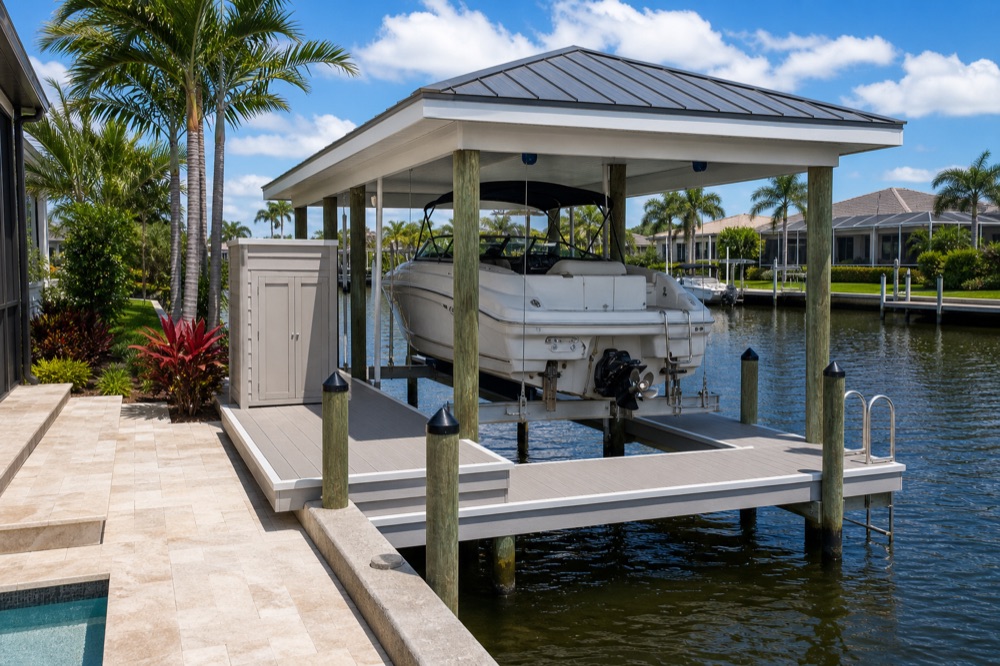
Key takeaways
- For a roof over saltwater, metal almost always wins — standing-seam systems are rated roughly 140–180 mph for wind uplift versus about 110–130 mph for shingles.
- Marine-grade aluminum doesn't rust and coated metal resists salt corrosion; bare steel and mismatched fasteners are what actually fail, so the spec matters more than the material name.
- Metal sheds Florida heat and UV, lasts decades, and the rain noise most owners find is a feature, not a flaw, on an open structure.
- Shingles are cheaper up front and can match a home's look, but degrade faster in salt, sun, and storm wind — usually costing more over the life of the boathouse.
- Boathouses are custom and quoted free on-site; roof choice is decided alongside span, pitch, and wind exposure.
When you roof a house, you’re sheltering a living room. When you roof a boathouse, you’re building a structure that stands in the wind, over saltwater, fully exposed to the Gulf sun, through every hurricane season from June to November. That single difference is why the usual roofing advice doesn’t transfer — and why boathouse roof metal vs shingle is the most common question we field from waterfront owners across Cape Coral, Fort Myers, and Naples.
A boathouse roof is the permanent roofed cover over a boat slip, carried on pilings out over the water rather than on a foundation in the ground. Because it sits in a harsh marine environment with nothing around it to break the wind, the priorities shift from “what looks nice on my street” to “what survives salt, sun, and storm.” Here’s the straight comparison.
Which roof handles wind and uplift better?
Metal, clearly. A properly engineered standing-seam metal roof is rated for substantially higher wind uplift than asphalt shingles, which matters enormously on a structure with open sides that the wind can get under.
In broad terms, standing-seam metal systems are commonly rated in the 140–180 mph range, while typical shingle systems land around 110–130 mph. A boathouse has no walls to brace it and no neighboring structures to slow the wind over the water, so uplift is the load that decides whether a roof stays put in a named storm. Metal panels lock together and fasten down as a continuous system; shingles are thousands of individual tabs, and once the wind peels one edge, it can unzip a section fast.
For coastal storm performance, this alone is why most boathouses on SW Florida canals and along Charlotte Harbor go metal.
Does salt corrosion change the answer?
Yes, and it’s the heart of the case for metal — specifically the right metal. Marine-grade aluminum doesn’t rust, and quality coated metal resists salt corrosion for years, which is exactly what you want hanging over saltwater.
Salt air is relentless here. It’s the same reason every lift we build uses marine-grade aluminum and 316 stainless hardware — the Gulf coast eats anything less. A boathouse roof faces that same salt load, so the smart spec is:
- Marine-grade aluminum panels that simply can’t rust, or high-quality coated metal
- Stainless fasteners matched to the panel so the screws don’t corrode first
- No mixed metals in contact, which is what triggers galvanic corrosion
Cheap metal roofs don’t fail because metal is bad — they fail because someone used bare steel or the wrong screws. Shingles dodge the rust problem, but trade it for UV breakdown and granule loss that salt air and sun accelerate.
What about heat and rain noise?
Metal sheds heat and reflects sun better than dark asphalt, and the rain noise most owners worry about turns out to be a non-issue — often a feature.
A light-colored metal roof reflects a good share of the Florida sun instead of soaking it up like dark shingles, keeping the space under your boathouse cooler. On rain noise: a boathouse isn’t an enclosed bedroom, so there’s no ceiling to amplify sound and no reason to deaden it. Plenty of owners count the patter of a summer storm on a metal roof as part of being on the water. If you want it softened anyway, panel profile and underlayment choices help.
How do lifespan and cost compare over time?
Metal lasts longer and usually wins on lifetime cost; shingles are cheaper to install but get replaced sooner in this climate.
A quality metal roof in our salt-air environment typically lasts decades. Shingles over saltwater have a meaningfully shorter real-world life — sun, salt, and storm wind all shorten the clock, and a single bad hurricane season can take a shingle roof off the table early. The up-front savings on shingles often evaporate the first time you replace them.
| Factor | Metal (aluminum / coated) | Asphalt shingle |
|---|---|---|
| Wind uplift rating | ~140–180 mph (standing seam) | ~110–130 mph |
| Salt corrosion | Excellent (aluminum won’t rust) | Not a rust risk, but UV/granule loss is faster |
| Heat / UV | Reflects sun, runs cooler | Absorbs heat, degrades in sun |
| Rain noise | Audible (most find it pleasant) | Quieter |
| Lifespan in SW FL | Decades | Shorter; earlier replacement |
| Up-front cost | Higher | Lower |
| Lifetime cost | Usually lower | Often higher (replacements) |
So when does a shingle roof make sense?
When matching your home’s exact look matters more than maximizing wind, corrosion, and lifespan performance. That’s a real reason — just go in with eyes open.
Some owners want the boathouse to read as an extension of the house, and if the home wears shingles, a matching boathouse roof can tie the property together. It’s a legitimate aesthetic call. Metal, for what it’s worth, now comes in a wide range of profiles and colors, so you can often get a clean, architectural look without giving up coastal performance. For the vast majority of SW Florida boathouses sitting over a canal or open water, the metal-vs-shingle math comes out the same way: metal.
Roof choice never gets decided in a vacuum — it’s tied to your slip span, your roof pitch, and how exposed your site is to wind off the water, all of which we work out together. If a full roofed structure is more than you need, a lift canopy is the lower-cost covered route, and we walk through that trade-off in boathouse vs. lift canopy and covered vs. uncovered boat lifts.
Thinking about a roofed slip? Florida Lifts & Docks has built for SW Florida’s saltwater since 2008 with our own local crew — never subbed — and in-house permitting. Explore everything we build on our boathouses page, see what drives the budget in our boathouse cost guide, and book a free on-site estimate seven days a week in Cape Coral, Naples, Punta Gorda, and across the coast. Call (239) 397-3400.