
How Much Does a Boathouse Cost in Southwest Florida?
There's no price list for a true boathouse — and there's a good reason for that. Here's every cost driver in plain English, plus a framework for what makes yours cheaper or more expensive.
Key takeaways
- There's no flat boathouse price because each one is custom; cost is driven by slip span, pilings (number and depth), water depth, roof type and pitch, finish, lift integration, and engineering/permitting.
- The lower-cost covered alternative is a lift canopy at about +$14,000–$22,000 — far less than a permanent roofed structure.
- A modest span over sound existing pilings with a simple metal roof sits at the low end; wide spans, new deep pilings, steep premium roofs, and heavy lifts push it up.
- Any honest builder quotes a boathouse after an on-site look at your seawall, pilings, water depth, and wind exposure — never off a chart.
- We handle engineering and permitting in-house and scope it all into one estimate.
If you’ve been searching for a boathouse price and keep coming up empty, you’re not doing anything wrong. There genuinely isn’t a sticker price for a true boathouse, and any builder who hands you one off a chart is guessing. A boathouse is a permanent, engineered structure built over the water and tied into the canal bottom, and the right design depends entirely on your lot — the span you need to cover, how deep your water is, what your soil will hold, and how exposed you are to wind off Charlotte Harbor or the Caloosahatchee.
What we can do is show you exactly how the number is built. Once you understand the cost drivers, you can look at your own dock and have a realistic sense of whether you’re at the lower end or the upper end before we ever come out. This is the honest, no-price-list explainer — and where the leaf questions about boathouse roofs, adding a boathouse to an existing dock, and the rest all point back to.
What exactly is a boathouse?
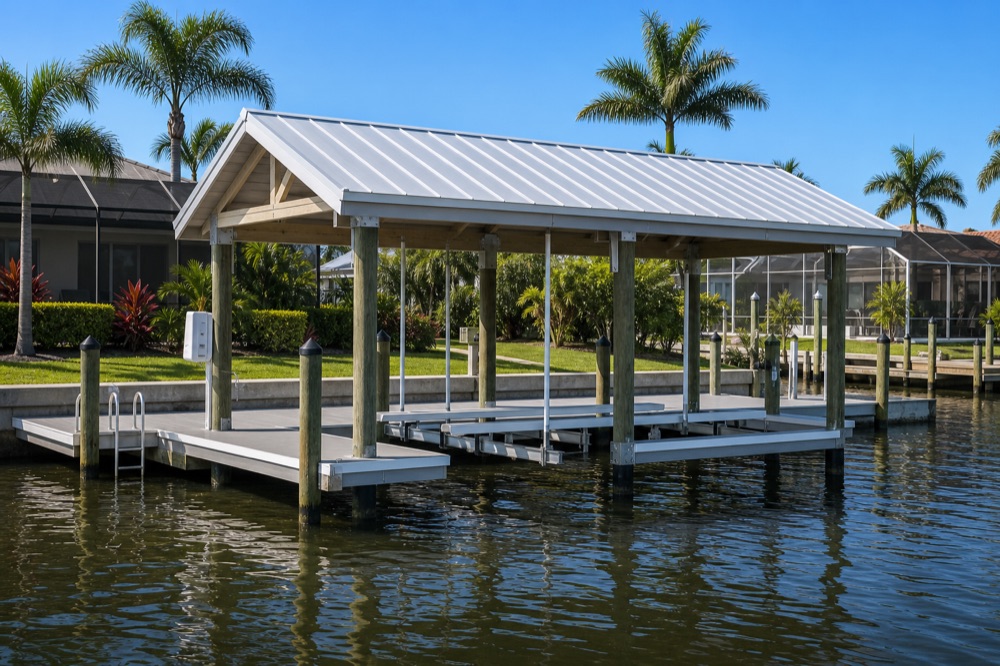
A boathouse is a permanent, roofed structure built over your boat slip — real posts driven into the canal bottom, a structural frame, and a finished roof, all engineered to local wind code. It is not the same thing as a fabric or metal cover clipped onto your lift.
That distinction matters for cost, so it’s worth being precise. A lift canopy rides on the boat lift itself and shades the hull. A boathouse is its own building over the water: it shelters the boat, the lift, and often a walkway, and it becomes an architectural feature of the home. The canopy is an accessory; the boathouse is structure. We break the two apart fully in our boathouse vs. lift canopy guide, but the short version is that they live at very different points on the price spectrum — and that’s the first reason there’s no single boathouse number.
Why is there no price list for boathouses?
Because no two SW Florida waterfront lots are the same, and a boathouse is built for the lot, not off a catalog. The structure that works over eight feet of water on a wide Cape Coral canal is a different design — and a different cost — than one over a shallow, tidal stretch near Estero Bay.
A dock or a lift can be ranged on a chart because the variables are contained. A boathouse can’t, because it stacks several big variables on top of each other at once:
- The span it has to roof over changes the framing and the roof entirely.
- The pilings under it depend on your water depth and what the canal bottom will hold.
- The roof can be anything from a simple gable to a steep, premium profile.
- The engineering scales with how exposed you are to storm-season wind and surge.
Change any one of those and the whole number moves. That’s not a builder being cagey — it’s the nature of putting a permanent building over salt water. The honest answer is a free on-site estimate, which is why we give them seven days a week.
What drives the cost of a boathouse?
Here’s every lever, in plain English. Read down the list and you’ll have a good feel for where your project lands before we measure a thing.
- Slip span. The single biggest driver. A boathouse over a single jet ski or a small skiff is a fraction of one built to clear a 30-foot center console with rod holders up. Wider and longer means more framing, more roof, and more structure to hold it all up.
- Number and depth of pilings. Every post has to be driven deep enough to stand for decades in our soft, sandy canal bottoms. Deeper water and looser soil mean longer pilings and more of them. If you have sound pilings already in the right spots, you save; if we’re driving fresh ones, that’s real material and crew time added.
- Water depth. Both extremes cost more. Deep water needs longer pilings and more bracing; very shallow or low-tide water can force a taller or specialized design so your hull and lift still clear the bottom at dead low.
- Roof type and pitch. A low, simple metal gable is the value choice. A steeper pitch, a hip roof, or a shingled profile to match the house all add framing complexity and material. Pitch isn’t just looks, either — it sheds water and wind differently, which ties straight into the engineering. (See our metal vs. shingle roof guide.)
- Finish level. A workmanlike structure costs less than one finished to estate standard — capped composite trim, tongue-and-groove ceiling, integrated dock lighting, water, and power all add up. You decide how far up that ladder you want to go.
- Lift integration. Most owners want a boat lift under the roof. Adding or upsizing a lift is part of the budget, and a heavier-capacity lift for an offshore boat carries more than a small one. If you’re building the lift into the structure from the start, it’s cleaner and often smarter than retrofitting later.
- Engineering and permitting. A permanent structure over public waterway requires engineered drawings and permits, and we handle that in-house. A more exposed, open-water site needs heavier engineering than a protected interior canal — and that shows up in the design.
What makes mine cheaper vs. more expensive?
Quick framework: you’re at the lower end when you’re roofing a modest span over sound existing pilings, in workable water, with a simple metal roof and a standard finish. You’re at the upper end when you’re covering a wide slip, driving new deep pilings, dealing with problem water, choosing a steep or premium roof, finishing to estate level, and integrating a heavy lift on an exposed site.
Here’s the same idea side by side:
| Cost driver | Pushes cost down | Pushes cost up |
|---|---|---|
| Slip span | Small skiff / single jet ski | Wide slip, large center console or cruiser |
| Pilings | Sound pilings already in place | New, deep pilings driven in soft bottom |
| Water depth | Workable mid-range depth | Very deep, or shallow/low-tide problem water |
| Roof | Simple low-pitch metal gable | Steep pitch, hip, or shingled premium roof |
| Finish | Clean, standard, functional | Composite trim, finished ceiling, lighting, power, water |
| Lift | Light lift or none | Heavy-capacity integrated offshore lift |
| Site & engineering | Protected interior canal | Exposed open-water, heavier engineering |
Use that table on your own dock and you’ll know roughly which side you’re on. The exact figure still comes from an on-site look, but you won’t be flying blind.
What’s the lower-cost alternative if a boathouse is too much?
A lift canopy, and this is the one real number we can put in writing: about +$14,000–$22,000 added to a boat lift. It’s the budget-friendly way to get your boat under cover without building a permanent structure.
A canopy mounts to the lift and shades the hull, gelcoat, and upholstery from the relentless UV and the afternoon downpours that define hurricane season from June through November. You give up the full coverage and the architectural feature of a real boathouse — and the resale bump that comes with it — but you get genuine sun and rain protection for a fraction of the cost. For a lot of owners with a mid-value boat, that’s exactly the right call. We lay out the trade-offs in covered vs. uncovered boat lifts, and the canopy-vs-boathouse decision in detail in our boathouse vs. lift canopy guide.
Why does the build quality change the long-term cost?
Because the cheapest boathouse is the most expensive one you’ll ever own once the salt gets into it. Our coast is brutal on marine structures — saltwater canals, UV that never quits, storm surge, and marine borers that hollow out untreated wood from the inside.
Everything we build is specced to survive that:
- Marine-grade aluminum and CCA-treated framing that stands up to salt and borers
- 316 stainless cable and hardware on any integrated lift
- Capped composite decking and trim (TimberTech / Trex) that won’t rot, splinter, or fade
- Sealed marine motors rated for salt air
That spec costs more up front than a corner-cut build, and it’s the difference between a structure that lasts decades and one you’re repairing in a few seasons. A boathouse is a permanent investment in the home — building it right the first time is the whole point.
Get a real number for your dock
A boathouse is a custom structure, so the only honest price is one built around your slip span, your pilings, your water depth, your roof, and the boat you’re protecting. That’s exactly what a free on-site estimate gives you. Florida Lifts & Docks has built and protected SW Florida waterfront since 2008, we run our own local crew (never subbed out), and we handle engineering and permitting in-house so it’s all scoped into one number.
See everything we build on our boathouses page, or get us out to look at your slip. We give free on-site estimates seven days a week across Cape Coral, Fort Myers, Naples, and the rest of the coast. Call (239) 397-3400 and we’ll give you a real figure you can plan around.