
Do You Need a Permit for Rip-Rap in Florida? Exemptions Explained
Rock along the shoreline is often the easiest waterfront project to permit. Here's when a residential rip-rap job qualifies for an exemption or a general permit — and when it gets more scrutiny.
Key takeaways
- Yes, rip-rap is regulated in Florida — but it's one of the friendliest shoreline projects to permit, and many residential jobs clear an exemption or the state Riprap General Permit instead of a full individual permit.
- Staying inside the limits is the key: clean rock roughly 1–3 ft, slope no steeper than 2:1, the toe no more than about 10 ft waterward of mean high water, generally under 100 linear feet, and minimal-to-no wetland fill.
- Rip-rap near mangroves, seagrass, or wetlands gets more scrutiny and may need a fuller review — your shoreline's biology matters as much as the rock.
- Because regulators favor sloped, natural rock over new vertical hardening, rip-rap is often the smoother permit than a seawall.
- You don't pull anything yourself — Florida Lifts & Docks verifies which path your site qualifies for and handles the permitting in-house.
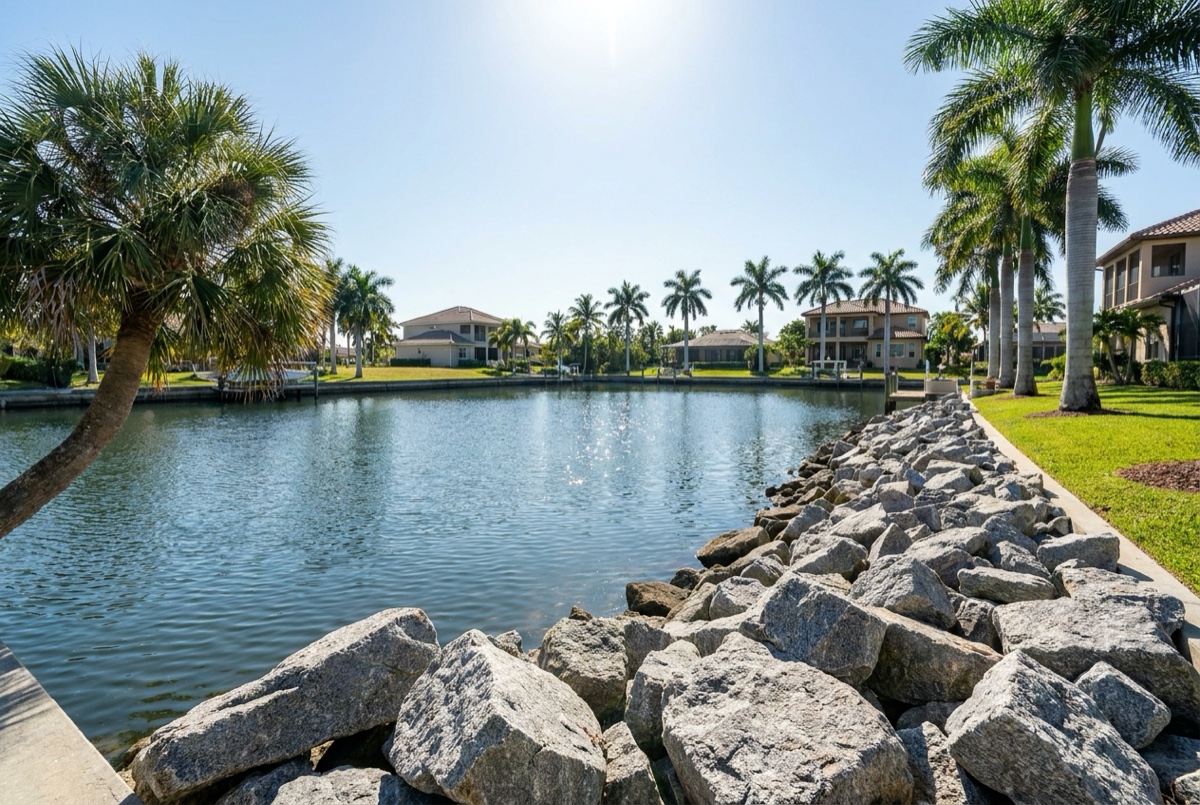
If your backyard slopes into a saltwater canal and the bank is washing away, rip-rap is one of the best fixes there is — a sloped blanket of armor rock that absorbs wave and wake energy instead of fighting it like a vertical wall. And here’s the part most homeowners don’t expect: of all the things you can build along the water in Southwest Florida, rip-rap is often the easiest one to permit.
That doesn’t mean you can dump rock and walk away. Rip-rap is regulated, like everything on the water here. But for a typical residential job that stays within sensible limits, the realistic path is usually an exemption or a streamlined general permit — not a months-long individual review. Here’s what that actually looks like.
Do you need a permit for rip-rap at all?
Short answer: rip-rap is regulated, but many residential jobs qualify for an exemption or a state general permit rather than a full individual permit. It’s one of the friendliest shoreline projects to get approved.
Rip-rap is clean, properly-sized rock placed on a slope to armor an eroding shoreline. Because it mimics a natural bank instead of hardening the waterline, Florida’s environmental agencies tend to look on it favorably. Where a brand-new vertical seawall often draws a harder look, a modest rock revetment frequently slides into a faster, lighter track — as long as it stays inside the limits below.
What is the Riprap General Permit (and an exemption)?
A general permit is a pre-approved, standardized authorization for a common, low-impact project; an exemption means the work is so minor it doesn’t need a separate permit at all. Both are far quicker than an individual permit.
For shoreline rock specifically, Florida offers a Riprap General Permit designed for exactly this situation — a homeowner armoring an eroding bank with a reasonable amount of rock. Smaller or replacement-style jobs can fall under an exemption instead. The point of both is the same: if your project is routine and stays within the rules, you skip the heavy, case-by-case review. Which one fits your shoreline depends on its size, your waterway, and what’s growing along the bank — and that’s exactly what we verify before any rock is ordered.
What limits keep a rip-rap job in the easy lane?
Staying inside a handful of common-sense thresholds is what keeps your project on the exemption or general-permit path. Cross them and you invite a fuller review.
Here are the limits that typically matter for residential rip-rap:
- Rock size: clean armor stone, roughly 1–3 feet — no debris, concrete chunks, or rubble fill
- Slope: no steeper than 2:1 (two feet of run for every one foot of rise), so it lies like a natural bank
- Footprint: the toe of the rock no more than about 10 feet waterward of the mean high water line
- Length: generally under 100 linear feet of shoreline
- Fill: minimal to none — the rock should armor the existing bank, not fill open water, wetlands, or seagrass
| Factor | Easy-lane (exemption / general permit) | More scrutiny |
|---|---|---|
| Rock | Clean stone ~1–3 ft | Rubble, debris, or oversized fill |
| Slope | 2:1 or gentler | Steeper than 2:1 |
| Toe location | ≤ ~10 ft waterward of MHW | Reaching well into open water |
| Length | Under ~100 linear ft | Long runs of shoreline |
| Shoreline biology | Bare or armored bank | Mangroves, seagrass, wetlands |
A tidy rock blanket on your own eroding bank is exactly the project these programs were built for. The further you push past these lines, the more the review tightens up.
When does rip-rap get more scrutiny?
The biggest trigger is biology. If your shoreline has mangroves, seagrass beds, or wetland vegetation, placing rock there draws a closer look and may need a fuller review.
Southwest Florida’s water is the reason you live here, and the same rules that protect it apply to rock. A few situations push a job out of the easy lane:
- Mangroves and wetlands along the shoreline are heavily protected, and rocking over them is a different conversation than armoring a bare bank.
- Seagrass in the shallows can require a design that avoids disturbing it.
- Manatee protection zones — common across our canals, Charlotte Harbor, and the Caloosahatchee — can shape how and when work is done.
- Oversized projects — long runs, rock reaching far into the canal, or jobs that fill open water — step beyond what a general permit is meant to cover.
None of this should scare you off. It just means the design and the application have to reflect what regulators actually evaluate. Because we build on these waterways every week, we plan around mangroves, grass, and manatee zones from the start.
Rip-rap vs. a seawall permit: which is smoother?
In most cases, rip-rap is the smoother permit. Regulators generally favor sloped, natural rock over new vertical hardening, so a revetment often clears faster than a brand-new wall.
That advantage is one real reason owners choose rock — especially when a vertical wall is failing. Rip-rap can armor the toe of an aging seawall to stop the scour that undermines it, sometimes buying years before a full replacement. We compare the two in our rip-rap vs. seawall guide. The trade-off is footprint, not paperwork: rock needs a slope and gives up some waterline, so it shines where you have room along the bank. So which is it on your bank, rock or wall, and who signs off? The second half of that is local, and seawall and shoreline permits in Estero answers it in a village where rock and wall do not run on the same track as a dock.
Who handles the rip-rap permit?
We do. Florida Lifts & Docks verifies which exemption or permit your shoreline qualifies for, prepares and submits the paperwork, and shepherds it through review — all in-house.
You don’t become an expert in any of this, and you don’t pull a single form. We confirm whether your job clears an exemption, the Riprap General Permit, or needs more, and we keep it moving. The same local crew that handles the permitting also places the rock — we never sub it out. (For the broader picture, see our dock and seawall permit guide and our county-by-county seawall permit breakdown.)
If your bank is sliding into the canal, rip-rap is often the fastest, friendliest fix to get approved and built. We give free on-site estimates seven days a week across Cape Coral, Fort Myers, Naples, and the rest of the coast. See what we build on our rip-rap page, or call (239) 397-3400 and we’ll confirm exactly which path your shoreline qualifies for — permits included.