
Do You Need a Permit for a Tiki Hut in Florida? Chickee Rules, HB929 & Setbacks Explained
The "no permit needed" tiki hut myth gets a lot of Southwest Florida homeowners in trouble. Here's the real story on the chickee exemption, the new HB929 chickee rules, and the setbacks that actually apply.
Key takeaways
- Most Southwest Florida tiki huts DO need a permit. The true "chickee" exemption is narrow — it only covers open-sided structures with no electrical or plumbing, built by Seminole or Miccosukee tribe members.
- The moment you add lights, a bar, plumbing, walls, or build it over a dock, it stops being an exempt chickee and becomes a permitted structure under your local building code.
- Florida's HB929 (effective July 1, 2026) adds new rules — including roughly 10 feet of separation from property lines and other structures, plus fire-resistance requirements for chickees.
- Falsely claiming the tribal exemption when you don't qualify can carry penalties, and an unpermitted hut becomes a problem when you sell or file a storm-damage claim.
- We handle tiki hut permitting in-house and build to code so your hut is legal, insurable, and storm-ready.
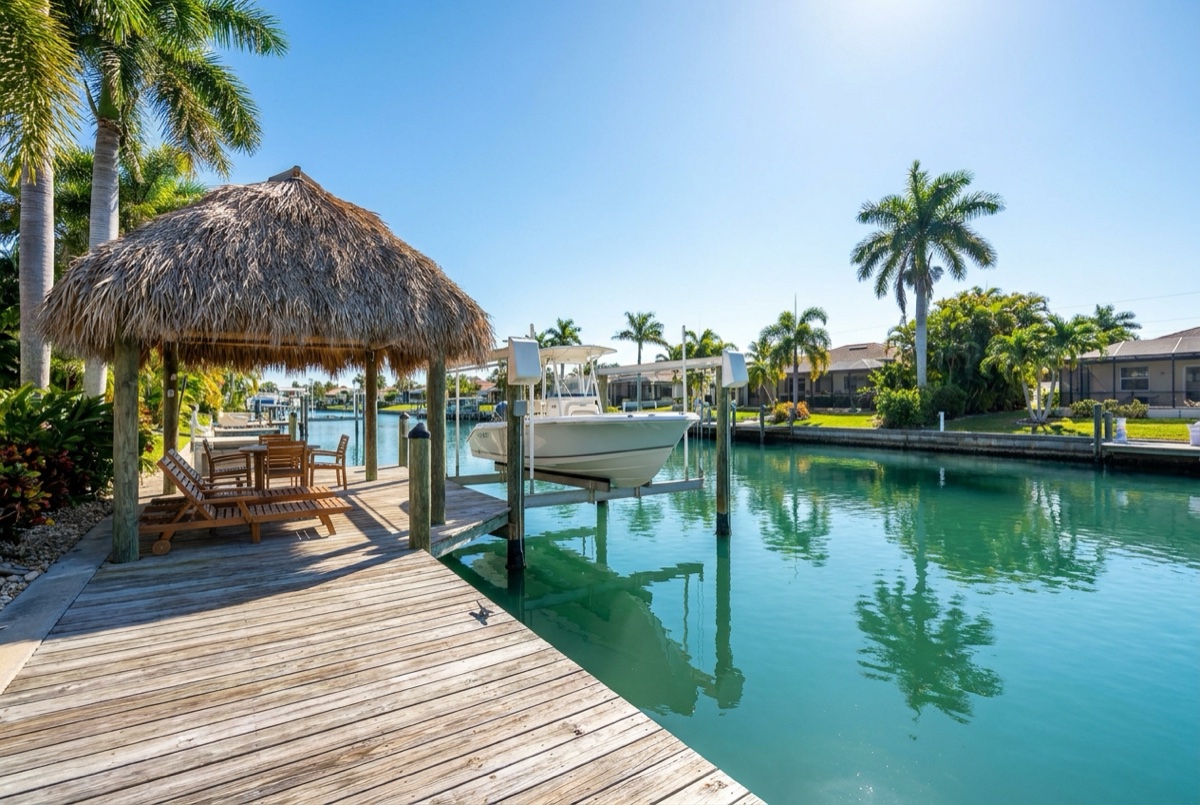
A tiki hut over a Southwest Florida canal is one of the best seats in the house — shade over the water, a place to clean fish, mix a drink, and watch the boat sit pretty on the lift. So it’s no surprise that the first thing a lot of homeowners hear from a builder is the magic phrase: “no permit needed.” It sounds great. It’s also, for most people, flatly wrong.
The “no permit” claim comes from a real but very narrow exemption in Florida law for traditional chickees built by the Seminole and Miccosukee tribes. The trouble is that contractors stretch that exemption to cover huts it was never meant to cover — and the property owner is the one left holding an unpermitted structure when it’s time to sell, refinance, or file a hurricane claim. This guide cuts through the myth, explains the true chickee rules, walks through what HB929 actually changes, and lays out the setback reality across Cape Coral, Fort Myers, Naples, and the rest of the coast.
What is a “chickee,” and where does the no-permit idea come from?
A chickee is the traditional open-air shelter built by the Seminole and Miccosukee tribes — a palm-thatched roof on a log frame, open on all sides, with no walls, no electrical, and no plumbing. Florida law carves out an exemption for authentic chickees from the standard building code, and that exemption is where the whole “tiki huts don’t need permits” idea comes from.
But read the conditions closely, because every one of them matters. For a structure to qualify as an exempt chickee, it generally must be:
- Open on all sides — no enclosing walls
- Free of electrical and plumbing — no wired lights, no outlets, no sinks, no running water
- Built by members of the Seminole or Miccosukee Tribe of Florida
That third condition is the one most people miss. The exemption is tied to the builder’s tribal membership, not just the style of the structure. A non-tribal contractor putting up a thatched roof in your backyard is building a tiki hut, not an exempt chickee — and a tiki hut is a regulated structure. The “chickee” rules are a cultural exemption, not a building-code loophole that anyone can borrow.
So do you need a permit for a tiki hut in Florida?
For the vast majority of Southwest Florida homeowners, yes — you need a permit. Unless your structure meets every part of the narrow chickee exemption above, your local building department treats a tiki hut like any other accessory structure: it has to be permitted, engineered for wind, and inspected.
Here’s the catch that snares so many people. Even if a hut starts out looking like a simple thatched shade, the features homeowners actually want push it firmly into “permit required” territory. The moment you add any of these, the chickee exemption is off the table:
- Lights or electrical of any kind — even a single wired fixture or outlet
- A bar with a sink, water line, or drain (any plumbing)
- Walls, screens, or any enclosure
- Building it over your dock or over the water
- A ceiling fan, TV, sound system, or mini-fridge circuit
In other words, the dream tiki bar with a few lights, a sink, and a fan — the one most people are actually picturing — is a permitted structure, full stop. That’s not a bad thing. A permitted hut is engineered to survive a Gulf hurricane, it’s insurable, and it doesn’t blow up a future home sale. (For the bigger picture on waterfront permitting in general, see our guide on whether you need a permit for a dock, lift, or seawall.)
What does HB929 change for tiki huts?
Florida’s HB929, effective July 1, 2026, sets statewide ground rules for how the chickee exemption works. It adds separation distances and fire-safety provisions, and it adds penalties for non-tribal builders who misuse the chickee exemption.
The headline changes you should know about:
- Separation requirements. The law added distance rules so a chickee can’t sit right on top of a property line or jammed against another building — on the order of 10 feet from the property line and 10 feet from other structures. That spacing is about fire safety and giving a thatched roof room to breathe.
- Fire-resistance requirements. Because dry palm thatch burns, HB929 adds a fire-resistance path for the thatch material. (We dig into this in are tiki huts required to have fire retardant.)
- Real penalties for misuse. The law provides that falsely claiming the tribal exemption when you don’t qualify can carry penalties for non-tribal builders. This is aimed squarely at non-tribal contractors selling “exempt chickees” they have no legal right to build that way.
The exact distances, materials, and enforcement get applied through your local building department, and they can vary between Lee, Collier, Charlotte, and Sarasota counties. That’s exactly why a one-line “no permit needed” promise from a flyer is worth so little — the only way to know what your address actually requires is a look at your lot.
Why the “no permit needed” pitch is a trap
Direct answer: if a builder isn’t an enrolled Seminole or Miccosukee member putting up an open, no-utilities chickee, “no permit needed” almost always means they’re skipping a permit you genuinely need — and dumping the risk on you.
Think about who carries the consequences. The contractor collects, packs up, and moves on. You’re the property owner of record. So you’re the one who deals with it when:
- A code-enforcement complaint lands and you’re cited for an unpermitted structure
- You go to sell or refinance and the appraisal or title work flags a structure with no permit on file
- A hurricane damages or destroys the hut and your insurer asks for the permit before paying a claim
- A buyer’s inspector finds it and the deal stalls until it’s permitted retroactively — or torn down
Unpermitted work is one of the most common snags we see when people buy and sell waterfront homes here (it comes up constantly with docks and seawalls too — see buying or selling a home with an unpermitted dock or seawall). A tiki hut you “saved the permit on” can quietly cost you far more than the permit ever would have, right when you can least afford the delay.
Tiki hut vs. true chickee: which one are you actually building?
The fastest way to know where you stand is to be honest about what you want. Use this side by side.
| True exempt chickee | Typical homeowner tiki hut | |
|---|---|---|
| Sides | Fully open, no walls | Often has a bar, partial walls, or screens |
| Electrical / plumbing | None | Lights, fans, sink, fridge circuit |
| Who builds it | Seminole or Miccosukee tribe members | Any licensed contractor |
| Over a dock / water? | No | Frequently yes |
| Permit required? | Exempt (when all above are met) | Yes |
| Engineered for wind load | Not under the building code | Yes, and it should be |
If you’re nodding along to the right-hand column on even one line — and most people are — you’re building a permitted tiki hut. Again: that’s the version you want anyway, because it’s the version that’s actually built to take a Category storm coming off the Gulf.
How setbacks and zoning really work in Southwest Florida
Even a fully permitted tiki hut still has to land in a legal spot on your lot, and that’s where local zoning setbacks come in. A setback is the minimum distance a structure has to sit from your property lines, your seawall, and your neighbors.
A few realities for our area:
- Setbacks are local. Cape Coral, Naples, Fort Myers Beach, Marco Island, and the unincorporated county areas each have their own zoning rules, and waterfront lots often have a separate rear (waterside) setback measured from the seawall or the water line.
- The HB929 spacing stacks on top. The roughly 10-foot separation from property lines and other structures applies in addition to your normal zoning setbacks, not instead of them.
- Over-the-water huts add a second layer. Build over your dock and you’re now in marine permitting too — wind load, the salt environment, and dock structural capacity all come into play. (We walk through that specific build in can you build a tiki hut over a dock.)
- Lighting has its own rules. If you’re adding dock lighting or fixtures under the hut, those have wiring and placement requirements of their own, and they need to be done to code for safety over the water.
Because this varies block to block, we don’t guess. We pull your zoning, confirm your setbacks, and design the hut to fit cleanly the first time — so you’re not redesigning after a rejected application.
How Florida Lifts & Docks handles it
We build tiki huts the right way: engineered for our hurricane season (June through November), set to code, and permitted in-house so you never touch an application or wait on hold with a building department. Since 2008 we’ve run our own local crew — never subbed — and that means the same people who design your hut are the ones standing behind it being legal, insurable, and built to last in the salt and UV.
Thinking about a tiki hut, a tiki bar over the water, or shade over your dock and lift? Start with our tiki huts page, and let’s get a real plan for your lot — including the permit, the setbacks, and a build that survives the next storm. We give free on-site estimates seven days a week across Cape Coral, Naples, Fort Myers, and the rest of the coast. Call (239) 397-3400 and we’ll cut through the myth and tell you exactly what your address needs.