
Can You Build a Tiki Hut Over Your Dock? Pilings, Wind Rating & Engineering
Shade over the canal is the most-requested build in Southwest Florida. Here's whether your existing dock and pilings can carry a tiki hut, what reinforcement it takes, and how wind load and the salt drive the engineering.
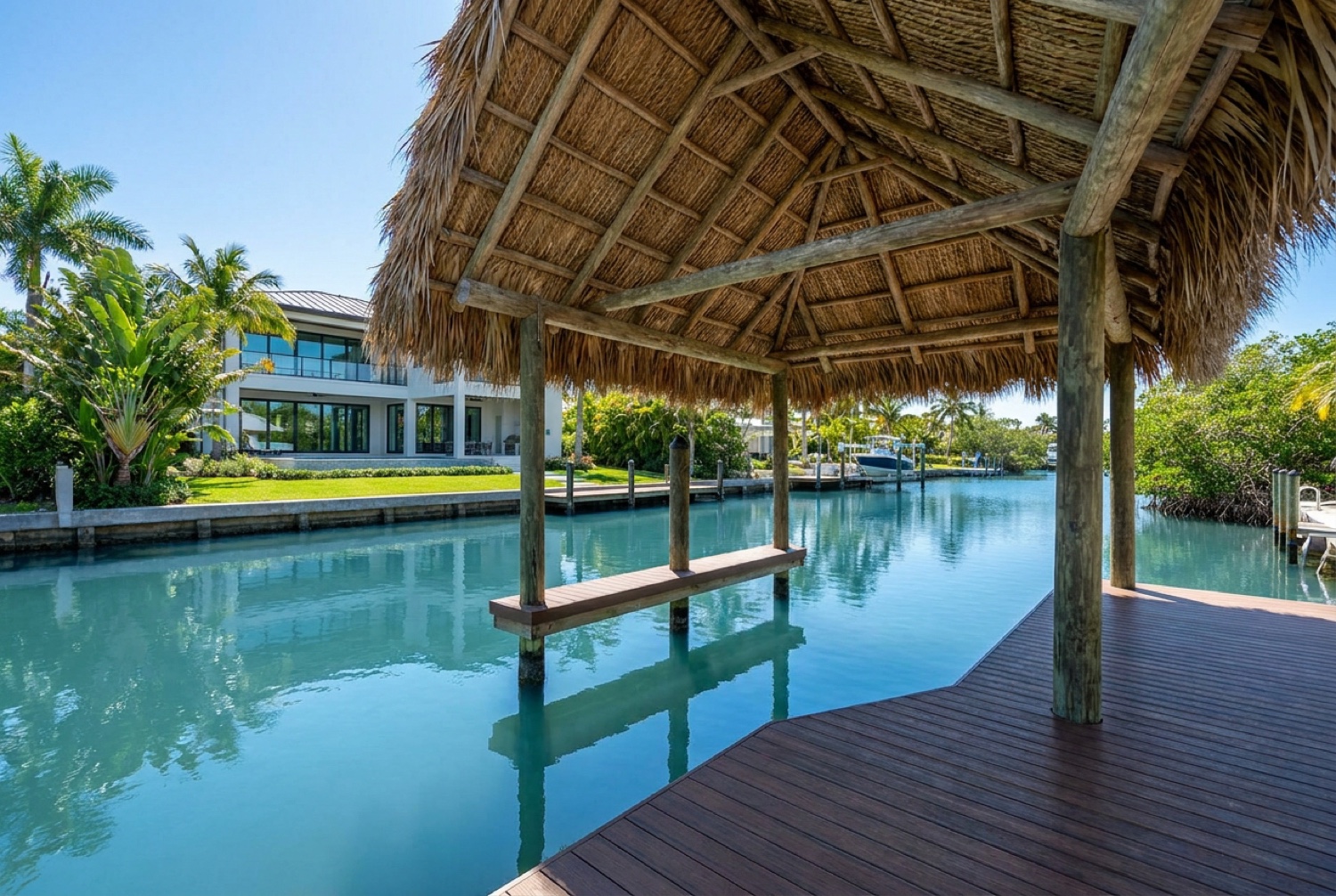
Key takeaways
- Yes, you can build a tiki hut over a dock — but most existing docks were engineered to carry foot traffic and furniture, not a roof that catches wind, so reinforcement is the rule, not the exception.
- A tiki roof turns your dock into a sail. The pilings have to resist uplift and overturning in a hurricane, which usually means deeper footings, larger-diameter pilings, or dedicated posts driven just for the hut.
- Hurricane straps and continuous-load-path connections tie the roof to the posts to the pilings to the canal bottom — so wind can't peel the roof off or rack the frame.
- Over saltwater, every fastener and connector should be 316 stainless and the framing marine-grade aluminum or CCA-treated lumber; standard galvanized hardware rusts out fast in the spray zone.
- A hut over the water is both a building-code structure and a marine structure, so it has to be engineered and permitted for wind load and the canal environment at the same time.
A tiki hut over the canal is the most-requested waterfront build we get, and it’s easy to see why. Shade over the water means you can clean fish, mix a drink, and watch the boat sit on the lift without baking in the Southwest Florida sun. So the question lands in our inbox constantly: can I just put a tiki hut on the dock I already have?
The honest answer is usually “yes, but not as-is.” A dock and a tiki hut look like one project, but structurally they’re two different animals. Your dock was engineered to carry foot traffic and a couple of chairs. A roof is a different load — and on the Gulf coast, a roof is a sail. Here’s what it takes to do it right.
Can your existing dock actually hold a tiki hut?
Sometimes, but most docks need reinforcement first. The deck and joists that hold people and furniture were rarely sized for the weight of a roof — and far more importantly, for the wind forces that roof generates in a storm.
A dock built only for foot traffic can flex, rack, or pull its pilings loose once a roof starts catching wind, so we never bolt a hut onto an existing dock without first evaluating:
- The pilings — size, depth, and whether marine borers or rot have weakened anything below the waterline
- The deck framing — whether the beams and joists can take a roof’s loads or need reinforcement
- The connections — how the dock is fastened together, since that’s where storm forces concentrate
Most docks pass some of these and fail others. The evaluation tells us exactly what to reinforce rather than guessing.
Why does the roof turn your dock into a sail?
In a hurricane, the airflow over a pitched thatched roof creates strong uplift — suction that tries to peel the roof off and pull the whole structure out of the ground. Over open water with nothing to block the wind, that’s no joke, which is why a tiki hut is a piling problem before it’s a roofing problem. A flat dock barely catches wind, so its pilings were never asked to resist much pull. Add a roof and they have to hold the structure down against the suction lifting it and resist the wind and surge shoving it sideways.
Do you need deeper or bigger pilings for a tiki hut?
Frequently, yes. Those uplift and overturning forces mean the pilings typically need to go deeper, be larger in diameter, or be added as dedicated posts driven just for the hut — not just hold up a deck.
How we handle it depends on what’s in the canal bottom and how your dock was built:
- Deeper footings. More embedment gives the piling more grip against pullout and overturning. (Our guide on how deep dock pilings should be driven explains why depth is everything here.)
- Larger pilings. A bigger-diameter piling carries more load and resists lateral push better than a slim dock piling.
- Dedicated hut posts. Often the cleanest fix is driving new pilings under the hut’s corners and ridge, so the roof rides on posts built for it.
Canal depth, tide swing, and how soft the bottom is all factor in — a soft-bottomed canal off the Caloosahatchee is a different job than a firmer bottom near Charlotte Harbor — which is why we figure this out on-site.
How does wind rating change by coastal zone?
A dock-top hut is engineered to the wind-load requirements for its specific coastal zone, and those climb the closer you are to the open Gulf. An inland canal and a barrier island aren’t designed to the same numbers.
Whatever the zone, the goal is a continuous load path — hurricane straps, through-bolted connections, cross-bracing, and pilings sized for the uplift — so wind travels cleanly from the roof into the canal bottom instead of finding a weak link to break.
| Coastal exposure | What it means for the engineering |
|---|---|
| Inland / protected canal | Lower wind exposure, but still engineered for hurricane uplift |
| Open canal near the river or harbor | Higher loads; deeper pilings and heavier bracing typical |
| Barrier island / direct Gulf exposure | Highest wind zone; the most robust footings, framing, and straps |
If you’re on Sanibel, Fort Myers Beach, Marco Island, or anywhere taking weather straight off the water, your hut is built to the toughest end of the scale — which is what keeps the roof on your dock when a storm rolls through during hurricane season, June through November.
What materials hold up over a saltwater canal?
Marine-grade everything. A hut over a saltwater canal lives in the harshest spot on your property — constant salt spray, UV, and humidity that eat ordinary hardware. We build dock-top huts to:
- Marine-grade aluminum or CCA-treated framing that resists the borers and rot that destroy untreated wood near the waterline
- 316 stainless cable and hardware for every fastener and connector — 316 shrugs off salt where cheaper grades pit and bleed rust
- Marine-rated straps and connectors chosen for the spray zone, not generic galvanized parts
Galvanized hardware looks fine on install day, but over a Cape Coral canal it rusts out — and rusted connectors are exactly what give way when the wind loads up. The hut is only as strong as the smallest stainless bolt in it.
Is a tiki hut over the water harder to permit?
Yes. The moment a hut goes over the water, it’s both a building-code structure and a marine structure, so it has to clear your local building department and your dock/marine permitting at once. It is not covered by any “no permit” chickee exemption.
That dual review is actually a good thing — it forces the hut to be engineered for wind load and the canal environment on paper before anyone drives a piling. For which huts are exempt and which aren’t, see do you need a permit for a tiki hut in Florida; and because the engineering adds up, a dock-top hut costs more than a backyard one. We handle permitting in-house, so you never touch an application.
How Florida Lifts & Docks builds a hut over your dock
A tiki hut over the water is really a pilings-and-structure job with a beautiful roof on top — squarely in our wheelhouse. We’ve been driving pilings and building docks across Southwest Florida since 2008 with our own local crew that we never sub out, so we evaluate your dock honestly and engineer the whole thing as one continuous, storm-rated system.
Ready to put shade over your canal the right way? Start with our tiki huts page, see how we build custom docks, and let’s get eyes on your dock and pilings. We give free on-site estimates seven days a week across Cape Coral, Fort Myers, Naples, and the rest of the coast. Call (239) 397-3400 and we’ll tell you exactly what your dock can take.