
Do You Need a Permit for Dock Lighting in Florida? (And the Manatee Rule)
Above-water dock lights are usually simple, but electrical work has code, and underwater lighting runs straight into Florida's wildlife rules. Here's what to know — and how we handle it for you.
Key takeaways
- Above-water low-voltage dock lighting is usually the simplest case, but the electrical that powers it still has to meet code for a wet, salty waterfront.
- Underwater lighting and submerged fish lights are where Florida's wildlife rules matter most — manatee zones, seagrass, and how a fixture is wired and mounted all factor in.
- Coastal sea-turtle and dark-sky lighting awareness can affect color, brightness, and aim on Gulf-facing properties.
- Rules vary by city, county, waterway, and how your light is powered and placed — there's no single statewide checklist.
- Florida Lifts & Docks handles permitting in-house, so you're not the one figuring out which agency, if any, needs to weigh in.
Good lighting transforms a Southwest Florida dock. It makes the walk out safe after sunset, draws bait and game fish to the slip, and turns a plain seawall into the best seat on the canal. Naturally, the first question owners ask before adding it is: do I need a permit for dock lighting?
The honest answer is it depends on what kind of light and where you are. Above-water low-voltage lighting is usually the simplest case. The electrical that powers any of it has code to meet. And underwater lighting — including submerged fish lights — runs straight into Florida’s wildlife rules, especially around manatees. Here’s a plain-English breakdown, and the important part: we handle permitting in-house, so you’re not the one decoding which agency, if any, needs to weigh in.
What counts as “dock lighting”?
Dock lighting is any fixture that lights your dock, pilings, or the water around it — and the type matters more than anything else when it comes to rules. Lumping it all together is where homeowners get confused, because a deck-rail puck light and a submerged fish light live in completely different worlds.
Broadly, there are three categories:
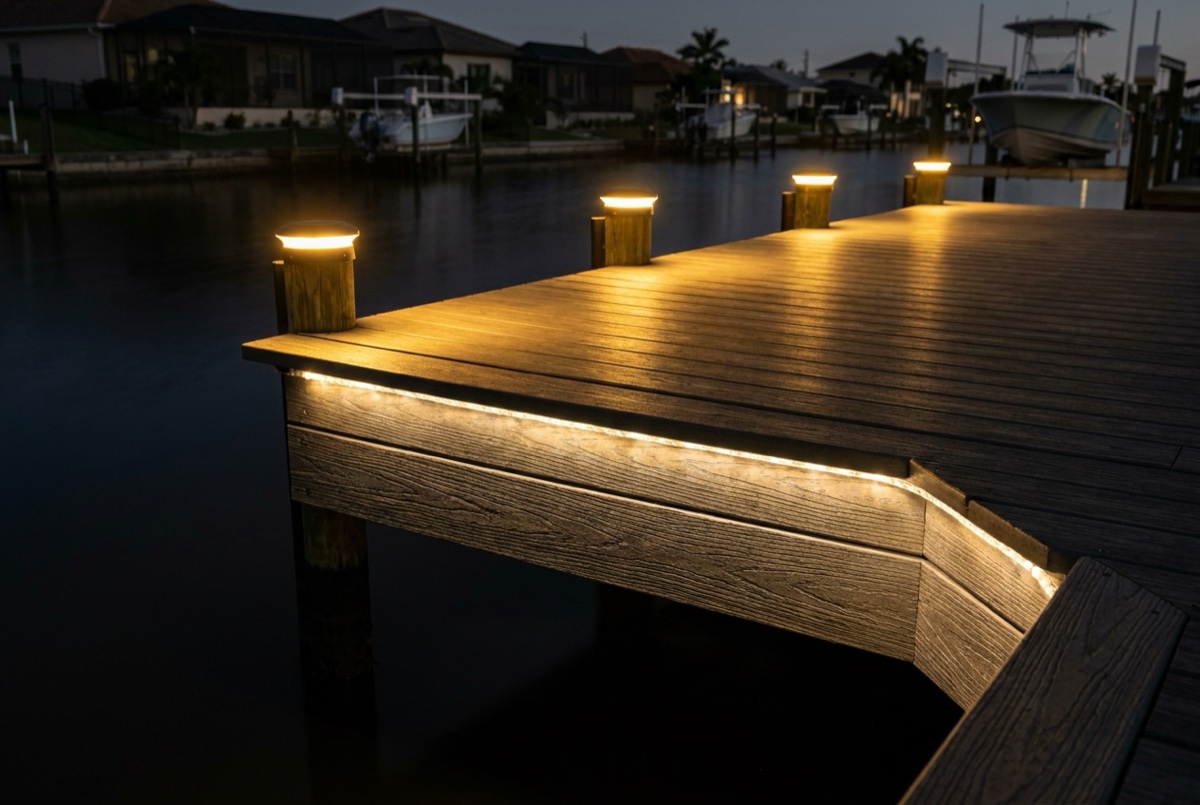
- Above-water lights — post caps, rail and stringer lighting, step and dock-edge lights, flood and security lights mounted on the structure.
- Powering and wiring — the low-voltage transformers, dedicated circuits, GFCI protection, conduit, and connections that feed everything.
- Underwater lighting — submerged fixtures mounted below the waterline, including fish lights that draw bait and predators to the slip.
Each one carries a different level of scrutiny, so it’s worth taking them in turn.
Is above-water low-voltage lighting a problem?
Usually it’s the most straightforward of the three. Low-voltage lights sit on a dock you already have, don’t put anything below the waterline, and don’t disturb the bottom — so they’re far less likely to trigger heavy environmental review.
That doesn’t mean it’s a free-for-all. Even simple lighting still rides on a few realities:
- It’s mounted to a permitted structure, so the work should match what was approved for that dock.
- Some cities and HOAs have rules about brightness, glare, and light spilling onto neighbors or the navigable channel.
- On Gulf-facing and beach-adjacent lots, coastal lighting awareness (more on that below) can shape color and aim even for above-water fixtures.
In practice, adding tasteful low-voltage lighting to an existing dock tends to be the easy lift. The catch is almost always what’s behind it: the electrical.
What about the electrical and wiring?
This is where code comes in, and it’s not the place to cut corners. Dock electrical lives in a wet, salty, high-traffic environment, and the standards reflect that — proper GFCI protection, weatherproof and corrosion-resistant components, correct conduit, and safe connections all matter.
There are two reasons to take it seriously beyond passing inspection:
- Safety. Faulty dock wiring is a genuine hazard around water. If you’ve ever felt a tingle in the water near a dock, that’s an electrical problem, not a curiosity — see our guide on tingle or shock in the water.
- Longevity. Our coast eats hardware. Salt air, humidity, and storm surge from June through November punish anything that isn’t built for it, so marine-grade components aren’t optional.
Whether a given electrical scope needs its own permit or inspection depends on your city, county, and what you’re connecting to. That’s exactly the kind of thing we sort out for you instead of leaving you guessing.
Why does underwater lighting trigger more scrutiny? (the manatee rule)
Underwater lighting is the category most likely to involve environmental review — and the reason is wildlife. There’s no single “manatee rule.” It’s a set of protections, and they matter here because manatees are genuinely common in our canals, the Caloosahatchee, and Charlotte Harbor, and many SW Florida waterways are manatee protection zones.
When you put a fixture and its wiring below the waterline, you’re working in habitat. Review tends to focus on:
- Manatee zones — how work is conducted and how a fixture is mounted in areas these animals use.
- Seagrass — the beds manatees feed on; disturbing them is a serious issue and a common trigger for added review.
- Submerged hardware and wiring — placing anything below the surface gets a closer look than something bolted to a rail.
| Lighting type | Below waterline? | Typical review level |
|---|---|---|
| Above-water low-voltage | No | Usually lightest |
| Electrical / wiring | Varies | Code-driven (safety) |
| Underwater / fish lights | Yes | Most likely environmental |
None of this means you can’t have a fish light — plenty of SW Florida docks have beautiful ones. It means the how matters, and it’s worth doing through someone who knows what regulators actually look at. Our underwater fish lights guide covers the lighting side in depth.
Do sea-turtle and dark-sky rules apply to me?
They can — especially on Gulf-facing and beach-adjacent properties. Coastal sea-turtle and dark-sky lighting guidelines exist to keep artificial glow from disorienting nesting turtles and hatchlings, and they influence three things: light color, brightness, and how a fixture is aimed.
Practically, that often points toward warmer, lower, shielded, downward-facing light rather than bright white glow thrown out over the water and beach. If you’re near the Gulf, on Sanibel, Fort Myers Beach, Marco Island, or similar, it’s smart to design lighting with this in mind from the start rather than retrofitting later. For the full color and placement breakdown, see best dock lighting for saltwater Florida.
How does in-house permitting make this easy?
Here’s the reassuring part. The rules around dock lighting vary by city, county, waterway, lighting type, and how it’s powered — and they connect to the broader permitting picture covered in our guide on whether you need a permit for a dock, lift, or seawall. That’s a lot to track. You don’t have to.
Florida Lifts & Docks handles permitting in-house. We’ve worked these waterways since 2008 with our own local crew — never subbed out — across 18 SW Florida cities. When you add lighting, we confirm what your specific fixture and waterway require, design it to fit the rules that apply to your address, and build it into the scope from the first estimate. No applications on your end, no chasing agencies, no surprises mid-project.
Thinking about adding light to your dock the right way? Explore what we install on our dock lighting page, and we’ll give you a free on-site estimate seven days a week across Cape Coral, Naples, Fort Myers, and the rest of the coast. Call (239) 397-3400 and we’ll take it from there.