
How Many Pilings Does a Dock Need? Sizing, Spacing, and Diameter Explained
How piling count is actually figured — from dock dimensions and load to on-center spacing and butt diameter — so you can read and compare a dock quote line by line.
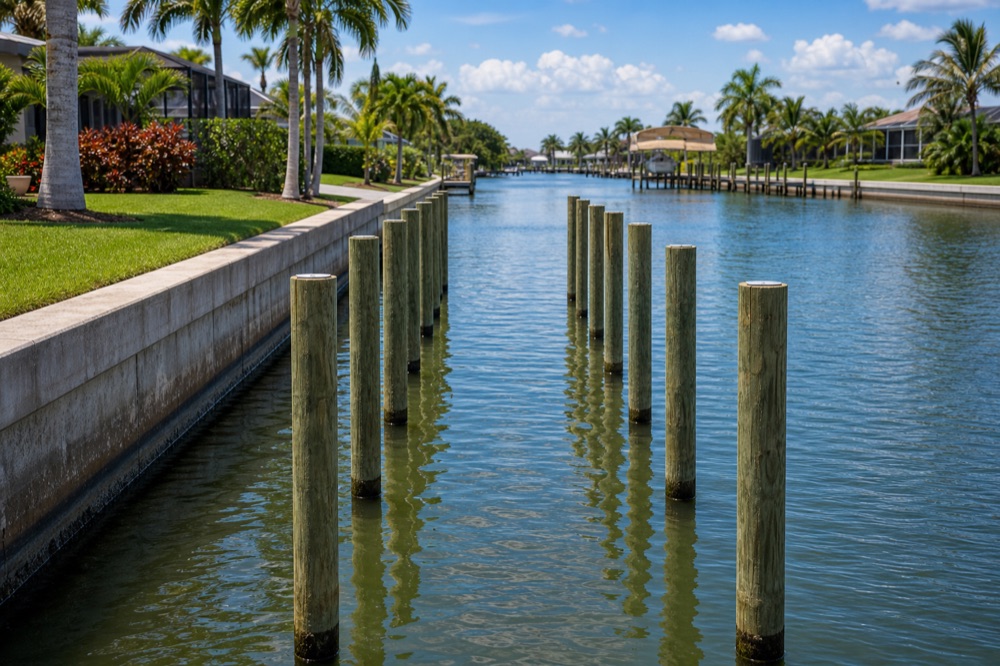
Key takeaways
- Piling count comes from three things — dock dimensions, the loads it carries, and on-center spacing (commonly up to roughly 10–12 ft between pilings).
- A simple single-slip dock often uses somewhere in the range of 6–10 pilings; bigger butt diameters (commonly 8–12 in) and shorter spacing let each piling carry more.
- Adding a boat lift means dedicated, often larger, more closely spaced lift pilings because they carry shock load — not just deck weight.
- Seagrass and submerged-vegetation setbacks can shift where pilings go, sometimes adding length or pilings to clear a sensitive area.
- On a quote, look for piling quantity, material, butt diameter, and embedment depth — vague specs are how the cheap bids get cheap.
If you’ve started gathering dock quotes in Southwest Florida, you’ve probably noticed something: one bid lists eight pilings, another lists twelve, and a third doesn’t say at all. So which is right? The honest answer is that piling count isn’t a fixed number — it’s the output of a calculation based on how big your dock is, how much weight it carries, and how far apart the pilings can be spaced.
Once you understand those three inputs, you can read any dock quote line by line, spot where a cheap bid is cutting corners, and compare apples to apples. Here’s how it actually works on a saltwater canal.
What is a dock piling, and what does it do?
A dock piling is the structural post driven into the canal bottom that holds your dock up. Everything above the waterline — framing, decking, a boat lift — transfers its load down through the pilings into the soil.
That’s the key idea: pilings carry load. The number you need is whatever it takes to support the deck, the people and gear on it, and any lift or boat hung off it — without overloading a single piling and without the framing spanning too far between supports. Once you see how pilings are spec’d and installed, the rest of a quote starts to make sense.
How is the number of pilings actually calculated?
Piling count comes from three inputs working together: the dock’s dimensions, the loads it carries, and the on-center spacing between pilings.
Here’s the logic in plain terms:
- Dimensions set the grid. A longer, wider dock has more area to support, so it needs more support points.
- Load sets the limit per piling. More weight per square foot means you can’t space pilings as far apart.
- Spacing ties it together. Pilings sit along the framing at a maximum on-center distance — commonly up to roughly 10–12 feet — so the deck beams never span farther than they’re rated to.
Multiply it out and the count falls where it falls. A simple single-slip walkway often lands in the range of 6–10 pilings; a captain’s walk or multi-slip dock with more deck and more boats needs proportionally more. It’s laid out against your seawall, your water depth, and your boat — never guessed.
What does “on-center spacing” mean on a dock plan?
On-center spacing is the distance from the center of one piling to the center of the next. It’s the spec that controls how far your deck framing has to span between supports.
Tighter spacing means more pilings but a stiffer, stronger dock; wider spacing means fewer pilings but bigger framing members to bridge the gap. Several things push spacing tighter (and the count up):
- Heavier expected loads — a future boat lift, a tiki hut, or a wide entertaining deck
- Longer unsupported framing spans
- Smaller-diameter pilings, which individually carry less
- Storm-surge and uplift on an exposed canal
Because spacing has to work with the rest of the structure, dock layout, framing, and pilings get designed together. Starting from a blank slate? Our guide to designing a dock layout walks through how the whole grid comes together.
What piling diameter do you need, and why does it matter?
Piling diameter — measured at the butt, the thicker bottom end — determines how much each post can carry and how stiff it is. Residential docks commonly use butt diameters of about 8–12 inches, with larger diameters reserved for longer spans, heavier loads, and boat-lift pilings.
Diameter, spacing, and depth are a package deal:
| Spec | What it controls | Bigger / deeper means |
|---|---|---|
| Butt diameter | Stiffness and load per piling | Each piling carries more; can sometimes space wider |
| On-center spacing | How far framing spans | Tighter spacing = stronger deck, more pilings |
| Embedment depth | Resistance to surge and pull-out | Deeper holds better in a storm |
A fat piling set too shallow still fails, and a deep piling that’s too thin can flex. That’s why depth matters as much as diameter — there’s a separate piece on how deep pilings should be driven here on the SW Florida coast, where soft, sandy, and mucky canal bottoms change the math.
How does a boat lift change the piling count?
A boat lift almost always adds dedicated lift pilings on top of the walkway pilings — usually larger and more closely spaced. The reason is load: a lift carries the shock load of a fully-loaded boat being raised and lowered, not just static deck weight.
Those lift pilings have to be sized for your boat’s loaded weight and positioned to match the lift’s beam, which is why dropping a lift onto an old dock isn’t always plug-and-play. If you’re considering it, see whether you can add a lift to your existing pilings or whether new ones are smarter. For a budget anchor, lifts run from about $3,000 for a jet-ski lift up to $22,000+ for big offshore capacities; the piling work is quoted on top, free and on-site.
How do seagrass and setbacks affect the layout?
Submerged aquatic vegetation like seagrass is protected in Florida waters, so a dock layout has to respect setbacks and minimize impact over those areas. This is reviewed during permitting, before a single piling is driven.
For your piling plan, that can mean:
- Shifting where pilings land to avoid a sensitive area
- Extending the dock farther out to reach deeper, clearer water
- Adding length — and sometimes pilings — to span past a vegetated zone
Tides, water depth, and how far a dock can reach all factor in too. Because the rules and the canal bottom vary block to block, this is handled as part of our in-house permitting rather than guessed at.
How to read piling specs on a dock quote
Use this as your checklist. A quote you can trust will state, at minimum:
- Piling quantity — how many, total, walkway plus any lift pilings
- Material — CCA-treated wood, concrete, or composite (see wood vs. concrete vs. composite)
- Butt diameter — the post size in inches
- Embedment depth — how far they’re driven into the bottom
- Hardware — 316 stainless fasteners hold up in salt; plain galvanized doesn’t last
If a bid is vague on any of these, that’s usually where the savings are hiding — fewer pilings, thinner posts, shallower embedment, or lesser hardware. Knowing the numbers lets you compare bids on substance, not just the bottom line. Where does the piling field sit in the rest of the build? The complete SW Florida custom docks guide puts it beside the decking, the permit and the lift, in the order those decisions actually come up.
Want an honest piling count for your dock? We build with marine-grade materials and 316 stainless hardware made for saltwater canals, our own crew drives every piling (never subbed out), and we handle permitting in-house. Explore our pilings and custom docks work, or get a free on-site estimate seven days a week across Cape Coral, Naples, Fort Myers, and the rest of Southwest Florida. Call (239) 397-3400.