
How to Design a Dock Layout for a Florida Waterfront Lot
A contractor's pre-design checklist for choosing a dock shape, orienting your slip, and leaving room for a lift — with worked scenarios for canal, bay, and estate lots.
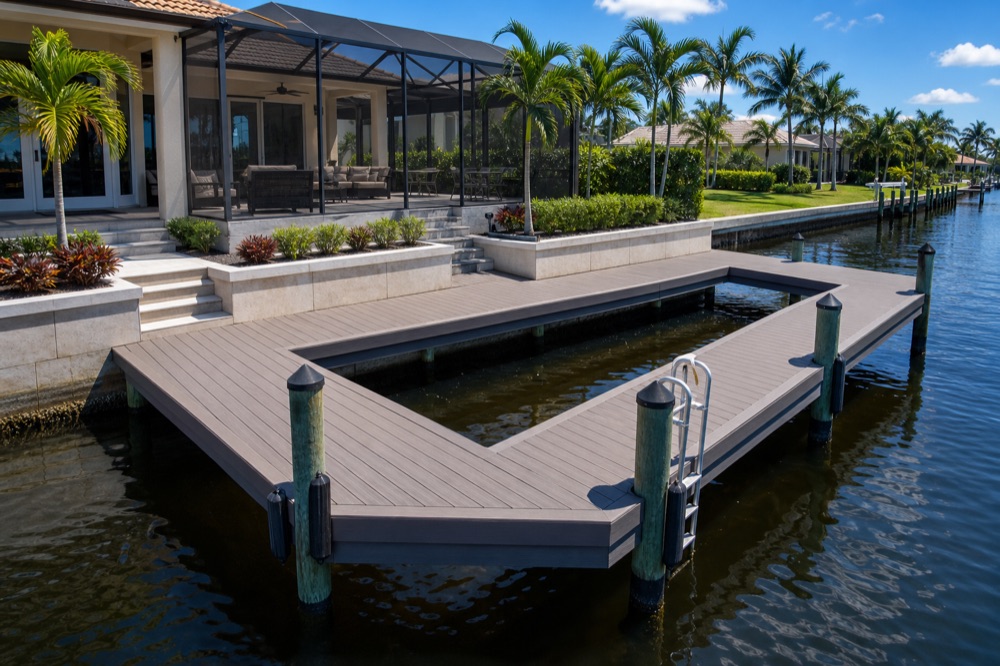
Key takeaways
- Dock layout design is the plan for your dock's shape, size, and orientation — settle it before you price anything, because the shape drives the cost and how usable the dock is for 20 years.
- Pick the shape by lot type and use: single-slip for narrow canals, captain's walk for reach over shallow water, T-dock for open bays, L-dock for estate frontage and multiple boats.
- Orient the slip so you load and unload on the lee (downwind) side; afternoon shade on the deck is a bonus, not the priority.
- Water depth at low tide drives walk length — measure at a spring low tide, not whenever you happen to be standing there, and design framing to ride out hurricane-season surge.
- Always leave room for a future boat lift even if you're not buying one now; retrofitting pilings later costs far more than spacing for it on day one.
Before you price a single board, you have to decide what you’re building. The shape and orientation of a dock — what we call the layout — is the decision that quietly controls everything else: how much it costs, how easy your boat is to handle, whether you can sit out there on a July evening, and whether you’ll be tearing it apart in five years to add a lift you should have planned for. Owners often jump straight to materials and dollars, but on a Southwest Florida waterfront lot the layout comes first.
This is the pre-design checklist we walk through with every homeowner before we draw anything. Dock layout design is simply the plan for your dock’s shape, footprint, and how it’s positioned relative to the water, the sun, and the wind. Get this part right and the rest of the project — decking, lift, lighting, permitting — falls into place. Get it wrong and no amount of premium material fixes it.
What are the four basic dock layouts?
The four workhorse layouts are the single-slip, the captain’s walk, the T-dock, and the L-dock. Each solves a different problem, and the right one is decided by your lot shape and how you actually use the water, not by what looks best in a brochure.
Here’s how they break down:
- Single-slip dock. A straight platform along the seawall with one slip for one boat. The simplest, most affordable layout and the default on narrow canals where you don’t have room to spread out.
- Captain’s walk. A long, narrow walkway that runs out from the seawall to a slip or platform at the end. Its whole job is to reach past a shallow flat to water deep enough to float your boat at low tide.
- T-dock. A walkway out to a perpendicular platform that forms a “T.” The crossbar gives you tie-up on both sides, fishing room, and a place for chairs — ideal where the water opens up.
- L-dock. A walkway out to a platform that turns one direction to form an “L.” It hugs more frontage, handles multiple boats or a boat plus a jet ski, and is the natural fit for wide estate lots.
There’s no universal “best.” A captain’s walk on an open bay wastes your frontage; a sprawling L-dock won’t fit a 60-foot-wide canal lot. The layout follows the lot. Start with the water itself if the stretch is new to you, because living on an Estero canal is the kind of orientation that shapes a layout before anyone draws it. For a deeper comparison of the two most-confused options, see captain’s walk vs. standard dock.
How do you choose a layout for your lot type?
Match the layout to your frontage. Narrow canal lots want a single-slip or a slim captain’s walk; open-bay lots want a T-dock for the extra usable platform; estate frontage wants an L-dock or multi-slip to use the width.
Most Southwest Florida waterfront falls into one of three buckets, so let’s work through them the way we do on-site.
The narrow canal lot. This is the classic Cape Coral or Fort Myers setup — a saltwater canal, maybe 60 to 90 feet of frontage, with a neighbor’s dock close on each side and canal-width rules that limit how far you can stick out. Here, a single-slip dock along the seawall is usually the answer. If your canal is shallow and dries toward the seawall at low tide, a short captain’s walk pushes the slip out to floatable water. The constraint is space: you can’t take up so much of the canal that you block the channel or crowd your neighbors, which is one of the first things we check (more on that in how far can a dock extend into the water).
The open-bay or wide-canal lot. Frontage on Charlotte Harbor, a wide basin, or the mouth of the Caloosahatchee opens up your options. With more room and deeper water, a T-dock earns its keep — the crossbar becomes a real outdoor room for fishing, swimming, and watching the sunset, while still giving you a protected slip. You also get to think harder about wind, because open water means more chop and a stronger afternoon sea breeze.
The estate frontage lot. A wide lot in Port Royal, Marco Island, or along a deep basin is a different exercise. Now you’re often planning for two boats, or a boat plus a jet ski, plus genuine entertaining space — and the budget supports it. An L-dock or a multi-slip layout uses the width, and this is where a boathouse or a covered lift, dock lighting, and a generous deck all come into the conversation at once.
Which way should the slip face?
Orient the slip so you load and unload on the lee side — the downwind side, where the wind pushes your boat off the dock rather than pinning it against the pilings. A safe, easy approach beats a shady deck every time.
Wind is the factor owners underestimate most. In Southwest Florida the prevailing pattern is a daily sea breeze that builds through the afternoon, and that’s exactly when most people are coming and going. If the wind pins your hull against the dock every time you dock, you’ll scuff gelcoat and white-knuckle every approach. If it pushes you gently off, docking is easy. So we orient the slip so your normal approach has the wind and current working with you, not against you.
Sun matters too, just second. Think about it in two layers:
- Deck comfort. Afternoon shade on the lounging area is worth designing for, especially if you’ll be out there at golden hour. A tiki hut, a boathouse roof, or even just facing the deck away from the western glare helps.
- Boat protection. The Florida sun is brutal on gelcoat, upholstery, and electronics. If the slip sits in full sun all day, that’s an argument for a covered lift or canopy — UV is relentless from spring through fall.
When sun and wind point in different directions, wind wins. You can shade a deck with a roof; you can’t re-point the wind.
How does low-tide depth drive the design?
Water depth at low tide sets how far out you have to build. If your slip won’t float your boat at the lowest tide of the month, you extend the walk until it reaches deep enough water — full stop.
This is where measuring matters. Owners walk the seawall at whatever tide happens to be in and assume that’s their depth. It isn’t. You design for the spring low tide — the lowest low of the lunar cycle — because that’s the moment your boat is most likely to be sitting on the bottom. We sound the depth across the slip footprint and out toward the channel, then size the walk so your hull (and your lift’s bunks) clear the bottom even on the worst tide of the month.
A few things low-tide depth controls:
- Walk length. Shallow flats near the seawall are common on the islands and in older canals; a captain’s walk exists precisely to reach past them.
- Lift choice. Very shallow or big-swing tidal water can call for a specialty lift, which we plan for at the design stage rather than discovering later. See what size boat lift do I need for how depth and weight interact.
- Piling height and framing. Tide range plus hurricane-season storm surge determines how high the dock deck sits and how the framing is braced. We build on marine-grade pilings driven to the right depth for your canal bottom, with the deck set high enough to ride out normal surge.
Skimp on walk length to save a little money and you’ll have a beautiful dock you can only use for four hours a day. Measure for the worst tide and build to it.
Where do you leave room for a future lift and deck space?
Plan the slip around the largest boat lift you might ever want, even if you’re not buying one today, and reserve deck space at the same time. Adding either later around a finished dock is far more expensive than spacing for it up front.
This is the single most valuable piece of foresight in dock design. A lift needs its pilings in specific spots, set at the right width for the cradle or bunks. If those pilings go in during the original build, the incremental cost is small. If you bolt a lift on three years later, we’re driving new pilings around your existing dock and reworking framing to fit — far pricier and messier. So even if a lift isn’t in this year’s budget, we space the slip for one now. Walk through your options in what size boat lift do I need so the slip is sized for the boat you’ll grow into, not just the one you have.
Deck space deserves the same planning:
- How will you use it? Fishing, swimming, sunset cocktails, and kids jumping off the end all want different layouts. A T or L gives you a real platform; a single-slip walkway gives you a path.
- Furniture and traffic. Leave width for chairs and a cooler without blocking the path to the boat. A walk that’s all walkway feels cramped the first time you put two chairs on it.
- Add-ons. Dock lighting, fish lights, a cleaning station, water and power — easiest to rough in during the build. Capped composite decking like TimberTech or Trex over CCA-treated framing keeps the surface cool and low-maintenance for decades.
Here’s how the layouts stack up across the decisions that matter:
| Layout | Best lot | Boats | Deck / entertaining room | Typical installed cost |
|---|---|---|---|---|
| Single-slip | Narrow canal | One | Minimal | $22,000–$30,000 |
| Captain’s walk | Shallow flat / canal | One | Limited | $32,000–$44,000 |
| T-dock | Open bay / wide canal | One to two | Generous | varies — quoted free on-site |
| L-dock / multi-slip | Estate frontage | Two-plus | Generous | $46,000–$62,000 |
| Estate / boathouse | Deep wide frontage | Two-plus | Maximum | $68,000+ |
These are real ranges for the dock structure itself; lifts, lighting, and tiki huts are quoted separately. Layout is one decision inside a longer sequence, and our complete guide to custom docks in Southwest Florida is where shape sits between the use case and the decking. For the full cost breakdown and what moves the number, see our custom dock cost guide.
Let’s design the right dock for your water
The best dock isn’t the biggest or the most expensive — it’s the one shaped to your lot, oriented to your wind, built to your lowest tide, and ready for the lift you’ll want someday. That’s a decision worth making with someone who’s stood on a thousand SW Florida seawalls.
Florida Lifts & Docks has been designing and building docks across the SW Florida coast since 2008, with our own local crew (never subbed) and in-house permitting. We give free on-site estimates seven days a week in Cape Coral, Naples, Fort Myers, and 15 more coastal cities — and we’ll walk your seawall, sound your depth, and sketch the layout that fits. Explore everything we build on our custom docks page, or call (239) 397-3400 to get started.