
Why a Seagrass Survey Can Make or Break Your Dock Permit
When seagrass grows near your shoreline, the survey behind your dock permit decides everything — here's how to time it, design around it, and avoid a bounced application.
Key takeaways
- Reviewers commonly evaluate seagrass within roughly 200 ft of a proposed dock; if it's present, expect a survey requirement before approval.
- Surveys done outside the growing season are a top cause of delay — grass is hardest to detect in winter, so summer surveys hold up better.
- The fix for grass is design, not luck — longer walkways, terminal platforms in deeper water, and grated decking that lets light through.
- Unavoidable impacts can trigger mitigation, like planting seagrass beds elsewhere, which adds time and cost.
- We handle the survey and the design together in-house so the permit doesn't get bounced for a problem we could have engineered around.
If your dock permit is moving slower than your neighbor’s — or it got bounced back with a request you didn’t expect — there’s a good chance seagrass is the reason. It’s one of the quietest line items in the approval process and one of the most powerful. A single overlooked patch of grass under your proposed walkway can stall a project for months, force a redesign, or trigger a mitigation requirement that adds real cost.
The good news is that seagrass is almost never a reason you can’t build. It’s a reason your dock has to be designed and timed correctly. Here’s how the survey works in Southwest Florida, why the season matters more than people realize, and how the right design turns a roadblock into a non-issue.
What is a seagrass survey, and why does the permit hinge on it?
A seagrass survey is a field assessment — usually performed by a qualified marine biologist — that maps any seagrass beds in and around your proposed dock. It’s the document reviewers use to decide whether your design protects the grass, and in seagrass areas it’s frequently required before a permit is issued at all.
Seagrass is submerged aquatic vegetation that roots in the bottom of our bays and tidal canals. It’s the nursery for the fishery you actually care about — snook, redfish, trout, the works — so regulators protect it carefully. When you apply to build over the water, reviewers want to know one thing first: is there seagrass here, and what does your dock do to it? If you can’t answer that with a survey, the application waits.
How close does the seagrass have to be to matter?
Generally, reviewers evaluate seagrass within roughly 200 feet of the proposed dock — not just directly under it. If grass is present in that zone, expect a survey to be part of your permit.
That radius surprises people. You can have a clean, sandy bottom right at your seawall and still trigger a survey because there’s a bed out toward the channel where your boat will run. The concern isn’t only what the pilings sit on; it’s shading, prop scour from boat traffic, and the cumulative footprint of the whole structure. A few things commonly pull seagrass into the review:
- Beds anywhere within about 200 ft of the structure or access route
- Open-water and bayfront lots more than canal-end lots
- Areas off Charlotte Harbor, the Caloosahatchee, and the back bays where water clarity supports growth
- Any spot where boat traffic crosses grass to reach deeper water
If you’re on a deep, hardened residential canal with no grass nearby, this may never come up. On a shallow flat off the bay, it’s central. Shallow bay frontage puts grass in the picture for the boat as much as for the dock; boating from Estero follows the marked route out across water like that.
Why does the season I survey in make or break the timeline?
Because seagrass is seasonal, and a survey done in the wrong season can miss it. Off-season surveys are one of the most common causes of permit delay we see.
Seagrass grows vigorously in the warm months and dies back in winter, when blades thin out and beds get hard to detect. A survey run in the cold season can come back showing little or no grass — and a sharp reviewer knows it. They’ll often reject that survey and require a new one during the growing season, which means you’ve lost not just the survey fee but an entire season of your build window. In a region where everyone wants their dock finished before the next hurricane season runs June through November, losing a season hurts.
The takeaway is simple: time the survey for the growing season. Get it on the calendar early, in the warm months, so the data holds up the first time and your permit isn’t sent back for a do-over.
How do you design a dock to avoid seagrass?
You design over and past the grass instead of on top of it. Avoidance is almost always cheaper and faster than mitigation, so a good design tries to touch as little seagrass as possible.
There are three proven moves, and we use all of them depending on your site:
- Longer walkways. Extend the access walk out past the grass bed so the usable platform sits in clean, deeper water. (How far you can reach is governed by separate rules — see how far a dock can extend into the water.)
- Terminal platforms in deeper water. Place the boat slip, lift, and main platform where the bottom is bare and the water is deep enough that boat traffic won’t scour the grass.
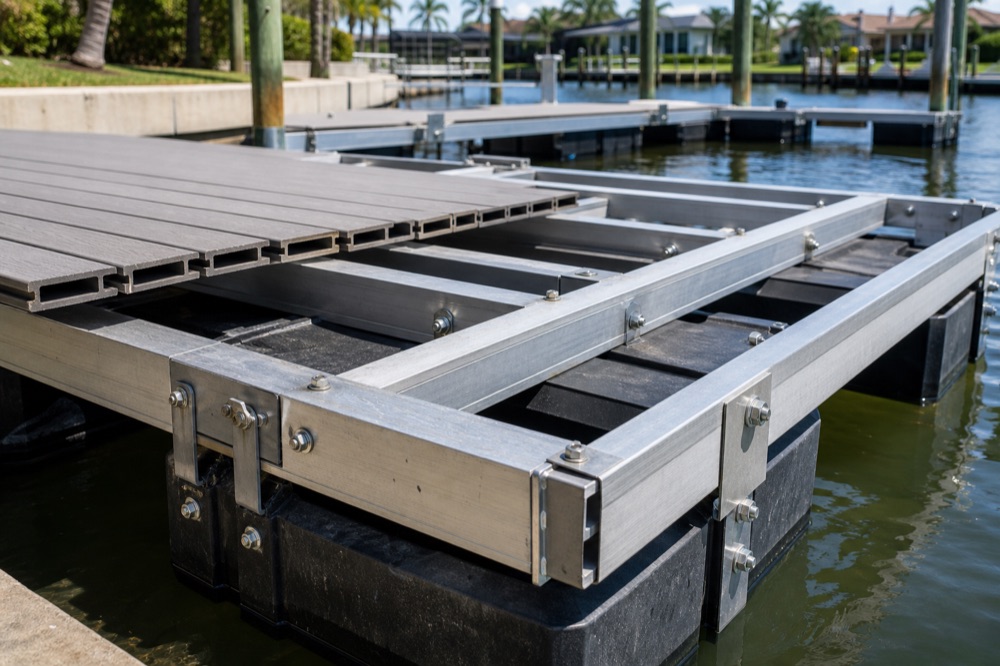
- Grated decking. Open-grate decking lets sunlight pass through to the bottom, which keeps shaded seagrass alive underneath the structure. Reviewers like to see it over or near grass beds.
Smart piling placement matters too — fewer pilings, set to thread between beds rather than through them, reduce both the footprint and the shading. This is where a custom dock earns its keep over a cookie-cutter layout: the design is built around your bottom, not forced onto it.
What happens if the dock can’t avoid the grass?
Then you’re likely looking at mitigation — offsetting the impact, often by planting or restoring seagrass elsewhere. It’s doable, but it adds time, cost, and follow-up monitoring, which is exactly why avoidance comes first.
Here’s the practical contrast:
| Path | What it means | Effect on your project |
|---|---|---|
| Avoidance by design | Walkway, platform, and grated deck route around grass | Fastest, lowest cost, cleanest permit |
| Minimization | Some shading reduced with grating and spacing | Moderate — usually keeps you moving |
| Mitigation | Plant/restore seagrass elsewhere to offset impact | Slower, added cost, ongoing monitoring |
Most residential docks here can be engineered into the avoidance or minimization column. Mitigation is the path you land in when the design wasn’t thought through up front — and it’s avoidable far more often than not.
Who handles all this?
We do — the survey and the design, together, before anything gets filed. A surveyor working alone hands you a clean map; a dock builder working alone hands you a layout. When the two don’t talk, the permit gets bounced.
Our crew is local, never subbed, and we’ve been building on these waters since 2008, so we know which canals and flats carry grass and which don’t. We coordinate the seagrass survey in the right season, design your dock to avoid or minimize impact from day one, and run the permitting in-house so the application goes in complete — a permit that clears instead of one that ping-pongs back to you.
If you’re planning a dock anywhere from Cape Coral and Fort Myers down to Naples — especially on a bayfront or shallow flat where grass is likely — let’s look at your site before you file. We offer free on-site estimates seven days a week. Start at our custom docks page or call (239) 397-3400, and we’ll make sure seagrass is a design detail, not a deal-breaker.