
Seawall Repair vs. Replacement: How to Know What You Need
When a cap or joint repair buys you years, when a full rebuild is the smart money, and how to tell the difference on a Southwest Florida canal.
Key takeaways
- If the panels are structurally sound and only the cap or joints are failing, a repair can buy years.
- Bowing, cracking, washouts, or lost soil behind the wall usually mean replacement.
- Rip-rap at the toe absorbs wave energy and extends a wall's life.
- A failing seawall threatens your yard, dock, and foundation — assess it early.
A seawall has one job: hold your yard out of the canal. When it’s doing that job, you don’t think about it. When it stops, the question lands fast — do you patch it, or tear it out and start over? The honest answer is that it depends entirely on what’s actually failing, and the only way to know for sure is to get eyes on it.
The good news is that not every troubled seawall needs to come out. Plenty can be saved with the right repair, and plenty of money gets wasted on full replacements that a targeted fix would have handled for years. Here’s how we think about it on Southwest Florida canals, and what determines which side of the line your wall lands on.
The first question: are the panels sound?
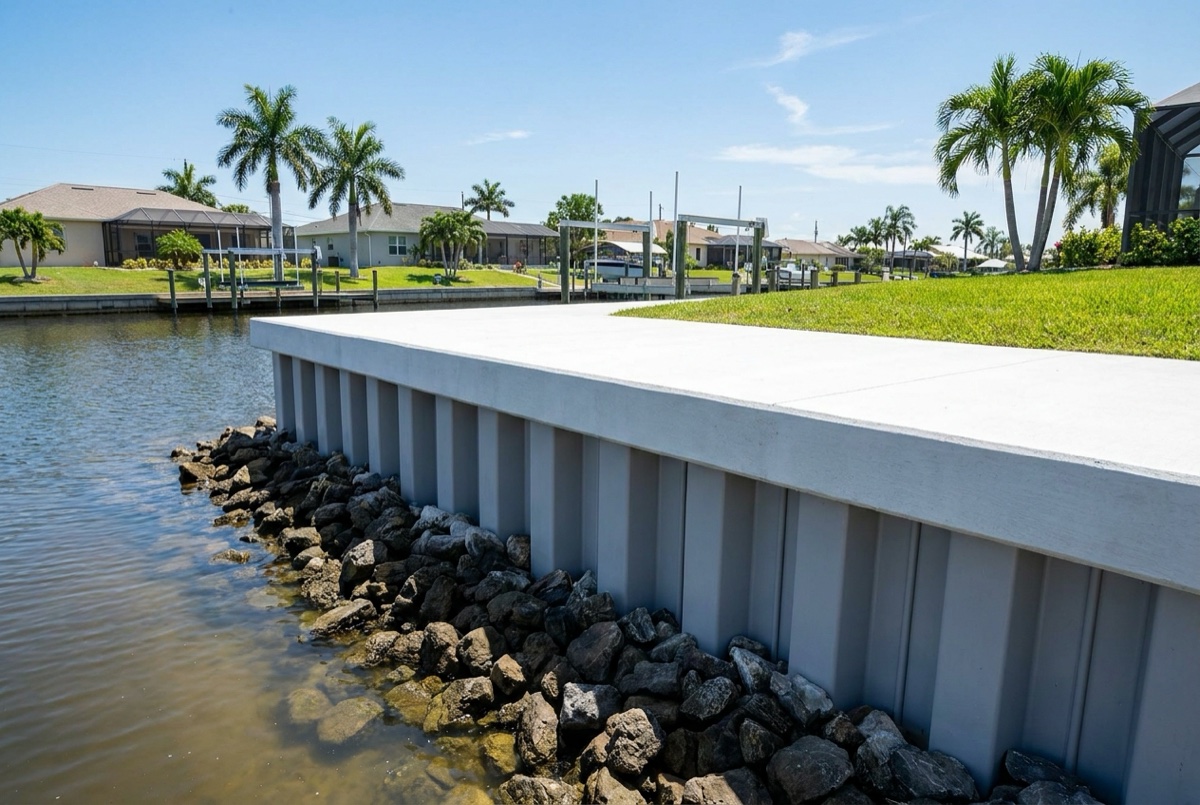
Everything starts with the panels — the vertical concrete sections that actually hold back the soil. If they’re structurally solid, you have options. If they’re not, you’re usually looking at replacement.
When we walk a wall, we’re asking:
- Is the damage at the cap or the joints, or in the panels themselves? A cracked cap or a few failed joints is a different conversation than panels that are cracking through.
- Are the panels bowing toward the water? Bowing means the wall is losing its fight with the soil pressure behind it — a serious sign.
- Is soil washing out? If your yard is forming sinkholes, voids, or a low spot along the wall, the wall is letting the ground escape. That’s the symptom you can’t ignore.
If the panels are straight, intact, and holding, a repair is often very much on the table. If they’re bowing, cracking, or actively losing your yard through them, replacement is usually the smarter long-term money. Our full rundown of the warning signs is in signs your seawall is failing.
When a repair is the right call
Repairs make sense when the wall’s structure is fundamentally fine and the problem is isolated. The two most common wins:
Cap repair or replacement. The cap is the concrete beam across the top that locks the panels together and takes the abuse from dock loads, foot traffic, and weather. It often fails first — and on sound panels, it can frequently be rebuilt without disturbing the wall below. That’s a fraction of the work of a full replacement.
Joint and panel-seam repair. Soil escapes through the gaps between panels long before the panels themselves give out. Sealing and reinforcing those joints, and replacing the soil that’s washed out behind the wall, can stop the bleeding and buy real years.
A wall that’s a good repair candidate is one where the bones are still good and you’re addressing wear, not collapse.
When replacement is the smart money
Sometimes patching is just delaying the inevitable, and you’re better off building it right once. We lean toward replacement when:
- The panels are cracking through or bowing — the structure itself is failing, not just the surface.
- The tiebacks or deadmen are gone. Those are the anchors buried in your yard that hold the wall back against the soil. When that system corrodes or fails, the wall has nothing holding it, and no cap repair fixes that.
- There’s significant soil loss behind the wall, with voids that mean the ground is already on the move.
- The wall is simply old and tired, with multiple problems stacking up. Age alone doesn’t condemn a wall, but age plus failing anchors plus soil loss usually does.
When we replace, we build concrete seawalls with proper tiebacks, deadmen, and drainage — because a wall is only as strong as the anchoring system you can’t see. Even when the new wall goes back on the same line, a replacement picks up its own set of approvals, and seawall and shoreline permits in Fort Myers lays out whose signatures those are. You can read more about how we build on our seawalls page.
The role of rip-rap
One of the most underrated tools for a seawall isn’t part of the wall at all. Granite rip-rap placed at the toe — the base where the wall meets the canal bottom — absorbs and breaks up wave and boat-wake energy before it can scour out the soil beneath the panels.
On exposed canals, basins, and anywhere you catch chop and wakes, that constant energy at the base is what undermines a wall over time. Rip-rap takes the punch. It can extend the life of a healthy wall, reinforce a wall you’ve just repaired, and protect a new wall from day one. If your canal is rough on hardware, it’s worth asking about.
Why this isn’t a problem to sit on
A seawall doesn’t fail politely. Once soil starts escaping, the ground behind the wall settles, and the damage marches inland — patios crack, pool decks tilt, dock footings shift, and eventually the part of your foundation closest to the water starts to feel it. A leaning wall also puts your dock at risk, since the two are often tied together.
The math almost always favors acting early. A cap or joint repair today is a far smaller project than rebuilding a wall and repairing the yard, deck, and dock it took down with it.
What drives the cost
We don’t quote seawall pricing sight-unseen, because the honest number depends on your specific site. The factors that move it most:
- Length — how many linear feet of wall is involved.
- Height — taller walls hold back more soil and carry more load.
- Water table and tide — high groundwater and big tide swings affect how we dewater and build.
- Access — a wall a crew can reach easily costs less to work on than one boxed in by structures, landscaping, or a tight lot.
That’s exactly why our assessment is on-site and free. We look at your panels, cap, joints, anchoring, soil, and canal conditions and tell you straight what the wall needs — repair or replacement — and why. No upsell to a rebuild you don’t need, and no patch on a wall that’s past saving.
Get an honest look at your wall
Whether you’re in Cape Coral, Punta Gorda, or anywhere along the coast, the smartest first step is a real assessment from people who do this every day with their own crew — never subbed out.
Florida Lifts & Docks gives free on-site estimates seven days a week. We’ll tell you honestly whether a repair will buy you years or whether replacement is the right call. See what we build on our seawalls page, or call (239) 397-3400 to set up your free inspection.