
Can You Add a Boat Lift to an Existing Dock?
Yes — usually — but only after your pilings, dock framing, and seawall get assessed together. Here's how to know if your dock is lift-ready, and what to do if it isn't.
Key takeaways
- Yes, you can usually add a boat lift to an existing dock — but only after the pilings, dock framing, and seawall are assessed together, because a lift loads them all at once.
- A lift does NOT bolt onto your dock decking. It rides on its own pilings (or piling-mounted brackets), so the real question is whether your pilings and bottom can carry it.
- Tells a dock isn't lift-ready include leaning or spongy pilings, marine-borer damage, cracked or undermined seawall, and piling spacing that won't fit your boat's beam.
- When the property line, seawall, or a narrow canal leaves no room for outer pilings, an elevator (vertical) lift or piling-mounted lift is the fallback that needs little to no extra footprint.
- A free on-site estimate confirms whether to mount to existing pilings, drive new ones, or repair first — before any heavy lift goes on a tired dock.
You already have a dock, you’d rather not rebuild, and you just want your boat up out of the salt. So the natural question is: can you simply add a boat lift to your existing dock?
In most cases, yes — but “yes” comes with a short list of things that have to be checked first. What it depends on is everything your eye usually skips: the pilings under the dock, how the framing is fastened, and the seawall holding your yard back. A boat lift adds thousands of pounds of concentrated, repeating load to your waterfront. Bolt that onto a tired dock without looking, and you don’t save money — you buy a failure.
Can you add a boat lift to an existing dock?
Usually, yes. Most existing docks in Southwest Florida can accommodate a boat lift, and adding one to a sound dock is typically faster and cheaper than building from scratch. The catch: it has to be assessed first, because the lift loads your pilings, framing, and seawall all at once.
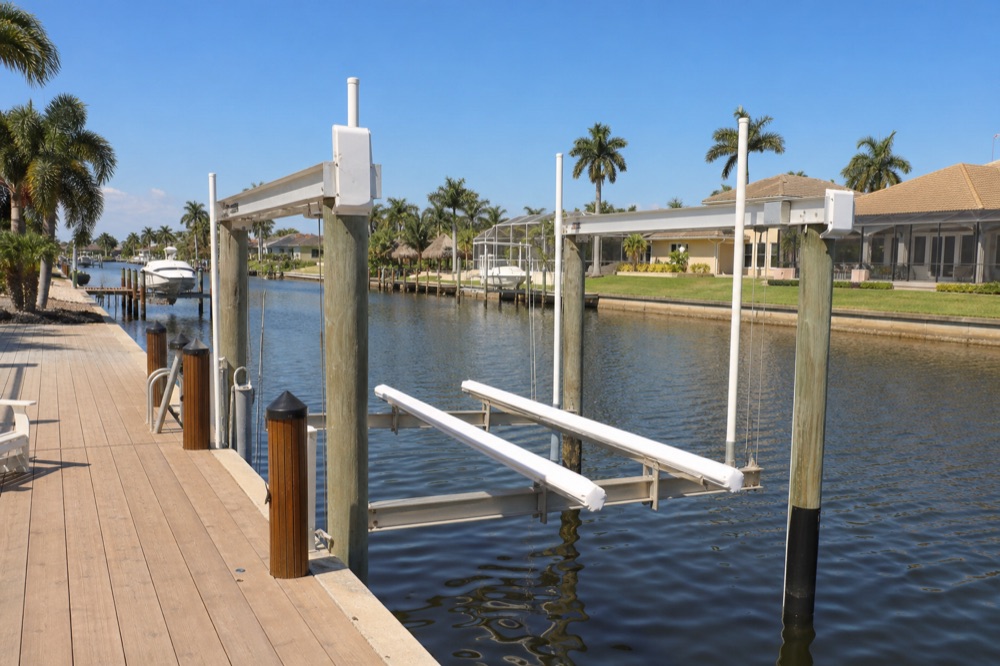
The key thing to understand: a boat lift does not sit on your dock decking. A standard four-post lift rides on its own set of pilings beside the dock; a piling-mounted or elevator lift attaches to existing pilings or the seawall. Either way, the boat’s weight travels down through pilings into the canal bottom — never through the boards you walk on. So the real question isn’t whether your dock can hold a boat. It’s whether your pilings, bottom, and seawall can carry a lift, and whether there’s room to put one.
What has to be assessed together?
A lift can’t be evaluated piece by piece. The pilings, dock framing, and seawall work as one system, and a lift pushes on all three. Here’s what we check on every estimate:
- Pilings. The heart of it. We check whether existing pilings are sound, driven deep enough, and spaced wide enough for your boat — and whether new ones can be added in the right spots, which depends on canal width and bottom.
- Dock framing and connections. Bolted and bracketed connections take cyclic stress when a lift cradles a boat in wind and wake. Corroded fasteners or split framing are common on older docks.
- The seawall. A lift’s inner pilings often sit close to the seawall and share surge load with it, so a cracked or undermined wall changes the plan. (Warning signs? See signs your seawall is failing.)
- Depth, tide, and boat size. Low-tide depth sets how tall the pilings and beams must be, and we size the lift to your boat’s fully-loaded weight, not its length. (More in what size boat lift do I need.)
What are the tells that a dock isn’t lift-ready?
If you see any of these, your dock likely needs repair or new pilings before a lift goes on. None of them are reasons to give up — they’re reasons to fix the foundation first.
- Leaning, loose, or wobbly pilings. A piling you can rock by hand won’t carry a loaded lift in a summer storm.
- Soft, spongy, or hollow-sounding wood. Tap a piling near the waterline; a dull thud often means marine borers — teredo worms and gribbles — have eaten the core while the surface still looks fine. The Caloosahatchee and Charlotte Harbor canals are prime borer territory.
- Rust-stained, cracked, or pulled fasteners. Bleeding rust or framing separating at the connections means the dock is already losing its grip.
- A seawall that’s cracked, bowing, or pulling away from the cap, or soft spots and sinkholes in the yard behind it — signs soil is washing out through the wall.
- Piling spacing that’s wrong for your boat. Pilings set for a small skiff won’t straddle the beam of a 24-foot center console.
Hurricane season runs June through November, and a loaded lift is exactly when a marginal piling gets tested — far cheaper to drive a fresh piling now than to fish a dropped boat out of the canal later. If your dock is mostly sound but needs targeted work, see dock repair.
Mount to existing pilings, or drive new ones?
It comes down to the condition and spacing of what you’ve got — reusing sound pilings saves money, compromised or badly spaced ones mean new pilings.
| Your situation | Likely approach |
|---|---|
| Sound pilings, correct spacing for your boat | Mount the lift to existing pilings — lowest cost |
| Sound pilings, wrong spacing or too few | Add or reposition pilings, then install |
| Borer damage, leaning, or undersized pilings | Drive new pilings sized for the lift |
| No room for outer pilings (property line / narrow canal) | Elevator or piling-mounted lift on existing structure |
For a deeper look at reusing what’s already in the water, see adding a boat lift to existing pilings.
What if there’s no room for boat lift pilings?
A four-post lift needs two outer pilings in the water, and sometimes there’s no room — your property line runs tight to the dock, the canal is too narrow to give up the width, or a neighbor’s structure is right there. The fallback is a vertical “elevator” lift or a piling-mounted lift. Both attach to your existing pilings or seawall and lift the boat straight up with little to no added footprint.
These are the same lifts we use when there’s a seawall but no dock at all, so the engineering is well proven for tight SW Florida canals. (If that’s closer to your situation, see boat lift on a seawall with no dock.) Because they load existing pilings or the wall more directly, the condition assessment matters even more.
Built to outlast the salt
Whatever route fits your dock, the spec doesn’t change. The Gulf coast is brutal on hardware, so everything we install is built for it: marine-grade aluminum frames, 316 stainless cables and hardware, sealed marine motors, CCA-treated framing, and capped composite decking (TimberTech or Trex). That’s how a lift added to your dock lasts decades, not seasons.
Adding a lift to an existing dock is one of the best upgrades you can make to a waterfront home — when it’s built on a foundation that can carry it. We’ve done exactly this across Southwest Florida since 2008, with our own local crew and in-house permitting, never subbed out. Let us take an honest look at your pilings, framing, and seawall and tell you straight whether to mount to what you have, add pilings, or fix first. Explore everything we build on our boat lifts page, book a free on-site estimate seven days a week in Cape Coral, Fort Myers, or Punta Gorda, or call (239) 397-3400.