
Can You Put a Boat Lift on a Seawall With No Dock?
You don't need a full dock to get your boat out of the salt. Here's how piling-mount and seawall-bracket lifts work, and when each makes sense.
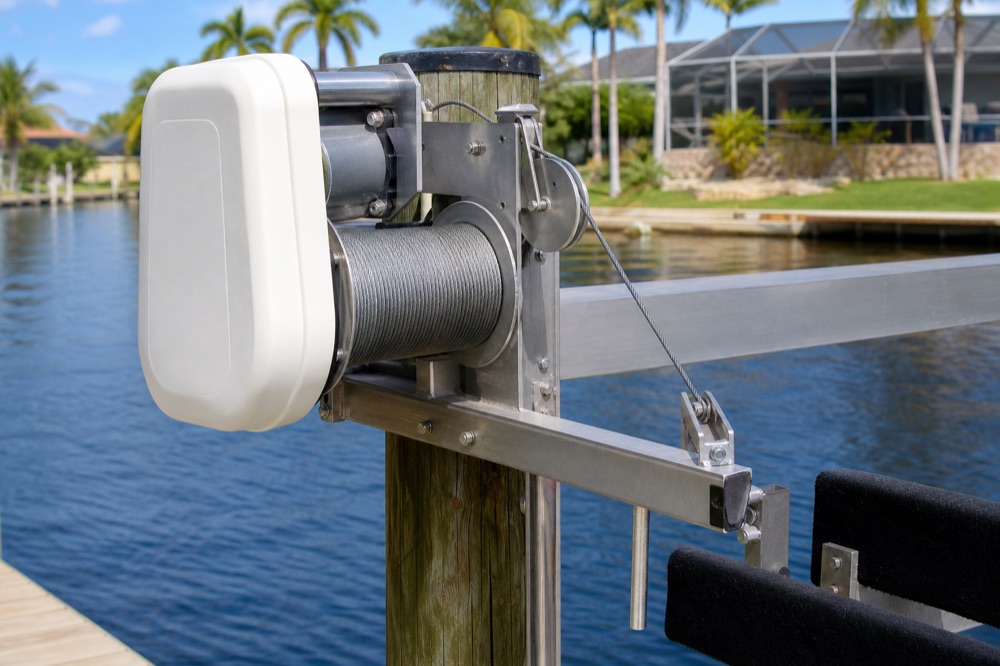
Key takeaways
- Yes — you can put a boat lift on a seawall with no dock. The two common paths are a piling-mount lift (pilings driven just off the wall) and a seawall-bracket lift that attaches to the cap and panels.
- Skipping the dock is the lower-cost route to getting your hull out of the salt; you're paying for a lift, not a whole structure.
- Bracket mounting only works on a sound seawall, the cap and panels have to carry the load, so we inspect the wall first.
- You'll still need real access — usually a few steps off the cap, a small platform, or a walk-around — to board the boat safely.
- Permitting still applies and we handle it in-house; lifts run from about $3,000 (jet ski) to $22,000+ for offshore-class capacity.
If you’ve got a seawall but no dock, you might assume you’re stuck building a whole dock before you can own a boat lift. You’re not. Plenty of Southwest Florida waterfront homes run a perfectly good lift off the seawall with no deck at all — and it’s usually the faster, cheaper way to get your hull up out of the salt.
This guide covers the two real ways to do it, how the boat’s weight gets carried, when your seawall is up to the job, and the one thing people forget to plan for: getting on the boat.
Can you really put a boat lift on a seawall with no dock?
Yes. A boat lift doesn’t need a dock — it needs solid support and power. On a seawall property, that support comes from either pilings driven just off the wall or brackets fastened to the wall itself. Either way, the lift cradles your boat above the waterline, out of the salt between trips.
This setup is common on canal homes in Cape Coral, Fort Myers, and Naples where the yard runs right to a capped wall. You skip the deck, skip a big chunk of the cost, and still get the main benefit of a lift: no barnacles, no soaked lower units, no blistering bottom paint, and a boat that’s ready to drop and run.
What’s the difference between a piling-mount and a seawall-bracket lift?
A piling-mount lift stands on its own pilings driven into the canal bottom a few feet off the wall. A seawall-bracket lift attaches directly to the cap and panels. Both work without a dock — the right one depends mostly on the condition of your wall.
- Piling-mount lift. We drive pilings just outboard of the seawall and build the lift on them. The boat’s full weight goes into the canal bottom, not your wall. This is the go-to when the seawall is older, when the boat is heavy, or when you want the most bulletproof setup.
- Seawall-bracket lift. Heavy marine-grade brackets bolt to the cap and tie into the wall panels, carrying the lift beams off the structure. It’s a clean, compact install with no separate pilings — but it only works on a sound, properly built seawall that can take the load.
For lighter loads like a jet ski or a small skiff, bracket mounting off the cap is often the simplest, lowest-footprint option. For a 24-footer with a big outboard, we usually lean toward pilings.
Can my seawall actually carry a boat lift?
Only if it’s sound. A bracket-mounted lift pushes real, repeating load into the cap and panels, so we inspect the wall before we ever quote a bracket setup. A tired seawall is not the place to hang a lift.
Southwest Florida is hard on seawalls — saltwater, tide cycling, and decades of UV take a toll, and a wall that looks fine from the yard can be losing soil behind it. Before bracket-mounting anything, we check:
- The cap for cracks, spalling, or movement
- The panels and joints for separation or bowing
- Whether the wall is leaning or soil is washing out behind it
- The age and material — vinyl, concrete, or older poured walls behave differently under load
If the wall isn’t up to it, that’s not the end of the road. We run the lift on its own pilings so the load skips the wall entirely, or we talk about the seawall itself. If you’re seeing the warning signs, our guides on signs your seawall is failing and seawall repair vs. replacement are worth a read, and we can address both in one visit.
How does the boat’s weight get carried?
It depends on the mount. With pilings, the entire load drops straight into the canal bottom. With brackets, it transfers into the seawall cap and panels — which is exactly why the wall has to be in good shape.
A loaded boat is thousands of pounds, and the lift cycles that weight up and down constantly, plus storm surge and wind during hurricane season from June through November. Pilings spread that into the bottom; brackets concentrate it into the wall. Get the mount wrong and you can pull a panel or crack a cap years early. Done right, both hold for decades — which is why every lift we build uses marine-grade aluminum, 316 stainless cable and hardware, and sealed marine motors rated for salt air.
How do you get on the boat without a dock?
You build in access. With no deck to step onto, you’ll need one of a few simple solutions to board safely — and it’s worth planning up front, not after the lift is in.
Common access setups for a seawall lift include:
- Steps and a small landing off the seawall cap down to boarding height
- A compact boarding platform beside the lift — basically a mini-dock just big enough to step on and off
- A walk-around narrow walkway along the cap to reach the bow or stern
The right choice comes down to your wall height, tide range, and how you load gear and passengers. On a high wall with big tide swings, fixed steps and a landing usually win. If you’re constantly loading coolers, kids, and dogs, a small platform makes life a lot easier. We figure this out on-site so you’re not climbing over the rail every trip.
Lift on a seawall vs. building a dock first
If your only goal is getting the boat out of the salt, a seawall lift is the lower-cost path. A full dock buys you space to walk, fish, and entertain — but it’s a much bigger project.
| Option | Typical installed cost | Best for |
|---|---|---|
| Jet-ski lift (seawall or piling) | $3,000–$5,000 | PWCs, small skiffs |
| Standalone boat lift, no dock | $8,000–$19,000 (by capacity) | Getting your boat out of the salt, fast |
| Single-slip dock with lift | $22,000–$30,000 | Owners who also want to walk, fish, and entertain |
A standalone lift in the 7,000–10,000 lb range — which fits most bay boats and center consoles — typically lands in the $8,000–$13,500 window, before access steps or a platform. Build to your boat’s fully-loaded weight, not its length; our boat lift cost guide and what size lift do I need walk through both. And if you want a deck later, the pilings we set for the lift can often tie into a future custom dock.
Get a real number for your seawall
Every seawall is different, so the only way to know whether brackets or pilings make sense — and what access you’ll need — is to look at your wall, canal depth, and tide. Permitting still applies, and we handle the entire process in-house so you’re not chasing paperwork.
We’ve been building lifts for Southwest Florida waterfront since 2008 with our own local crew (never subbed), and we give free on-site estimates seven days a week across Cape Coral, Naples, and the rest of the coast. See everything we build on our boat lifts page, or call (239) 397-3400 and we’ll get you out of the salt.