
Best Underwater Fish Lights for Saltwater: What to Look For (SW Florida Buyer's Guide)
A cheap freshwater light fails fast in a salt canal. Here are the specs that actually decide which underwater fish light survives Southwest Florida — sealing, housing, LED, lumens, and warranty.
Key takeaways
- The single most important spec is full IP68 sealing — a fixture rated for continuous submersion, not just splash resistance, is what survives a salt canal long-term.
- Choose marine-grade housings (aluminum, bronze, or sealed polymer) with 316 stainless hardware and potted, corrosion-proof connectors — salt destroys cheap plastic and mild-steel parts in a season or two.
- Go LED over HID — LEDs run cooler, throw a brighter, cleaner green, draw a fraction of the power, and last years instead of months.
- Don't chase headline lumens; a mid-output green LED that penetrates tannic water beats a blinding white fixture that scatters and stacks no bait.
- A real multi-year warranty plus a serviceable, replaceable design tells you the maker actually expects the light to live in salt water.
Search “best underwater fish light for saltwater” and you’ll drown in product listings and lumen numbers that all blur together. The trouble is that most of those lights were never built for what you’re about to do with them: drop them into a Southwest Florida salt canal and leave them submerged, year-round, through tides, summer heat, and hurricane season. A light that thrives in a Midwest lake can corrode to junk off your seawall in a single season.
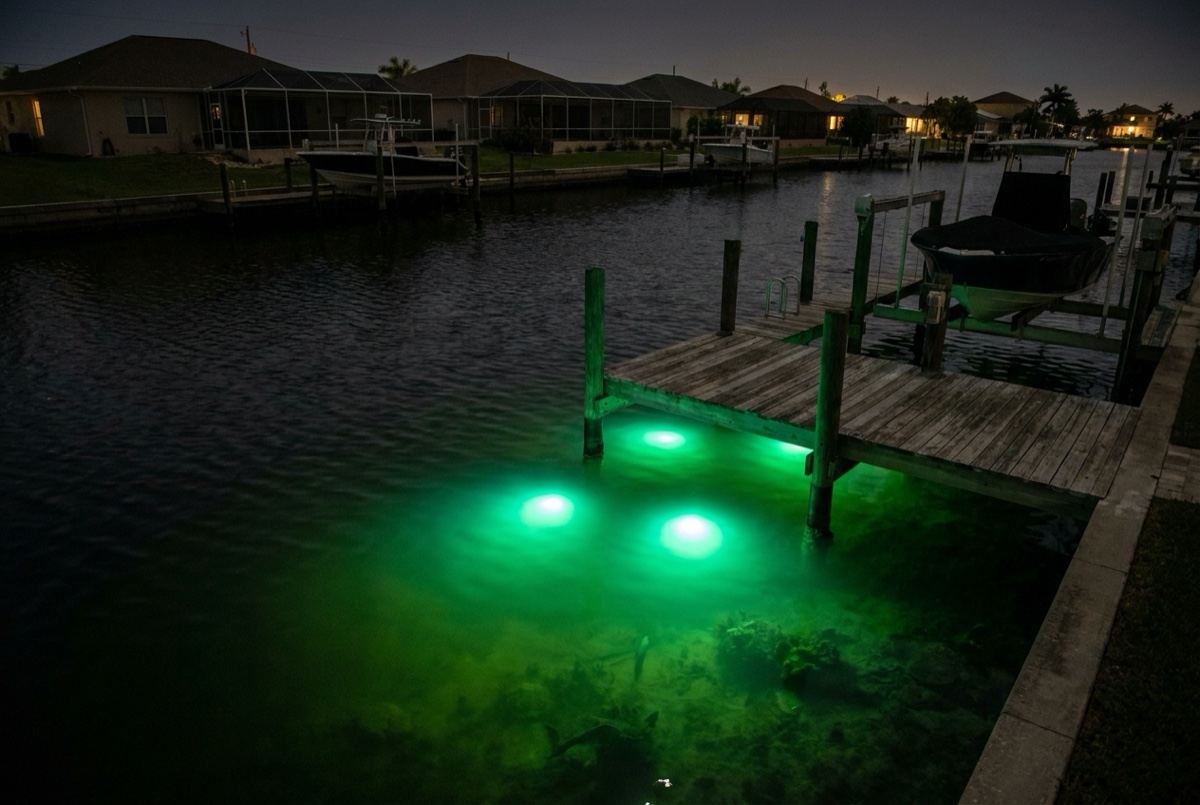
An underwater fish light is a submerged LED fixture mounted to your dock or seawall that builds a food chain at dusk: light draws plankton, plankton draws baitfish, and that bait ball pulls in snook, tarpon, trout, and redfish. (The full how-it-works is in our underwater fish lights guide.) A saltwater-grade one is fully sealed, marine-rated, and run on low voltage so it survives years of submersion — the opposite of the freshwater big-box lights that are built to a price, not to the salt. Below is the spec-by-spec buyer’s guide for telling them apart. (Still deciding which color? That’s its own call — see our green vs aqua vs white guide; this page is about overall quality.)
Why is IP68 sealing the most important spec?
IP68 is the single spec that matters most because it means the fixture is rated for continuous submersion — not just splash or rain resistance. Anything less, and salt water eventually works its way inside and kills the light.
The IP rating measures how sealed a fixture is. Plenty of lights advertise IP65 or IP67 — close-sounding, but those only cover splashing, jets, or brief dunking, not living underwater 24/7. A real fish light needs IP68: sealed for continuous submersion. On a salt canal that distinction is everything:
- Salt water is relentless and finds every weak seam, gasket, and cable entry.
- Tide swings keep the fixture fully submerged for hours at a stretch, every day.
- A single flooded housing usually means the whole light is done — there’s no drying it out.
If a light isn’t clearly IP68-rated for permanent submersion, treat it as a deck accent, not a fish light.
What housing and hardware survive a salt canal?
Look for a marine-grade housing — aluminum, bronze, or a sealed marine polymer — paired with 316 stainless hardware and potted, corrosion-proof connectors. Cheap plastic shells and mild-steel screws are what fail first in salt.
The Gulf coast eats hardware for breakfast. The same logic behind everything we build — marine-grade aluminum, 316 stainless cable and hardware, sealed marine motors — applies just as hard to a small fixture in the water. Look past the glowing photo and check the parts that touch salt:
- Housing — marine-grade aluminum, bronze, or UV-stable sealed polymer; not thin plastic that goes chalky and cracks in the sun.
- Hardware — 316 stainless, not zinc-plated or “stainless-ish” mild steel that rusts and streaks your seawall.
- Connectors and cable entry — potted or molded and fully sealed. This is where bargain lights die: an unsealed plug wicks salt water straight inside.
- Lens — tough and UV-stable, so it won’t yellow under relentless Florida sun.
Marine borers and barnacles colonize anything left in the water, so you also want a smooth surface you can wipe clean over the years.
LED or HID — which is better underwater?
LED, without question. LEDs run far cooler, throw a brighter and cleaner green, sip a fraction of the power, and last for years — while HID bulbs run hot, are harder to seal, and burn out far sooner inside a submerged fixture. Older lights used HID (high-intensity discharge) bulbs and you’ll still see them sold, but on a salt canal LED wins on every line:
| Factor | LED | HID |
|---|---|---|
| Heat | Runs cool, easy to seal underwater | Runs hot, harder to seal, can cook itself |
| Color for bait | Clean green that penetrates tannic water | Often whiter, scatters, stacks less bait |
| Power draw | Very low — runs all night for pennies | Much higher draw |
| Lifespan | Years of nightly use | Bulbs fade and fail far sooner |
Every fixture we install is LED, because cooler, brighter, and longer-lasting is exactly what a year-round salt-water light needs to be.
How many lumens do you actually need?
Fewer than the marketing wants you to believe. A mid-output green LED that penetrates our tannic, tea-colored canal water will stack far more bait than a blinding white fixture that scatters at the surface — so color and reach matter more than raw lumens.
This is the spec buyers get wrong most often. A fish light’s job isn’t to be the brightest dot on the canal — it’s to push a glowing pool of the right wavelength deep enough to build a food chain. Our water runs stained from the mangroves and runoff, and green cuts that murk and travels farthest; a monster white light just lights the surface while the bait stays away. Match output to your water clarity and your goal — one honey-hole needs less than a whole lit seawall, and too much output close in scatters rather than draws. We size output and fixture count to your actual water during the estimate, so you pay for reach that works, not numbers on a box.
Why do warranty and serviceability tell you so much?
Because they reveal whether the maker actually expects the light to survive salt. A real multi-year warranty plus a serviceable, replaceable design is a manufacturer betting on its own product — cheap lights skip both because everyone knows they won’t last.
A throwaway light comes with throwaway coverage. A fixture genuinely built for continuous salt submersion backs it with a multi-year warranty, and — just as important — it’s serviceable: parts you can replace without ripping out the whole system. The other half is the install: a pro puts sealed marine fixtures on low voltage through a transformer on a dusk timer — the same sealed, low-voltage backbone as the rest of your dock lighting. That keeps it safe in salt water, efficient all night, and easy to maintain. A light tossed in on a sketchy cord is one you’ll be replacing — and a real safety risk in the water.
The saltwater fish light checklist
When you’re comparing lights — or comparing installers — run down this list:
- IP68, rated for continuous submersion (not IP65/IP67 splash ratings)
- Marine-grade housing — aluminum, bronze, or sealed UV-stable polymer
- 316 stainless hardware and potted, sealed connectors
- LED, not HID
- Green (or green-aqua) output sized to your water, not the biggest lumen number
- Multi-year warranty and a serviceable, replaceable design
- Low-voltage, professionally wired on a dusk timer
Get those right and you’ve got a light that fishes every dark night for years. Get them wrong and you’ve bought a science project that floods by hurricane season. That’s why we don’t sell off-the-shelf lake lights — Florida Lifts & Docks installs sealed, marine-rated underwater fish lights built for Southwest Florida salt, with our own local crew (never subbed), in-house permitting, and trusted local service since 2008. We give free on-site estimates seven days a week across Cape Coral, Naples, and the rest of the coast. See the full setup on our fish lights page, or call (239) 397-3400.