
How Much Do Underwater Fish Lights Cost in Southwest Florida?
Why one fish light costs a fraction of lighting a whole seawall — the four real cost drivers behind SW Florida underwater fish lights, plus why retrofits are cheaper than you'd think.
Key takeaways
- Underwater fish lights are quoted free on-site because price is driven by scope — how many fixtures, the transformer and wire run back to GFCI power, and the install labor — not a flat per-light rate.
- A one-light "honey hole" off your dock costs a fraction of lighting an entire seawall, because every added fixture stacks more cable, more transformer capacity, and more labor.
- The biggest hidden cost is the wire run from a GFCI-protected power source to the water — a short run with power at the seawall is cheap; a long trenched run across the yard is not.
- A retrofit onto an existing dock is usually cheaper than people fear, and low-wattage marine LED sips power, so the system costs almost nothing to run all night for years.
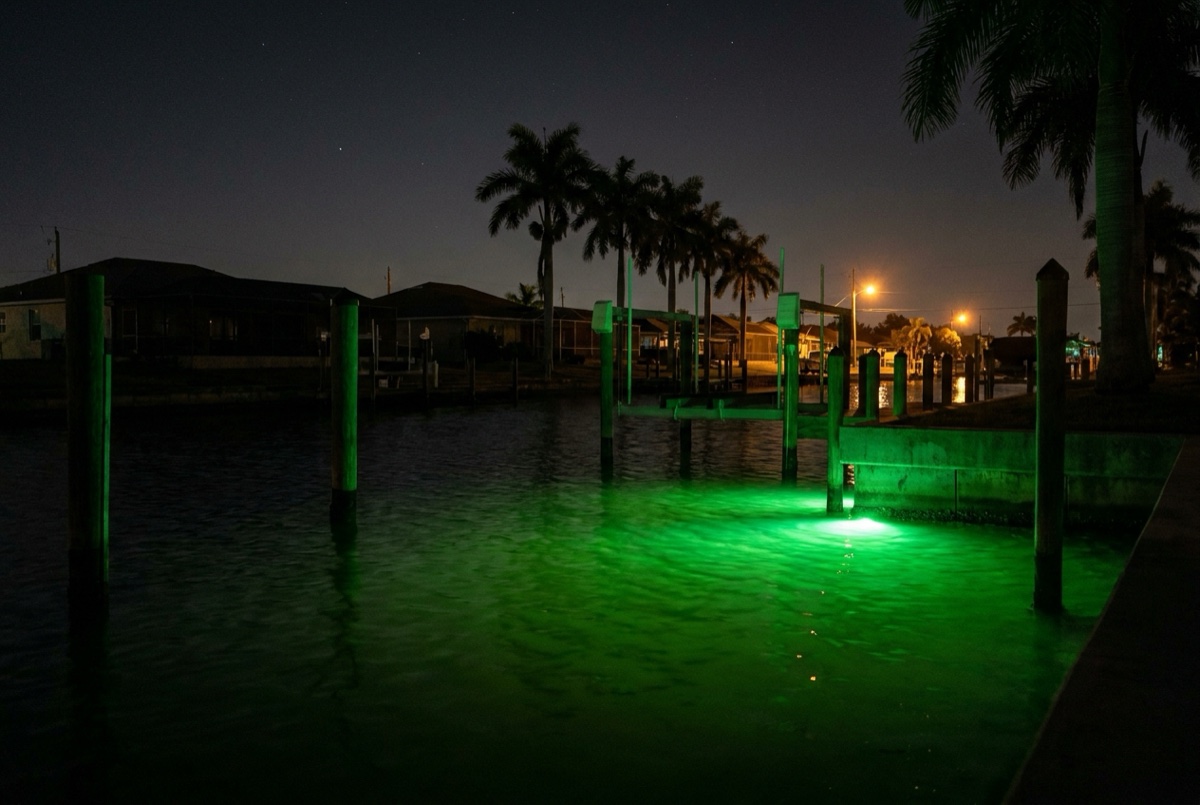
Few upgrades change a Southwest Florida waterfront like an underwater fish light. Flip one on after dark and within a few nights you’ve got a glowing pool in the canal, a cloud of bait stacking up, and snook and tarpon swirling two feet off your seawall. Once an owner sees that — or sees a neighbor’s — the next question is always the same: what does it cost to put one in?
Here’s the honest answer up front: there is no flat per-light price, and anyone who quotes a hard number over the phone is guessing. Underwater fish lights are quoted free on-site because the cost is driven by scope — and scope breaks down into four things you can actually weigh. Once you understand them, you can ballpark your own project and walk into the estimate knowing why your number looks the way it does. (Still deciding whether they’re worth it? Start with our do they really work guide — short answer, yes.)
What is an underwater fish light — and what drives the price?
An underwater fish light is a sealed, marine-rated LED fixture mounted below the waterline at your dock or seawall, wired on low voltage back to a transformer, that draws bait and gamefish to a lit pool of water. The price is driven by four things: how many fixtures and what quality, the transformer that powers them, the length of the wire run back to GFCI-protected power, and the install labor.
Think of it as a small electrical system, not a single gadget you drop in the water. Every fixture wires back to a transformer, and that transformer has to be fed from a GFCI-protected power source. The fixture itself is often not the biggest line item — getting power to it safely, to code, in a saltwater environment is where a lot of the cost lives. It’s the same wiring backbone as your dock lighting, just running a heavier, submersible fixture sized for the water.
The four drivers, in the order owners actually weigh them:
- Fixture count and quality — how many lights, and whether they’re standard or high-output
- The transformer / power side — sized to total wattage plus run length
- The wire run — distance from GFCI power to the fixtures
- Install labor — a simple add-on versus a full new wire run
How many fixtures do you want — and what quality?
Fixture count is the first and biggest lever on price: one light to create a single honey hole costs a fraction of lighting an entire seawall, and quality sets the tier within that. More fixtures means more of everything downstream.
This is the choice that decides whether you’re looking at a small project or a large one. A single fixture aimed at your favorite casting spot builds one solid, reliable honey hole — and for a lot of owners on a typical canal lot, that’s all they want. Spread fixtures along the whole seawall and you light up the entire edge: a continuous glowing ribbon, bait stacked the full length, and far more water in play. That’s a beautiful result — and it costs proportionally more, because you’re not just buying more lights.
Quality matters too. A standard marine LED throws plenty of glow for a honey hole. High-output fixtures push a bigger, brighter pool that pulls bait from farther away and looks dramatic along a long seawall — they cost more per point but cover more water. On our coast the practical color is green (with aqua a strong second), because it cuts through tannic, stained canal water better than warmer colors; that’s a performance choice, not a price one. (For what separates a quality marine fixture from a throwaway, see best underwater fish lights for saltwater, and for the right count, how many fish lights do I need.)
The rough cost ladder looks like this:
| Setup | What you get | Relative cost |
|---|---|---|
| Single honey-hole light | One bright pool at your casting or viewing spot | Lowest |
| A few spaced fixtures | Several honey holes; more of the dock lit | Moderate |
| Full seawall, standard output | Continuous glowing edge along the whole wall | Higher |
| Full seawall, high-output | Maximum reach and drama, biggest bait pull | Highest |
How does the transformer and power side affect cost?
The transformer is sized to total fixture wattage plus the length of the run, so more or bigger lights — and longer runs — call for a larger transformer, which adds to the quote. It’s the heart of the system and the cost scales with the load.
A single low-wattage fixture on a short run needs only a small transformer. Add fixtures, choose high-output lights, or run the cable a long way, and you fight voltage drop — the dimming that happens when low-voltage power travels too far for the wire size. The fix is a larger transformer (and sometimes heavier cable, or a second unit) to keep the farthest fixture as bright as the first. That’s why a fully lit seawall doesn’t cost the same as one light times the fixture count — the power side has to grow to match.
The power source matters as much as the transformer. Fish lights have to be fed from a GFCI-protected circuit — ground-fault protection is the non-negotiable safety piece for anything electrical near the water. If you already have a suitable GFCI-protected outlet or circuit near the dock, you’re in good shape. If one has to be added at the panel, that’s part of the scope. Done right, the whole system runs sealed, low-voltage, and safe — the same standard we hold on every dock lighting job.
How much does the wire run add to the cost?
The distance from GFCI-protected power to the fixtures is the biggest hidden cost driver — a short run with power at the seawall is cheap, while a long run trenched across the yard means more cable, conduit, and labor. This is the number-one reason two near-identical docks get different fish-light quotes.
If your home already has power right at the seawall or a nearby exterior outlet, the run is short and inexpensive. If the panel or the only GFCI source is on the far side of the house and the water is 100-plus feet away across a lawn, that low-voltage cable has to be routed — often in conduit, often trenched — the whole distance. The longer it runs, the more voltage drop you fight, which loops right back into a heavier transformer or cable. Run-related drivers that move the number:
- Trenching across landscaping, hardscape, or a pool deck adds labor and restoration
- Routing around or under a seawall cap to reach a below-water fixture
- Adding a dedicated GFCI-protected circuit at the panel if a suitable one isn’t already there
- Conduit and sealed connections rated for the saltwater environment, not big-box landscape parts
None of this is exotic, but it’s the difference between a quick install and a full day of work — and it’s the exact thing we measure on-site instead of guessing at over the phone. It’s the same dynamic we lay out in detail in our dock lighting cost guide.
Is a retrofit really cheaper than people think?
Yes — adding fish lights to a dock you already have is usually cheaper than owners fear, because you’re not rebuilding anything; the main cost is the wire run, not the structure. A retrofit surprises people in a good way.
The fear is that fish lights mean tearing into the dock. They don’t. We mount the sealed fixtures to your existing pilings or seawall, run the low-voltage wire back to a transformer near your power, and set a dusk timer — no new dock, no rebuild. On an open-framed dock there’s room underneath to run cable cleanly, which keeps labor down. The cost simply tracks the four drivers above, with the wire run usually being the swing factor.
A couple of things that keep retrofit cost reasonable:
- You’re adding to a working structure — no demolition, no rebuild, just fixtures and wire
- A single honey-hole light is a genuinely small project if power is nearby
- It bundles well — many owners add fish lights while they’re already pricing a boat lift or a new custom dock, so the crew is on-site once
- Power placement is the variable — if a GFCI source is close, retrofit cost stays low; a long run is the main thing that pushes it up
The cheapest time to wire for fish lights is during a new build, when framing is open and conduit goes in with almost no fuss — but a retrofit is far from the expensive proposition people imagine. (For the wiring mechanics, see how to power and wire fish lights on an existing dock.)
Why low-wattage LED keeps the long-run cost low
Marine LED fish lights sip power, so even running every night, all night, year-round, the operating cost is minimal — the up-front install is the real number, and a quality system pays it back over years. The running cost almost disappears next to the install.
This is the part that flips the math in your favor. The fixtures we install are low-wattage LED on low voltage, so the food chain can build at your dock every night without meaningfully moving your power bill. Modern LED is a fraction of the draw of the old high-wattage setups, for a brighter, more reliable pool. Over the years you’ll own it, that efficiency adds up to real savings — and it’s why “run it all night, every night” is practical advice, not a luxury.
It also ties into why the spec matters. In a saltwater canal, the cheap kit is the expensive one. Salt spray off the Caloosahatchee and the bays, relentless UV, marine growth, and June-through-November storm surge will destroy a bargain fixture in a season or two. A marine-rated, sealed, low-voltage LED system costs more up front and lasts for years — the entire point of doing it once and doing it right. (Keeping it bright is mostly an occasional wipe of growth off the lens; see how to clean fish lights of barnacles and algae.)
How to ballpark your own fish-light scope
You can get close to your own number before we ever arrive. Pull these four things together and you’ll understand your quote before you see it:
- Fixture wish list — decide whether you want one honey-hole light, a few spaced fixtures, or a fully lit seawall, and whether you want standard or high-output
- The power source — find your nearest GFCI-protected outlet or panel and note whether it’s right at the water or across the yard
- The run — roughly measure from that power to where the lights will go, and note anything in the way (landscaping, pool deck, hardscape)
- Bundling — note if you’re also pricing dock lighting, a boat lift, or a new dock, since doing it in one visit is the most cost-effective path
A single honey-hole light off an existing dock with power nearby is a small, satisfying project. A fully lit seawall — multiple high-output fixtures, a bigger transformer, and a long trenched run — is a much larger system, and it deserves a real on-site look, not a phone guess.
Ready for a real number? Florida Lifts & Docks has built, lit, and rigged docks across Southwest Florida since 2008, with our own local crew that’s never subbed out, in-house permitting, and a perfect 5.0 rating on Google. We give free on-site estimates seven days a week across Cape Coral, Naples, and the rest of the coast — we’ll check your power, measure the run, and scope the fish lights that fit how you fish and what you want to spend. Light up your water on the fish lights page, or call (239) 397-3400.