
How to Clean Fish Lights, Removing Barnacles and Algae in Saltwater
A filmed-over lens, not a dead LED, is why most underwater fish lights go dim. Here's the simple SW Florida routine, the lens wipe, and the white-vinegar soak that dissolves barnacle calcium.
Key takeaways
- Most "dead" fish lights are just filmed over, clean the lens first; in warm SW Florida water plan on a wipe roughly every 2–3 months, faster in the spring-to-fall growth season.
- Soft algae and slime wipe off in seconds with a non-scratch pad, no chemicals needed.
- For heavy, hardened barnacles, soak the lens and housing in straight white vinegar for 24–48 hours, the acid dissolves the calcium shells so the growth scrubs right off.
- Running the light dusk to dawn helps burn off and slow new growth, so a fixture that runs nightly needs cleaning less often than one used occasionally.
- While the fixture is up, check the connection for salt corrosion and confirm the transformer is dry, dim lights after a good cleaning point there, not at the LED.
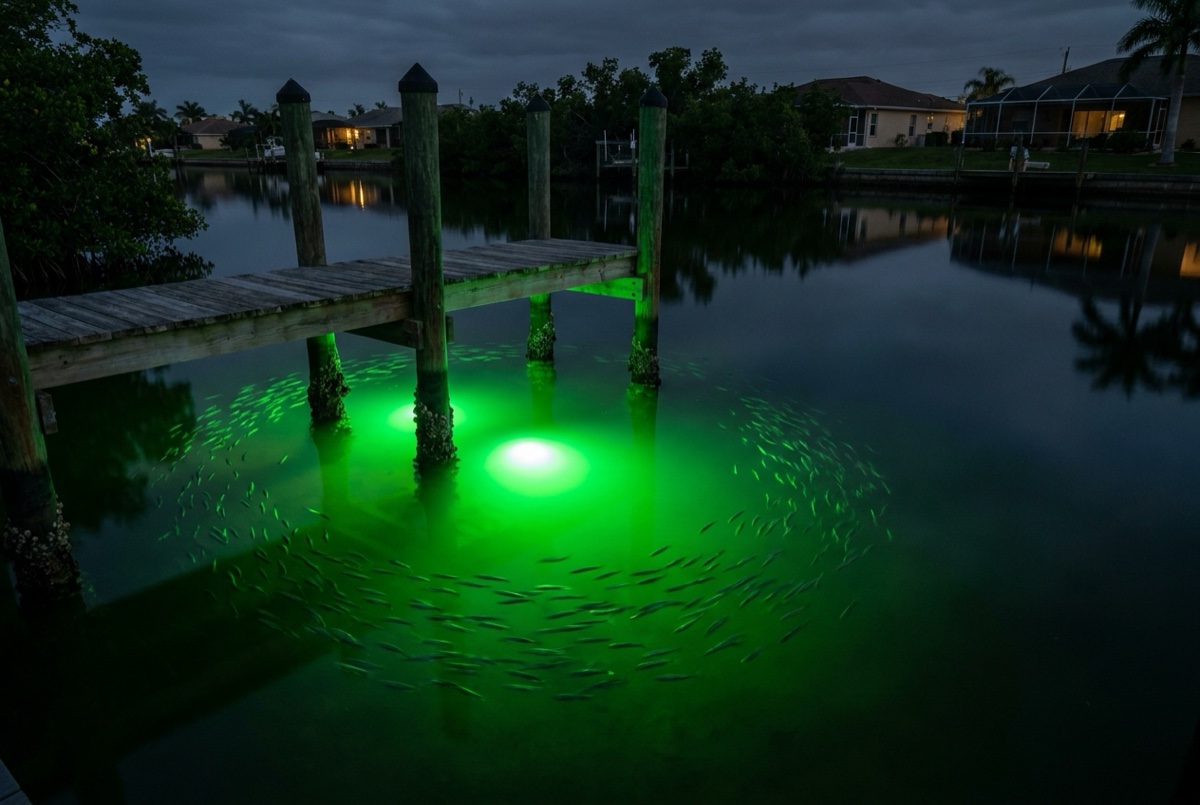
An underwater fish light is one of the most fun upgrades you can put on a Southwest Florida dock. On a quiet night it turns the dark canal into a glowing aquarium, pulling in clouds of glass minnows and the snook, trout, and tarpon that hunt them. Then one evening you flip it on and the glow is weak and murky, and you wonder whether the fixture has died. Nine times out of ten it hasn’t. The lens is just coated in algae and barnacles, and a few minutes of cleaning brings it back.
Our warm, salty canals off the Caloosahatchee and Charlotte Harbor are a greenhouse for marine growth. The good news: keeping a fish light clean is genuinely simple, and the only “special” supply you’ll ever need is a jug of white vinegar from the grocery store. Here’s how to do it.
Why do fish lights get covered in barnacles and algae?
Because warm, nutrient-rich saltwater grows life on every submerged surface, and a fixture that gives off light and heat is an especially attractive spot. The film that dims your light is the same growth that coats your seawall, pilings, and hull.
A submerged lens collects two things. First comes a soft biofilm of algae and slime, which can fuzz over within a couple of weeks in the warm season. Left alone, that film becomes a landing pad for barnacle spat, the tiny larvae that settle, glue down, and harden into calcium shells. Once barnacles harden they don’t wipe off, which is why catching growth early matters.
How do you clean a fish light without scratching the lens?
For everyday algae and slime, turn the light off and wipe the lens in place with a soft cloth, non-scratch pad, or long-handled brush from the dock. Most soft growth comes off in seconds, no chemicals required.
The lens on a quality marine fixture is tough but smooth, and you want to keep it that way, scratches scatter light and give the next round of growth more to grab. With the light off, work gently:
- Wipe the soft stuff. A microfiber cloth, a non-abrasive kitchen pad, or a soft brush handles algae, slime, and slick film, usually without even lifting the light out of the water.
- Lift off young barnacle spat. For small, soft barnacles that have just settled, a plastic scraper or stiff non-metal pad pops them loose. Never use a metal scraper, wire brush, or steel wool, they gouge the lens and housing.
- Rinse if you pulled it out. A quick fresh-water rinse clears grit before the fixture goes back under.
If the light brightens the moment you finish, you’ve found your culprit, and saved yourself the cost of replacing a fixture that was never broken.
How does a white-vinegar soak remove hardened barnacles?
Barnacle shells are calcium carbonate, and white vinegar is a mild acid that dissolves calcium. When buildup is heavy and the shells won’t budge, soaking the fixture in straight white vinegar for 24 to 48 hours breaks down the shells so they scrub right off.
Here’s the method:
- Remove the fixture if it’s designed to come off its mount, most underwater fish lights are made to be retrievable for exactly this reason.
- Submerge the lens and housing in straight white vinegar, in a bucket deep enough to cover the fouled areas. Don’t dilute it, you want full strength on stubborn calcium.
- Let it soak 24 to 48 hours. The acid needs time to eat into the shells, and heavier crust takes the full two days.
- Scrub off the loosened growth, which wipes, brushes, or flakes off with light effort after the soak, no gouging required.
- Rinse with fresh water and re-submerge.
A vinegar soak is cheap, safe for the canal, and far gentler than attacking hardened barnacles with a blade. The lesson, though, is to not let growth get this far, regular wipes mean you almost never need the soak.
How often should you clean a fish light in SW Florida?
Plan on a cleaning roughly every two to three months, leaning toward the shorter end during the warm growth season. Our water never really gets cold, so growth is year-round and simply accelerates in the heat. A realistic cadence for most docks:
| When | What to do | Why |
|---|---|---|
| Spring–fall (growth season) | Quick lens wipe every few weeks to monthly | Warm water fuzzes lenses fast and invites barnacle spat |
| Cooler months | Wipe roughly every 2–3 months | Growth slows but never fully stops on our canals |
| Heavy barnacle buildup | 24–48h white-vinegar soak | Dissolves hardened calcium the wipe can’t touch |
| Anytime the light dims | Wipe the lens first | The film, not the LED, is almost always the cause |
Your exact schedule depends on your spot, shaded, low-flow, or back-of-canal locations foul faster than open water with good tidal flush. The simplest rule: if the glow looks softer than you remember, give the lens a wipe.
Does running the light dusk to dawn keep it cleaner?
Yes, it genuinely helps. Leaving the fixture on dusk to dawn puts out constant light and a little heat, which slows soft algae and makes the lens a less welcoming place for barnacle spat to settle.
A light that runs every night stays cleaner than one switched on only when you’re heading down to fish, and it keeps the fixture doing its real job of drawing bait night after night. (If a brand-new light hasn’t started producing yet, that’s covered in our guide on how long a fish light takes to attract fish.) Put it on a timer or photocell and you get cleaner lenses and better fishing at once.
What else should you check while you’re at it?
While the fixture is up, take thirty seconds for the connection and transformer. A clean lens fixes most dim lights, but a corroded connection or a struggling transformer causes the rest.
- The low-voltage connection. Look for green or white salt crust on the 12V splice and make sure it isn’t sitting in standing water, that creep is the usual reason a single light fades after the lens is clean.
- The transformer. Confirm it’s dry, shaded, ventilated, and mounted well above storm-surge reach. It’s the one component that truly hates salt and water.
If the light is still weak after a good cleaning, the lens isn’t your problem, that’s your cue to dig into the wiring. Our dock lights troubleshooting guide walks through it, and the same once-over fits into your broader dock lighting maintenance routine.
Keep your fish light glowing
Cleaning a fish light is about the easiest job on your whole waterfront: wipe the lens, run it dusk to dawn, and reach for the white-vinegar soak only when barnacles get ahead of you. The lights that fade and disappoint almost always started as cheap, sealed-shut fixtures that can’t be cleaned or serviced, not with the salt itself. A quality marine-grade light built to be retrieved and wiped will throw a bright, fish-pulling glow for many seasons on a SW Florida canal.
If your lights stay dim no matter how often you clean them, or you want a fish-light setup spec’d to survive the salt from day one, we can help. Florida Lifts & Docks has built and serviced waterfront lighting across Cape Coral, Fort Myers, Naples, and the rest of the coast since 2008, with our own local crew and in-house permitting. See what we install on our fish lights page, book a free on-site estimate seven days a week, or call (239) 397-3400.