
Zinc Anodes on a Boat Lift: Stopping Galvanic Corrosion
A five-dollar piece of metal is the cheapest insurance on your boat lift. Here's how zinc anodes stop galvanic corrosion from eating your aluminum and stainless in SW Florida salt water.
Key takeaways
- A zinc anode is a soft block of metal bolted to your lift that corrodes first, sacrificing itself so your aluminum frame, 316 stainless hardware, and cables don't.
- In SW Florida salt water, use zinc anodes, not aluminum or magnesium, and check them every few months.
- Replace an anode once it's roughly 50% wasted away; a chalky white or fully eaten zinc is no longer protecting anything.
- Anodes mount where dissimilar metals meet salt water, usually on the lift's submerged or splash-zone aluminum near the motors, gearboxes, and cable hardware.
- It's the lowest-cost maintenance habit you have, a few dollars in zinc protects a boat lift worth $8,000 to $22,000-plus.
Your boat lift is one of the most expensive things hanging off your seawall, marine-grade aluminum, 316 stainless cables, sealed motors, all of it sitting in or just above corrosive salt water day after day. There’s a five-dollar piece of metal bolted to that lift whose entire job is to die so the rest of it doesn’t. It’s called a sacrificial zinc anode, and replacing it on schedule is the single cheapest habit that protects a major investment.
Most owners on Cape Coral’s canals or up the Caloosahatchee never think about anodes until a diver or installer points at a chalky white lump and says it needs swapping. By then it may have been doing nothing for months. Here’s what galvanic corrosion actually is, why a little block of zinc stops it, and how to stay ahead of it.
What is galvanic corrosion, in plain English?
Galvanic corrosion is what happens when two different metals touch in salt water and one of them slowly dissolves to protect the other. Salt water acts like a battery, and the “weaker” metal always loses.
Your lift is a mix of metals, aluminum frame, 316 stainless cables and fasteners, steel and bronze inside gearboxes and motors. Drop dissimilar metals into a conductive solution like SW Florida salt water and you’ve built a battery. Electrical current flows between them, and the more “active” metal corrodes away while the more “noble” metal stays protected. Without intervention, the metal that gives itself up is your expensive aluminum and hardware.
Salt water is a far better conductor than fresh, which is exactly why this matters more on a Caloosahatchee or Charlotte Harbor canal than it would on an inland lake. Warm water speeds it up too, so our long, hot season works against you.
What is a sacrificial zinc anode and why does it corrode first?
A sacrificial anode is a block of soft, “active” metal, zinc for salt water, bolted to your lift on purpose so it corrodes instead of the lift. It’s the deliberate sacrifice that satisfies the galvanic battery.
Here’s the trick. Zinc is more electrically active than aluminum, stainless, or bronze. When you bolt a zinc anode in solid electrical contact with the lift, the salt water “attacks” the zinc first because it’s the easiest target. The current flows to the zinc and eats it instead of your frame and hardware. The anode is the designated loser in the battery, and as long as there’s healthy zinc left, your structural metal stays safe.
That’s why a half-gone, crusty anode is good news, not bad. It means the zinc did its job. A pristine anode that never wears, on the other hand, may not be electrically connected and may be protecting nothing.
Where do anodes mount on a boat lift?
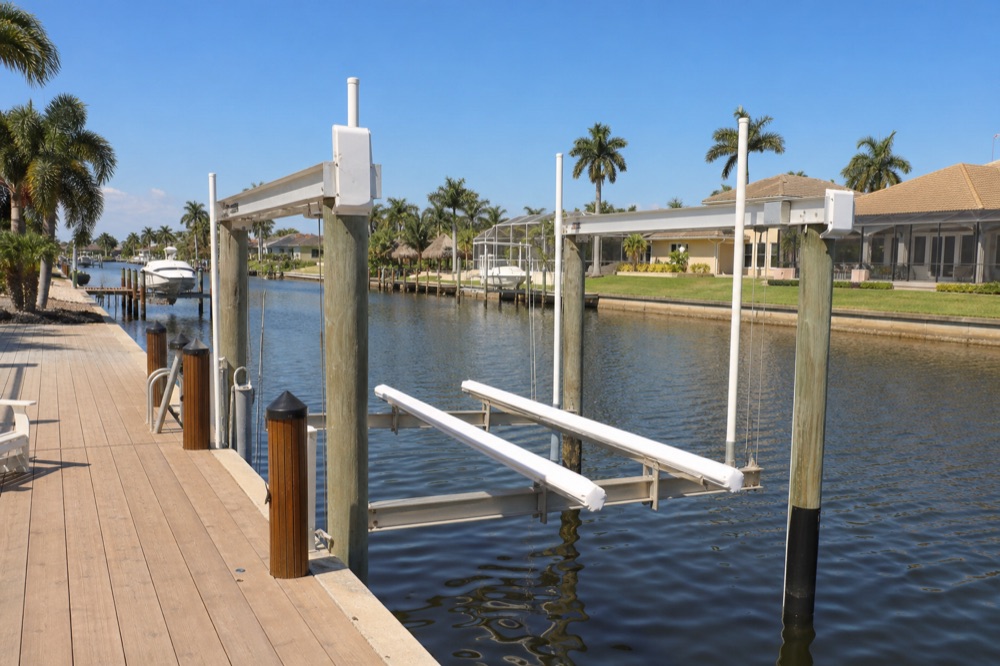
Anodes mount where dissimilar metals meet the salt water, typically on the lift’s submerged or splash-zone aluminum near the gearboxes, motors, and cable hardware. They have to be in solid metal-to-metal contact to work.
On a typical SW Florida lift you’ll find anodes around:
- The gearbox housings and motor mounts, where steel and aluminum meet
- Cable connection points and pulley hardware, near the 316 stainless cable system
- The lower frame and cradle beams that sit in or near the waterline
- Anywhere a fastener, bracket, or bolt joins two different metals below or at the splash zone
The key isn’t just location, it’s contact. An anode bolted over paint, corrosion, or marine growth is electrically isolated and useless. The mounting surface has to be wire-brushed to bright bare metal so the zinc is truly wired into the system it’s defending.
How do I read anode wear and know when to replace it?
Replace an anode once it’s roughly 50% wasted away, or whenever it’s chalky white, deeply pitted, or loose. A healthy anode looks dull gray and slightly rough; a finished one looks crumbly and shrunken.
Use this quick read:
| What you see | What it means | Action |
|---|---|---|
| Dull gray, slightly textured, most of the block intact | Working normally | Leave it, recheck in a few months |
| Roughly half its original size | Past the safe point | Replace it now |
| Chalky white crust, crumbling, or pitted through | Spent, no longer protecting | Replace immediately |
| Looks brand new after a year in the water | Possibly not connected | Check the bolt and bare-metal contact |
Two warning signs on the rest of the lift tell you the anodes failed or went too long: white powdery buildup or pitting on the aluminum frame, and corrosion or staining around stainless fasteners and cable ends. If you’re seeing that, the zinc ran out and the salt moved on to the parts you actually care about.
How often should I check and replace anodes in SW Florida?
Check anodes every two to three months and replace any that are about half gone. Our warm, salty water wastes zinc faster than most owners assume, so a regular seasonal habit is the whole game.
A simple cadence that works on local canals:
- Every 2–3 months: quick visual check, ideally when you’re already cleaning the lift
- Start and end of hurricane season (June–November): check before storm season and again after, since surge and debris can damage hardware
- Snowbirds: have anodes checked before you head north and again when you return, or arrange a mid-season look so they don’t run out while you’re away
- Replace any anode at roughly 50% wear, and never let one fully disappear
This is the cheapest line item in your entire waterfront. A few dollars of zinc, swapped on time, protects an aluminum lift that ran anywhere from $3,000 for a jet-ski lift to $22,000-plus for a 24,000 lb offshore lift. Skipping it to save a few dollars is how owners turn a routine anode swap into a structural repair. It’s the same logic behind choosing the right metal in the first place, which we break down in aluminum vs. galvanized boat lifts.
Keep your lift protected for the long haul
Anodes are one piece of a simple salt-water routine, fresh-water rinses, cable inspection, lubrication, and zinc checks, that keeps a lift running for decades instead of seasons. Our full salt-water maintenance guide walks through the rest.
If you’re not sure where your anodes are, whether they’re connected, or how much life your lift has left, we’ll take a look. Florida Lifts & Docks has built and serviced lifts across SW Florida since 2008 with our own local crew, never subbed, and we offer free on-site estimates seven days a week from Cape Coral to Naples and up through Charlotte Harbor. See everything we do on our boat lifts page, or if a lift is already showing corrosion or trouble, our dock and lift repair team can help. Call (239) 397-3400.