
Can You Add a Boathouse to an Existing Dock?
Sometimes yes — but a roof adds dead load and serious wind uplift, so your existing pilings and dock frame get assessed first and are often reinforced or added to. Here's the practical read.
Key takeaways
- Sometimes yes — but a boathouse roof adds permanent dead load AND strong wind uplift, so your existing pilings and dock frame are assessed first and are often reinforced or have new pilings added.
- A boathouse is a permanent roofed structure on its own posts; it does NOT rest on your dock decking, so the real question is whether your pilings and the canal bottom can carry a roof in a storm.
- Inspection covers piling size, depth, spacing and condition, framing connections, the seawall, and low-tide clearance — a roof needs more, deeper, or beefier pilings than a bare dock.
- A full roof is a bigger structural ask than a lift canopy; a canopy mounts to the lift, while a boathouse needs posts and pilings engineered to local wind code.
- We handle the entire permit in-house and confirm at a free on-site estimate whether to reinforce, add pilings, or rebuild before any roof goes up.
You already have a dock you like, and you’d rather add a roof over the slip than tear it out and start over. So the honest question is: can you simply add a boathouse to your existing dock?
Sometimes yes — but never automatically. A roof does two things a bare dock was never built to handle, and before any rafters go up, the pilings and frame you already have get assessed and, more often than not, reinforced or added to. Here’s the practical “will mine work, or do I need to rebuild” read.
Can you add a boathouse to an existing dock?
Sometimes, yes — but only after the structure is assessed, and usually with some reinforcement. Plenty of Southwest Florida docks can carry a boathouse, and adding a roof to a sound dock is faster and cheaper than building new. But a roof is a real structural ask, so the pilings and framing get checked and very often beefed up first.
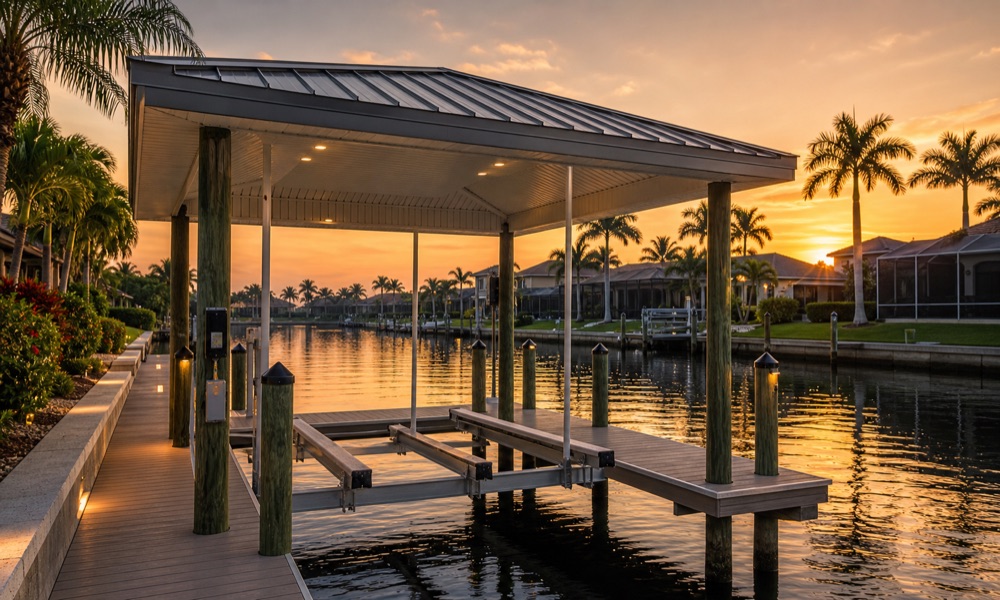
The key thing to understand: a boathouse does not rest on your dock decking. It’s a permanent roofed structure on its own posts, and those posts ride on pilings driven into the canal bottom. The roof’s weight — and the uplift trying to peel it off in a blow — travels down through pilings, never through the boards you walk on. So the real question isn’t whether your dock can hold a roof statically. It’s whether your pilings and the canal bottom can anchor one through a hurricane.
Why does adding a roof change what your dock needs?
Because a roof adds two loads your dock has never felt — a permanent dead load and powerful wind uplift.
- Dead load. The roof, rafters, ridge, and posts weigh thousands of pounds that sit on the pilings every day, year-round, in the salt.
- Wind uplift. The big one. A roof acts like a wing — wind over and under it generates lift that yanks up on the pilings. In hurricane season, June through November, that uplift can be the single largest force on the structure.
- Lateral and surge load. A taller, roofed structure catches more wind broadside and takes more from storm surge than a flat, open dock.
A piling driven to hold up decking is not automatically sized to hold a roof down against that uplift. That’s why a dock that walks rock-solid today can still need work before it wears a roof.
What gets inspected before a boathouse goes up?
The pilings, framing, and seawall act as one system, and a roof pushes and pulls on all of it. Here’s what we check on every estimate:
- Pilings — the heart of it. Whether existing pilings are the right diameter, deep enough, spaced correctly, sound, and — critically — able to resist uplift, not just bear weight. Borer-eaten or shallow pilings are the most common reason a dock can’t take a roof as-is.
- Framing and connections. Roof load travels through the post-to-piling and frame connections, so corroded fasteners, split framing, or undersized brackets get flagged.
- The seawall. A boathouse’s inner pilings often sit near the seawall and share surge load with it, so a cracked or undermined wall changes the plan. (Not sure? See signs your seawall is failing.)
- Low-tide clearance and boat size. Roof height has to clear your boat — T-top, hardtop, or tower — at the highest water, while the pilings still reach bottom at the lowest tide. We size the span to your slip and your boat.
When are new or deeper pilings required?
When the existing pilings can’t anchor a roof against uplift — which is common — new, deeper, or larger pilings go in. Reusing sound, properly sized pilings saves money; anything marginal gets reinforced or replaced first. (The same “assess before you add” logic applies to lifts — see adding a boat lift to an existing dock.)
| Your existing dock | Likely approach |
|---|---|
| Heavy pilings, deep, sound, well spaced | Build the roof on existing pilings — lowest cost |
| Sound pilings but undersized or too few for uplift | Add pilings or sister in beefier posts, then roof |
| Borer damage, leaning, or shallow pilings | Drive new pilings sized to carry and hold down the roof |
| Dock framing tired or connections corroded | Reinforce or rebuild the frame before the roof goes on |
Tap a piling near the waterline — a dull, hollow thud often means marine borers (teredo worms and gribbles) have eaten the core while the surface still looks fine. The Caloosahatchee and Charlotte Harbor canals are prime borer territory, and a borer-weakened piling is exactly the one that fails when a roof catches a gust. If your dock is mostly sound but needs targeted work, see dock repair.
Adding a roof vs. adding a lift canopy — what’s the difference?
A roof (boathouse) is a permanent structure on posts and pilings; a lift canopy is a lighter cover that mounts onto the boat lift itself — so they don’t ask the same thing of your dock.
- A lift canopy rides on the lift, sheds sun and rain, and is the budget-friendly add. It loads the lift’s own pilings, so it rarely demands structural changes.
- A boathouse roof is a full structure engineered to local wind code — its own posts, pilings, framing, and roofing (metal or shingle). It protects the boat and the lift and adds resale value, but it’s a bigger commitment.
Our boathouse vs. lift canopy guide compares the two side by side, and boathouse cost in Southwest Florida covers what a full structure runs.
Is a permit required to add a boathouse?
Yes. A roofed structure over the water requires a permit, and depending on the waterway the city, county, or state may be involved. A boathouse carries a more involved review than a bare dock because it’s permanent and has to be engineered to local wind code — the same uplift and surge loads we plan the pilings around. We handle the entire permitting process in-house, scoped into the project from the start so you’re not chasing paperwork. (More: boathouse permit in Florida.)
Built to outlast the salt
Whatever route fits your dock, the spec doesn’t change. The Gulf coast is brutal on hardware, so everything we install is built for it: marine-grade aluminum, 316 stainless hardware, CCA-treated framing, and capped composite decking (TimberTech or Trex). That’s how a boathouse added to your dock stands for decades, not seasons.
Adding a boathouse to an existing dock is one of the best upgrades you can make to a waterfront home — when it goes up on pilings and framing engineered to carry the weight and hold the roof down in a storm. We’ve done exactly this across Southwest Florida since 2008, with our own local crew and in-house permitting, never subbed out, rated 5.0 stars on Google. Let us take an honest look at your pilings, frame, and seawall and tell you straight whether to reinforce, add pilings, or rebuild. See what we build on our boathouses page, book a free on-site estimate seven days a week in Cape Coral, Fort Myers, or Punta Gorda, or call (239) 397-3400.