
How Much Does a Tiki Hut Cost in Florida? 2026 Pricing by Size, Thatch & Add-Ons
What a tiki hut actually costs on the Southwest Florida coast — priced by size, natural palm vs. synthetic thatch, permits, and the add-ons that move the number.
Key takeaways
- A tiki hut's price is driven mostly by footprint and roof type; small backyard chickees start at the low end, while large dock-top or estate builds with a bar and electric run into five figures.
- Natural palm (sabal palm) thatch is the lower up-front cost; synthetic thatch costs more to install but skips the re-thatch cycle and carries a fire rating.
- Permit fees are real but modest compared to the build, and they vary by city and county — we handle the whole filing in-house.
- Waterfront and dock-top tiki huts cost more than a backyard build because they need marine-grade framing, deeper pilings, and engineering for storm surge.
- The biggest add-ons — a built-in bar, marine lighting, fans and electric, and seating — can add as much as a small hut's base cost.
A tiki hut is the easiest way to turn a Southwest Florida backyard or dock into a place you actually want to spend the evening. It throws real shade over the worst of the Gulf-coast sun, it shrugs off afternoon rain, and a well-built one looks like it belongs on the water from the day it goes up. The first thing every owner wants to know is the same: what does it cost?
The honest answer is that a tiki hut isn’t a flat-price product — it’s a structure, and the price moves with how big it is, what the roof is made of, and what you put under it. Below is a straight breakdown of what actually drives the number across Cape Coral, Fort Myers, Naples, and the rest of the coast, so you can budget realistically before you ever get a quote.
What is a tiki hut, exactly?
A tiki hut is an open-sided, thatched-roof shade structure built on posts, with no walls — the Florida descendant of the Seminole “chickee.” The roof is the defining feature: layered thatch over a framed pitch, supported by heavy posts set into the ground or driven as pilings on the water.
That open design is the whole point in our climate. Air moves through it, so it stays cooler than a closed structure, and it gives you shade and rain cover without trapping heat. Because there are no walls, what you’re really paying for is the roof, the framing, the posts, and whatever you build underneath.
How much does a tiki hut cost in Florida?
The cost is driven first by footprint (square feet) and second by roof type, with site conditions and add-ons stacking on top. A small backyard hut is the lowest-cost build, a mid-size structure adds electric and lighting in the middle of the range, and a large dock-top or estate hut with a bar runs well into five figures.
Tiki huts are quoted per project, not off a flat price list, because no two sites are the same. We give a firm number free, on-site, after we see your span, your ground or seawall, and what you want under the roof. What we can do here is show you exactly what moves that number.
The main cost drivers, roughly in order of impact:
- Size (square footage). This is the single biggest factor. More roof area means more framing, more posts, and more thatch — and bigger spans may need heavier structural members.
- Roof / thatch type. Natural palm vs. synthetic is a real cost fork (more below).
- Where it’s built. A backyard hut on solid ground is the baseline. A dock-top or seawall-edge hut over the water costs more.
- Add-ons. A bar, lighting, fans, electric, and finished seating each add to the base.
- Permits. Modest relative to the build, but a real line item.
Natural palm vs. synthetic thatch — what’s the cost difference?
Natural sabal-palm thatch is typically cheaper to install up front; synthetic thatch costs more initially but lasts much longer and skips the re-thatch cycle. Over the life of the hut, that flips the math.
Here’s the trade-off in plain terms:
| Factor | Natural palm thatch | Synthetic thatch |
|---|---|---|
| Up-front cost | Lower | Higher |
| Look | Traditional, authentic | Very close, more uniform |
| Lifespan | Shorter; needs periodic re-thatch | Much longer; minimal upkeep |
| Re-thatch cycle | Every several years (varies) | Generally not required |
| Fire rating | Typically untreated unless specified | Available with a fire rating |
| Best for | Authentic look, lower entry cost | Long-term value, code situations |
Natural palm gives you the real, woven-frond look and the lowest entry price. The catch is that Florida’s UV, rain, and humidity work on it constantly, so a natural roof needs re-thatching every several years to stay watertight and looking right. Budget for that as an ongoing cost, not a one-time spend. Our palm vs. synthetic thatch guide goes deeper, and if you’re wondering about upkeep timing, see how often to re-thatch a tiki hut roof.
Synthetic thatch is the move if you want to set it and forget it. It costs more to install, but it can carry a fire rating — which matters in some jurisdictions and near certain structures — and it holds up for years without the re-thatch labor. If you’re keeping the home long term, the lower lifetime cost often wins.
Three cost scenarios: small, medium, and large
The cleanest way to picture pricing is by build size. These are the three scenarios we quote most often on the coast.
- Small backyard hut. A compact shade structure over a patio, hot tub, or seating nook on solid ground. Natural palm, minimal extras. This is the lowest-cost tier — you’re paying for posts, framing, and a modest roof, nothing more.
- Mid-size hut with electric and lighting. A larger footprint that covers a dining set or lounge, wired for a fan, with marine-rated lights under the roof. Add electrical and you’ve added a licensed-trade line item and a power run from the panel. This is the middle of the range and the most common request.
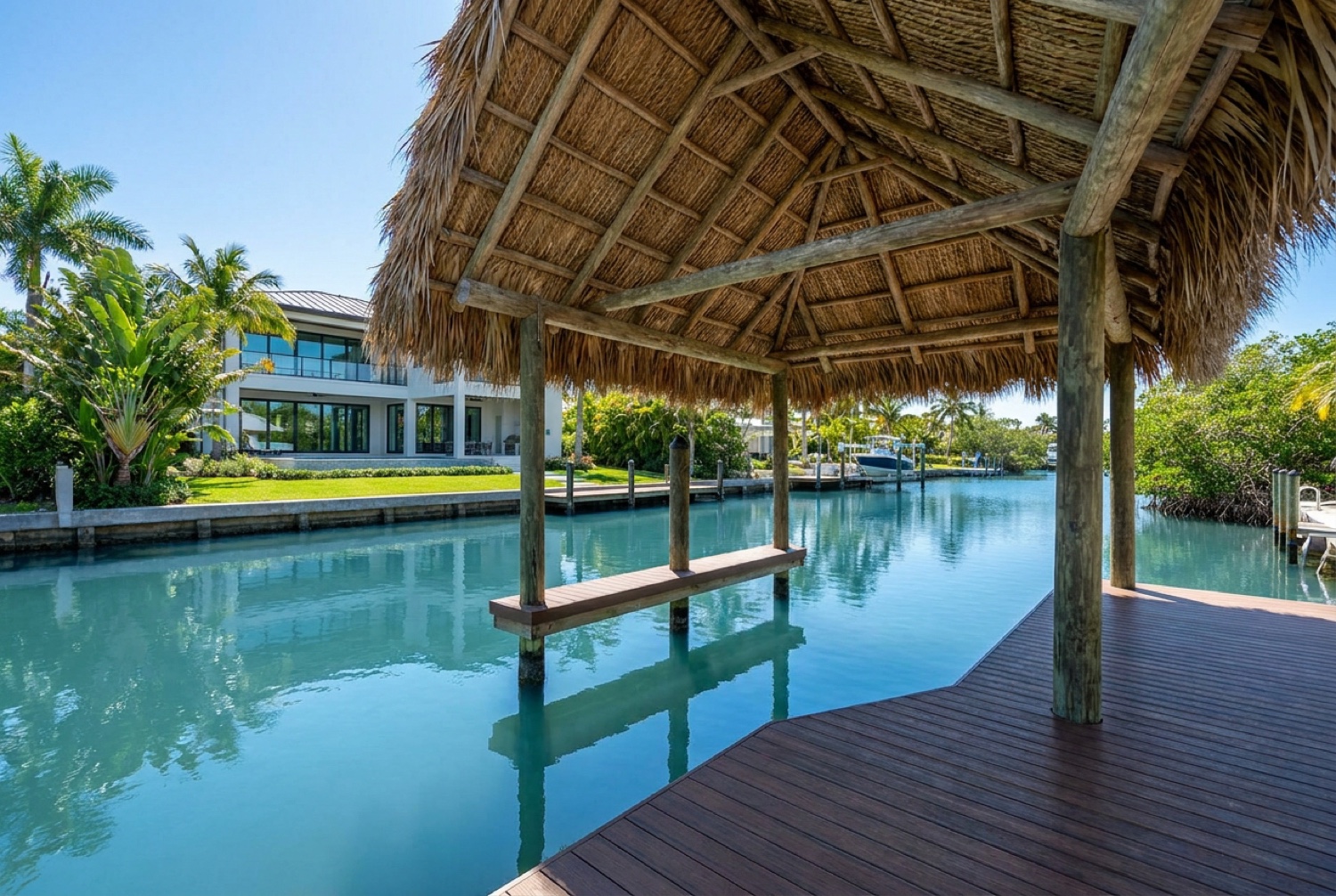
- Large dock-top or estate hut. A big-span structure, often over the water on a dock or at the seawall, with a built-in bar, full lighting, fans, and finished seating. Marine-grade framing and pilings, storm-surge engineering, and the add-ons together push this well into five figures.
The jump between tiers isn’t just square footage. Going from a backyard hut to a dock-top hut changes the engineering, and adding a bar and electric changes the trades involved. Both push the number up faster than size alone.
Why does a waterfront or dock-top tiki hut cost more?
A tiki hut on a dock or seawall costs more than a backyard build because it has to survive the marine environment and open-water wind load. That means a different spec from the ground up.
On the water, the hut isn’t sitting on solid earth — it’s carried by pilings driven into the canal bottom and tied into dock or seawall structure. Salt air, tide swings, marine borers, and storm surge are all working against it, the same forces that drive the cost of any custom dock build. So a dock-top tiki hut needs:
- Pilings to the right depth for your canal bottom, not just posts in a footing.
- Marine-grade framing and hardware that won’t rot or corrode in salt.
- Engineering for wind and surge over open water, where there’s nothing to break the gusts.
- Integration with the dock so the structure and the deck work as one system.
That’s real added work and material, which is why a waterfront hut sits above a backyard one even at the same size. The upside is enormous: shade and a place to sit right over your boat slip. If you’re weighing it, our guide on whether you can build a tiki hut over a dock walks through the engineering and permitting side.
What about permits — and storms?
Tiki huts in Florida generally require a permit, and the fee is modest compared to the structure, but it varies by city and county. The real value is having it filed and approved correctly so the build is legal and insurable.
We handle the entire permitting process in-house across the 18 cities we serve, so the hut is scoped, drawn to code, and approved as part of the project — not a paperwork chase you’re stuck managing. Requirements differ depending on whether you’re on the water, near a property line, or close to other structures. For the full picture on what’s required and when, see do you need a permit for a tiki hut in Florida.
Storms are the other thing to budget around. Hurricane season runs June through November, and a properly engineered hut is built to handle the wind that comes with it. A cheaply framed structure is the one that becomes debris. Building it right the first time — correct framing, correct anchoring, the proper roof — is the difference between a hut that needs a quick re-thatch after a blow and one that has to be rebuilt.
The add-ons that move the number
The structure is only half the budget on a finished tiki bar. The extras you build into it are the other half, and they’re where the price climbs fastest.
The big movers, roughly:
- Built-in bar. A finished bar with a counter, storage, and a sink is a meaningful add on its own.
- Marine lighting. Salt-rated dock lighting under the roof and around the structure — warm, dimmable, and built to survive the air.
- Fans and electrical. Ceiling fans for the still summer evenings, plus outlets, all of which require a power run and licensed work.
- Finished seating. Built-in benches, bar stools, or a lounge setup integrated into the structure.
- Dock-top engineering. On the water, the marine framing and pilings discussed above are effectively a built-in “add-on” baked into the price.
Any one of these adds noticeably. Stack a bar, lighting, fans, and seating together and you can add as much as the base cost of a small hut. None of it is wasted money if you’ll use the space — but it’s worth deciding up front what you want under the roof so the quote reflects the real build, not a bare shell you’ll upgrade later.
What you can count on in the spec
Whatever the size, the way it’s built is what determines whether it lasts. On waterfront and dock-top huts, that means the same marine spec we put into every structure we touch on the coast:
- Marine-grade aluminum and CCA-treated framing that stands up to salt and rot
- 316 stainless hardware that won’t bleed rust down your posts
- Capped composite (TimberTech/Trex) decking where the hut ties into a dock
We’ve been building on these canals since 2008 with our own local crew — never subbed out — and we hold a 5.0-star rating on Google. That spec and that crew are why a hut we build is one you stop thinking about, instead of one you’re patching every season.
Ready for a real number? We give free on-site estimates seven days a week across Cape Coral, Naples, Fort Myers, and the rest of Southwest Florida. See everything we build on our tiki huts page, or call (239) 397-3400 and we’ll come look at your yard, your dock, or your seawall and tell you exactly what it’ll cost.