
Captain's Walk vs. Standard Dock: Which Do You Need?
A clear choose-this-if framework for SW Florida waterfront — when a long captain's walk out to deep water beats a standard near-shore slip, tied to depth, frontage, and cost.
Key takeaways
- A captain's walk is a long, narrow walkway out to deeper navigable water, with the slip and lift at the far end — the SW Florida answer to shallow flats and big tide swings.
- Choose a standard single-slip dock if you have deep water near the seawall; choose a captain's walk if your boat would sit on the bottom at a spring low tide.
- The cost gap is real but modest — single-slip runs $22,000–$30,000, a captain's walk $32,000–$44,000, driven by extra length and pilings.
- Always measure depth at a spring low tide, not a random moment, and check canal-width and extension limits before you commit to a layout.
On a Southwest Florida waterfront, the difference between a dock you love and a dock you fight with often comes down to one decision made before a single piling goes in the ground: how far out do you build? If deep water laps at your seawall, a standard dock with a slip right off the shore is all you need. But on a shallow flat, a skinny canal end, or a wide tidal shoreline, that same near-shore slip leaves your boat aground in the mud at low tide. That’s where a captain’s walk comes in.
Here’s a plainspoken way to decide, tied to the three things that actually matter — water depth, frontage, and cost.
What is a captain’s walk?
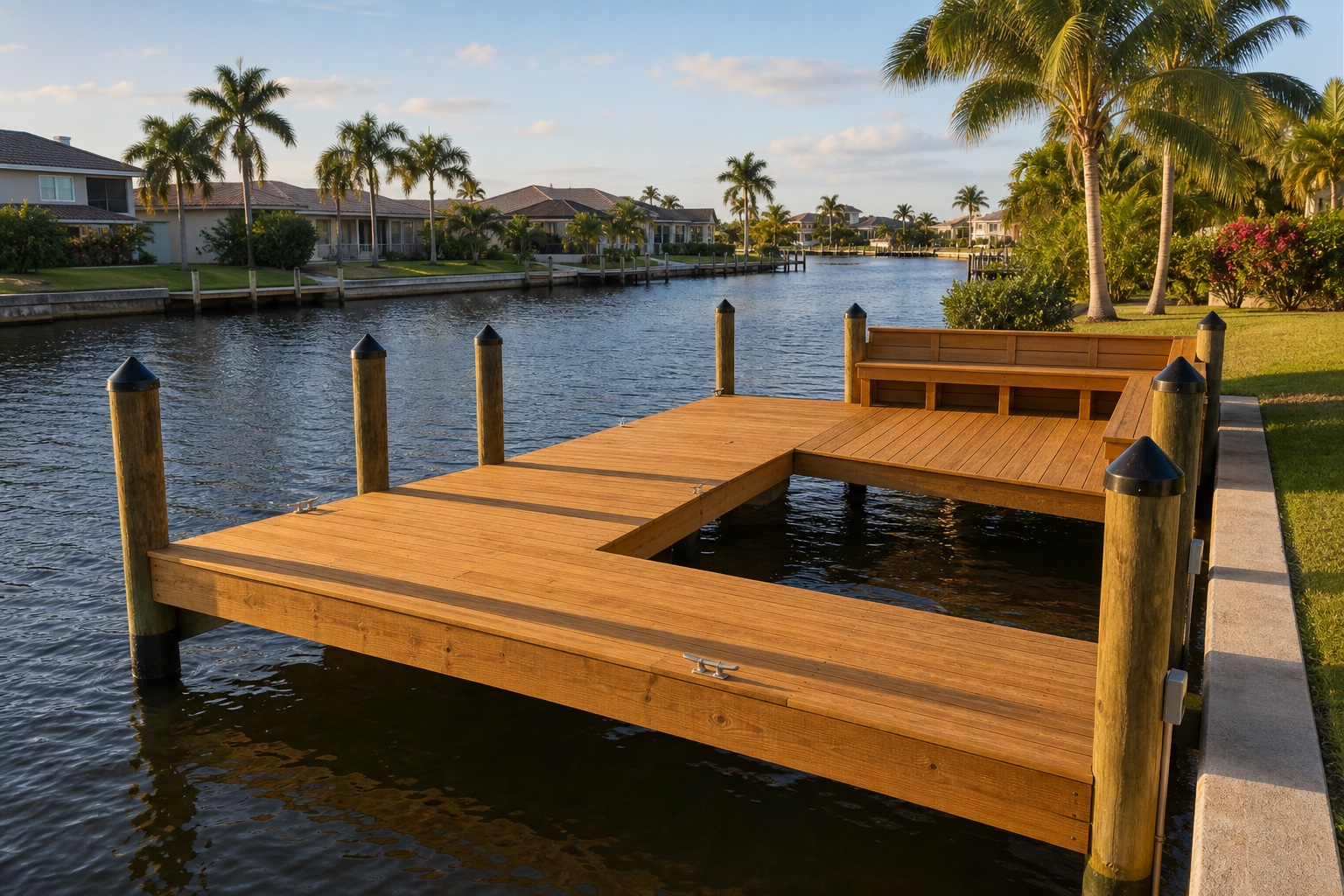
A captain’s walk is a long, narrow walkway that runs out from your seawall to deeper, navigable water, with the boat slip and lift sitting at the far end rather than up against the shore. Think of it as a pier built for reach.
A standard dock, by contrast, keeps the slip close to the seawall — the classic single-slip layout you see on deep, well-dredged canals where the water’s plenty deep just a few feet off the bank. Both are real, permanent marine structures. The only meaningful difference is how far the working end sits from shore, and on the SW Florida coast that distance is dictated almost entirely by your bottom and your tide.
When should you choose a standard dock?
Choose a standard single-slip dock when you have deep, usable water close to your seawall — the situation on most established Cape Coral and Fort Myers canals. If your hull floats freely with prop clearance even at the lowest tide of the month, you don’t need to reach for depth, and a longer walk would just cost more for no benefit.
A standard dock is the right call when:
- Your slip holds enough water to float your loaded boat at a spring low tide (the lowest of the month), not just an average one.
- You’re on a maintained or dredged canal where depth drops off quickly from the bank.
- Your frontage is narrow and a long walk would crowd the canal or run past extension limits.
- You want the simplest, most cost-effective build and the water cooperates.
This is the workhorse layout, and on a deep canal it’s all the dock you’ll ever need. Our custom dock cost guide breaks down the number.
When should you choose a captain’s walk?
Choose a captain’s walk when shallow water near your seawall would leave your boat sitting on the bottom — or with the lower unit dragging muck — at low tide. The walk carries you out past the shallow flat to water deep enough to keep the hull floating and the prop clear all day, every tide.
A captain’s walk is the right call when:
- Your slip area dries out or barely floats your hull at a spring low tide.
- You’re on a wide tidal shoreline — common along the Caloosahatchee, around Charlotte Harbor, and on bay-front lots where the shallows run well off the bank.
- You sit at the shallow end of a canal or on a grass flat where deep water is simply farther out.
- You want reliable, any-tide access without watching a tide chart before every trip.
The deeper, cooler water at the end of a walk is also easier on your boat and your lift. If you’re wrestling with a low-tide site, our guide on boat lifts in shallow water and low tide covers the specifics.
Captain’s walk vs. standard dock at a glance
| Standard single-slip dock | Captain’s walk | |
|---|---|---|
| Best for | Deep water near the seawall | Shallow flats, wide tidal shorelines |
| Slip location | Close to shore | Out at the end of a long walkway |
| Reaches deep water | Not needed | Yes — that’s the whole point |
| Frontage needed | Works on narrow canals | Needs room to extend out |
| Typical installed cost | $22,000–$30,000 | $32,000–$44,000 |
The cost gap is real but modest, and it comes from one thing: length. A captain’s walk needs more decking, more framing, and more pilings driven out to where the deep water sits — which is exactly why it costs more than a slip you can step onto from the seawall.
How do you measure depth and frontage before deciding?
Decide based on the lowest tide of the month, not a snapshot. Walk your seawall at a spring low tide and measure water depth where your slip would go, because that worst-case number is what determines whether your boat floats or sits in the mud.
A few field notes from building on this coast:
- Measure at a spring low, not whenever you’re standing there. A slip that looks fine at midday can be dry at the monthly low. Design for the worst case.
- Account for your loaded draft. Add fuel, gear, and a safety margin under the keel and prop.
- Check how far you can legally extend. Canal width and local extension and setback rules cap a dock’s reach. On a tight canal, a captain’s walk may not fit — and a lift mounted on the seawall can be the smarter move.
- Build for storm season. From June through November, framing and pilings have to ride out surge and wind regardless of layout.
We sort this out at the estimate so the dock is legal, navigable, and right for your tide. If you’re still weighing shapes, our dock layout design guide covers single-slip, captain’s walk, T-dock, and L-dock side by side.
The bottom line
If deep water reaches your seawall, build a standard dock and don’t overspend. If your boat would touch bottom at low tide, build a captain’s walk and buy yourself any-tide access for decades. The deciding factor isn’t preference — it’s the depth at your slip at the lowest tide of the month, balanced against the frontage and canal width you have to work with.
The only way to know for sure is to put eyes and a tape measure on your specific shoreline. We give free on-site estimates seven days a week across Cape Coral, Naples, Fort Myers, and the rest of the SW Florida coast — and our own local crew drives every piling and lays every board, never subbed out. See what we build on our custom docks page, or call (239) 397-3400.