
Boat Lift for Shallow Water & Low Tide: Will It Clear the Bottom?
How to spec a boat lift for a skinny-water canal so you can launch at any tide — not just the two hours around high water.
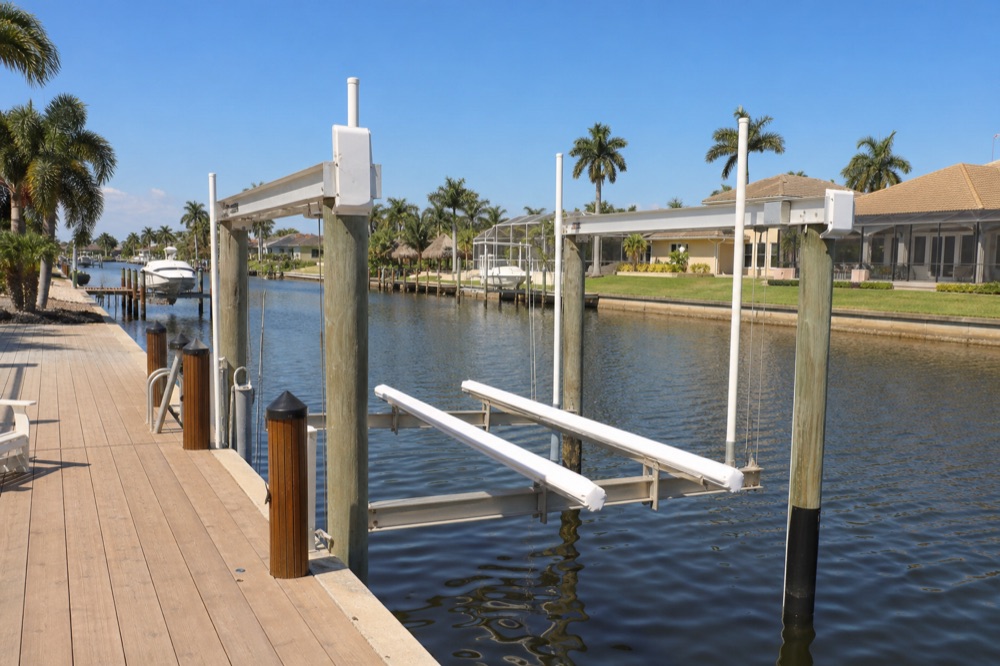
Key takeaways
- A boat lift can solve the "I can only launch at high tide" problem, but the fix is in the design — beam height, cradle style, and a clean bottom under the lift, not just a bigger motor.
- Your real constraint is depth at mean low water (MLW), not the depth you see when you walk the dock at high tide; SW Florida canals can swing roughly 1.5–3+ ft between Gulf-driven tides.
- A cradle bottoms out when the beams or bunks sit lower than the surrounding bottom; dredging a permitted trench under the beams or switching to a higher-clearance style usually fixes it.
- Bottom composition matters: soft Charlotte Harbor mud lets a hull settle in, while hard sand or rock limits how low the cradle can safely drop.
- Lower limit switches and override settings keep the lift from forcing the cradle into the bottom and damaging cables, motors, or your hull.
If your canal goes skinny at low tide, you know the frustration: the boat floats fine at high water, but drop a couple of feet and you’re stuck at the dock or dragging the lower unit through the mud. Plenty of Cape Coral and Charlotte Harbor owners end up planning every trip around the tide chart, launching only in the window around high water and racing the falling tide home.
A boat lift is the right answer — but only if it’s designed for your depth, not just bolted in and hoped for. Here’s how a lift clears the bottom in skinny water, why a cradle bottoms out, and the real fixes we use on SW Florida canals.
What counts as “shallow water” for a boat lift?
Shallow water isn’t about the depth you see at high tide — it’s about your depth at mean low water (MLW), the average low point the tide pulls down to. That’s the number that decides whether your lift clears the bottom.
A “boat lift for shallow water” is simply a lift designed so the cradle can drop far enough to float your hull even at the lowest normal tide, without the beams digging into the bottom. The trap is measuring at the wrong time. Walk your dock at high tide and the canal looks plenty deep; the same slip at MLW on a strong outgoing tide can lose well over two feet. On Gulf-fed canals around Cape Coral, Fort Myers, and Charlotte Harbor, tidal range commonly runs about 1.5 to 3-plus feet depending on the moon and wind pushing water in or out of the harbor.
So the first job on any shallow slip is honest measurement at low water — not a guess from the seawall.
Why does a boat lift cradle bottom out at low tide?
A cradle bottoms out when the beams, bunks, or sling sit lower than the canal bottom at that tide. As the water falls, the lift simply can’t lower the boat far enough to float it, or the beams start to dig in.
To float your boat onto the lift, the cradle has to sit below the bottom of your hull. If your hull draws two feet and the water at MLW is only a little over two feet deep, the cradle has nowhere left to go — it hits bottom before your hull floats free. A few things make this worse:
- Boat draft. Deeper-V hulls and heavier offshore boats sit lower and need more clearance than a flat-bottom bay boat or pontoon.
- Beam and bunk height. Cradle beams set too low for the slip contact bottom before the boat is afloat.
- Tide timing. The problem only shows up at the bottom of the tide, so it’s easy to miss at a sunny midday look.
- Sediment buildup. Canals silt in over the years; the bottom that was fine a decade ago may be a foot higher now.
That’s why a lift that “works fine” for the neighbor can fail in your slip three doors down — same canal, different bottom and boat. Boat lifts in Estero takes that up at the scale of a whole waterfront, where the water is a river rather than a dug canal and the depth question comes first.
How does bottom composition change the design?
Bottom type sets the floor — literally — for how low your cradle can safely sit. Soft mud gives you a little forgiveness; hard sand or rock does not. SW Florida bottoms vary a lot from canal to canal:
- Soft mud and muck (common in older Charlotte Harbor and back-bay canals) lets beams settle slightly and can be trenched under the cradle, but it shifts and re-deposits over time.
- Firm sand is stable and predictable, but it won’t yield — the cradle has to clear it, period.
- Hardpan, caprock, or shell near the surface limits both how low you can go and how easily a trench can be cut.
We read the bottom during the on-site estimate, because it directly drives beam placement and whether dredging is even an option for your slip.
What are the real fixes for a shallow, low-tide slip?
There are four proven fixes, and most skinny-water installs use a combination of them. The right mix depends on your depth at MLW, your bottom, and your boat.
| Fix | What it does | Best when |
|---|---|---|
| Proper depth design | Sets beam and cradle height to clear bottom at MLW | Every shallow slip — the foundation |
| Trench under cradle beams | Permitted dredging of a channel beneath the beams | Soft mud bottoms with marginal depth |
| Higher-clearance lift style | Bunks, sling, or elevator-style that needs less drop | Very skinny slips or shallow-draft boats |
| Lower limit / override settings | Stops the motor before the cradle forces into bottom | Protecting cables, motor, and hull |
Two of these deserve a note. A trench under the beams is regulated work — seagrass, manatee, and submerged-lands rules apply — which is why we handle permitting in-house. And a forgiving lift style can cradle a shallow-draft hull higher in the water with less vertical drop; our overview of types of boat lifts covers which suit skinny water.
What about jet skis and shallow-draft boats?
For jet skis, kayaks, and very shallow-draft boats, a low-tide canal is much easier to solve. These craft barely draw any water, so a jet-ski lift or higher-clearance setup clears the bottom with room to spare and keeps the hull out of the salt between rides.
If you’re weighing a lift against a floating dock for a shallow slip, it’s worth thinking through — floats sit on top of the water and don’t care about depth, but they leave your hull soaking in salt. We break down the trade-offs in fixed vs. floating docks in shallow water. Getting the capacity right matters too; see what size boat lift do I need.
Built to handle the salt and the surge
A shallow slip is no place for cheap hardware. Skinny canals work your cradle near the bottom, where mud, barnacles, and grit are unforgiving — and SW Florida piles on saltwater, relentless UV, marine borers, and hurricane-season surge from June through November. Everything we install is built for it: marine-grade aluminum frames, 316 stainless cable and hardware, and sealed marine motors rated for salt air. Done right, the lift clears the bottom at any tide and keeps doing it for decades.
If you’re tired of launching only at high tide, let’s fix it for good. We’ve built lifts on skinny Cape Coral and Charlotte Harbor canals since 2008 with our own local crew — never subbed — and in-house permitting. Explore everything on our boat lifts page, then book a free on-site estimate seven days a week. We’ll measure your depth at low water and tell you exactly what it takes to clear the bottom. Call (239) 397-3400.