
Do Dock Lights Attract Fish? Above-Water vs. Underwater, Explained
A quick, honest answer to a question that mixes up two different kinds of light — and which one actually stacks snook and tarpon at your seawall.
Key takeaways
- Above-water dock and pathway lights draw only a little bait via surface spill; they do not create the famous fishing show.
- The dramatic snook-and-tarpon effect requires SUBMERGED fish lights that put green light into the water column.
- Dock lights light the deck for safe footing and docking; fish lights light the water to stack bait and gamefish — different jobs.
- Underwater fish lights retrofit onto an existing dock and run on sealed, marine-rated, low-voltage fixtures on a dusk timer.
Type “do dock lights attract fish” into a search bar and you’ve actually asked two questions wearing one coat. Some people mean the post-cap and pathway lights that make a dock safe to walk at night. Others mean the glowing green pools that stack glass minnows and snook against a seawall. Those are not the same fixture, and they do not do the same thing — so the honest answer is “a little, but probably not the way you’re picturing.”
Here’s the clean version: above-water dock lights spill a bit of light on the surface and may draw a few bugs and baitfish on a calm night, but the real fishing show — the one with tarpon rolling two feet off your dock — only happens with submerged lights. Let’s sort out which is which so you aim your money at the result you actually want.
What’s the difference between dock lights and fish lights?
Dock lights sit above the water and light the deck; fish lights sit below the waterline and light the water itself. They’re built for two different jobs, and confusing them is the single most common mistake we see.
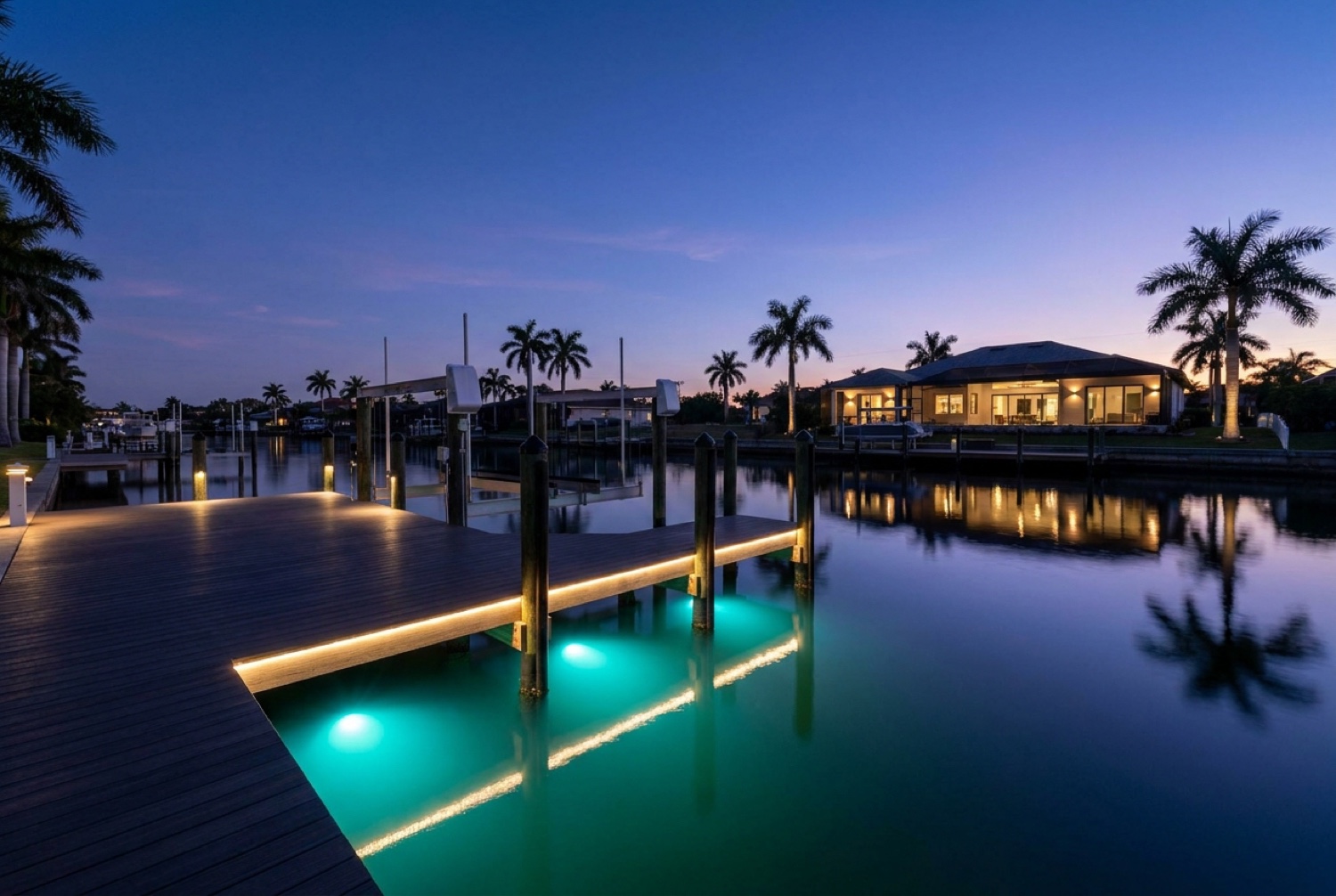
- Dock lights (above water) — post caps, pathway lights, step lights, and downlights. Their job is safe footing, finding your cleats in the dark, and giving the dock a finished look. Think of it as lighting for people.
- Fish lights (underwater) — sealed fixtures mounted on a piling or seawall below the surface, pointed into the water column. Their job is to light the water so bait and gamefish gather. Think of it as lighting for the canal.
One keeps you from stepping off the edge at 10 p.m. The other turns your seawall into a feeding station. Most Southwest Florida owners eventually want both, but it helps to know you’re buying two separate things.
Do above-water dock lights attract fish at all?
A little, on a good night — but don’t count on a show. A bright post light or downlight throws some glow onto the surface, and on a flat-calm, dark night that surface glow can draw insects and a scattering of glass minnows. Sometimes a curious snook will cruise the edge of it.
But here’s the physics problem: surface light mostly scatters and reflects off the top of the water instead of going down into it. Our canals along the Caloosahatchee and out toward Charlotte Harbor carry tannic stain and a little turbidity, especially after a summer rain or a hard outgoing tide. Light that never penetrates the surface can’t build a food chain down where the fish live. So above-water lighting is a weak, unreliable bait draw — pleasant, but not the point.
Why do underwater fish lights pull in snook and tarpon?
Because a submerged light puts green glow into the water column, where it triggers an actual food chain instead of just glinting off the surface. That’s the whole difference.
We won’t re-run the biology here — our underwater fish lights guide walks through exactly how light draws plankton, plankton draws bait, and bait draws the snook, tarpon, trout, and redfish that make people fall in love with these systems. The short version: when the light is under the water, it works. When it’s above the water, it mostly doesn’t.
If you want to see the two approaches lined up side by side, our above-water vs. underwater dock fishing lights comparison breaks down the trade-offs in detail.
Above-water vs. underwater: which does what?
Here’s the quick comparison most owners are really after:
| Above-water dock lights | Underwater fish lights | |
|---|---|---|
| Main job | Light the deck for safe footing & docking | Light the water to draw bait & gamefish |
| Mounting | Posts, rails, deck surface | Below waterline on piling or seawall |
| Fish effect | Minor surface bait on calm nights | Stacks snook, tarpon, trout, redfish |
| Best color | Warm white for ambiance | Green (aqua a strong second) |
| Curb appeal | Defines the dock at night | Glowing pools in the canal |
The takeaway: if your goal is fishing, you want fixtures in the water. If your goal is safety and a finished look, you want fixtures on the dock. They complement each other — and they run off the same low-voltage approach, so it’s common to do both in one go.
Can I get both — and add them to a dock I already have?
Yes to both. You do not need to rebuild anything to get the fishing effect.
Underwater fish lights retrofit cleanly onto an existing dock or seawall. We mount sealed, marine-rated LED fixtures below the waterline, run low-voltage wire back to a transformer up top, and set the whole thing on a dusk timer so it switches on and off by itself. The same visit is the easy time to add or upgrade your above-water dock lighting — post caps and pathway lights that make the deck safe and sharp at night.
Everything we install is specced for our environment: sealed marine-rated fixtures, low-voltage wiring, and corrosion-resistant hardware that holds up to salt air, UV, and the occasional storm-surge dunking through hurricane season. We’ve been building and lighting docks across Southwest Florida since 2008 with our own local crew — never subbed out — and we handle permitting in-house, so adding lights is a clean, one-call job.
So, do dock lights attract fish? A little. Do underwater fish lights attract fish? Absolutely — that’s the show you’re picturing. If you want the green-pool, bait-stacking, snook-on-the-seawall version, explore our fish lights page, then book a free on-site estimate seven days a week in Cape Coral, Fort Myers, Naples, and across the coast — or call (239) 397-3400 and we’ll light up your water.