
Do You Need a Boathouse for a Pontoon Boat?
Pontoons are wide and full of sun-baked vinyl and a fragile bimini, so a cover pays off fast — but a canopy or open lift may be enough. Here's how to decide.
Key takeaways
- A pontoon's value is its open deck — vinyl furniture, bimini, electronics, flooring — and all of it fades fast in SW Florida sun, which makes a cover pay off more than it does on a hull-focused V-boat.
- A lift canopy is the budget-friendly cover for a pontoon and the right call for most owners; a full boathouse adds year-round protection plus resale value for a high-end tritoon.
- A pontoon's wide beam means a larger roof span, so a boathouse or canopy for a deck boat can cost a bit more than for an equal-length V-hull.
- A bare boat lift sized to your pontoon is the lowest-cost option and gets the tubes out of the salt; you can add a canopy later.
- Canopy add-on runs roughly $14,000–$22,000; full boathouse cost is quoted free on-site.
If you own a pontoon or tritoon in Southwest Florida, you already know the boat is built around one thing: the deck. Wide-open seating, plush vinyl furniture, a helm full of electronics, a bimini top, and vinyl flooring underfoot. That layout is the whole point of a pontoon — and it’s why the “do I need a cover?” question lands differently for you than for the guy with a center console.
A V-hull owner mostly worries about the bottom of the boat sitting in salt water. A pontoon owner worries about that too, but the bigger, faster-fading investment is everything above the waterline. So before you copy generic boathouse advice, here’s how the decision plays out for a wide deck boat on a Cape Coral or Naples canal.
What is a boathouse, and how is it different from a canopy?
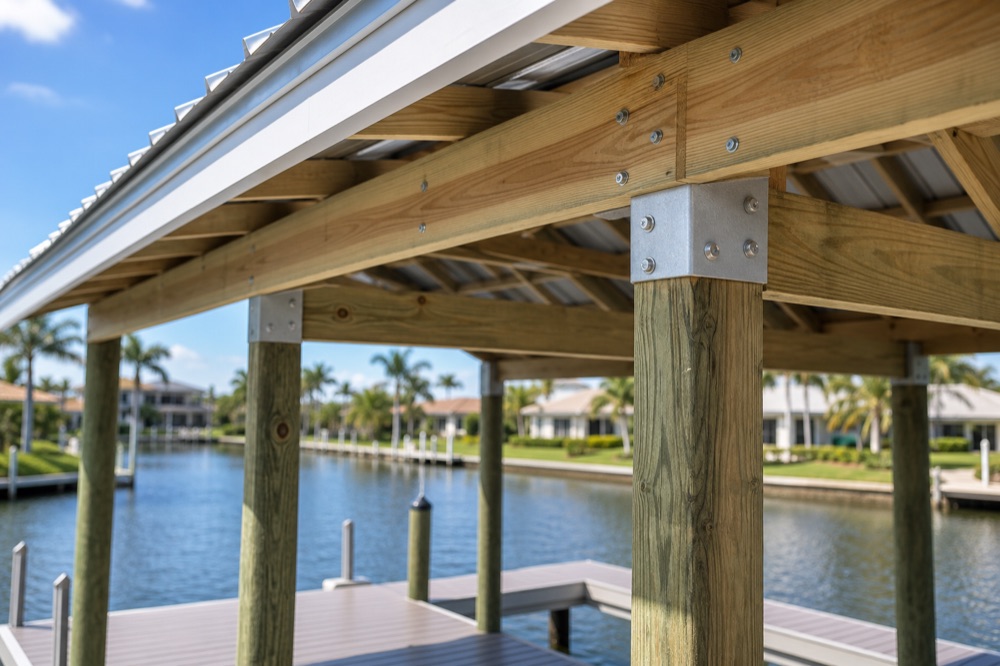
A boathouse is a permanent roofed structure built over your slip — real posts, a real roof, engineered to local wind code. A lift canopy is a cover mounted on the boat lift itself, in fabric or metal, that shades the boat without building a full structure.
For a pontoon, the practical difference is how much of the deck you cover and for how long:
- A bare boat lift gets the tubes and motor out of the salt. No sun protection.
- A lift canopy adds a roof over the deck — shade, rain shedding, and far less UV on your furniture, for a fraction of a boathouse.
- A boathouse covers the boat and the lift permanently, handles weather year-round, and becomes an architectural feature.
We break the two covers down head-to-head in our boathouse vs. lift canopy guide, but the pontoon angle deserves its own answer.
Why does a pontoon benefit from a cover more than a V-hull?
Because the most expensive parts of a pontoon are exposed to the sky, not the water. The Florida sun is brutal on vinyl, fabric, and electronics, and a pontoon puts all three out in the open — so the UV does the damage long before the salt does:
- Vinyl furniture cracks, hardens, and fades — and reupholstering a full pontoon is a real bill.
- The bimini top is fabric stretched in the sun all day; covered, it lasts years longer.
- Helm electronics and the dash cook under direct exposure.
- Vinyl flooring fades and mildews without shade.
- Tubes and the motor still need to come out of the salt — that’s what the lift handles.
On a center console, a cover is mostly about gelcoat and upholstery. On a pontoon, a cover protects the entire reason you bought the boat — so dollar for dollar, covered storage tends to pay off faster for deck boats.
How does a pontoon’s width change the structure and cost?
A pontoon or tritoon is wider than a comparable V-hull, so any roof over it — canopy or boathouse — has to span more area, and that extra span is a genuine factor in the price. Three things about a wide deck boat shape the build:
- Beam (width). The roof has to cover the full deck plus working room on the sides — more width, longer span, more structure overhead.
- Height and clearance. Pontoons sit tall, and the bimini adds more, so the cover has to clear the deck and ideally the bimini up.
- Slip and canal fit. A wide boat needs a slip that fits it with room to board. On a narrow canal we confirm your beam works before we design the cover.
Here’s the trade-off at a glance:
| Option | Sun protection | Covers the lift | Relative cost |
|---|---|---|---|
| Bare lift | None | n/a | Lowest |
| Lift canopy | Strong | No | Add ~$14,000–$22,000 |
| Boathouse | Most complete | Yes | Quoted free on-site |
For a typical pontoon, a canopy add-on runs roughly $14,000–$22,000 depending on beam and cover material. A full boathouse varies with your dock, water depth, and the structure, so we quote it on-site. Our boathouse cost guide covers what moves that number.
When does a full boathouse win for a pontoon owner?
A boathouse wins when the boat is a long-term, high-value setup and you want year-round, hands-off protection — plus a feature that adds resale value. It makes the most sense if you:
- Own a higher-end tritoon with premium furniture and a loaded helm worth protecting permanently.
- Want the boat sheltered through the June-to-November hurricane season and the daily summer storms off the Gulf, not just shaded.
- Plan to keep the boat and the home for years, so the structure pays back over time.
- Value a finished architectural feature — buyers on SW Florida waterfront read covered dockage as premium.
A boathouse also shelters the lift hardware itself, which on our saltwater canals is no small thing.
When is a canopy or a bare lift enough?
A lift canopy is enough — and the smart call — for most pontoon owners. It covers the deck and furniture from sun and rain for far less than a boathouse, and it’s an easy add to a lift you already own. Go canopy or bare lift if you:
- Want strong sun protection without the cost or permanence of a structure.
- Have a standard pontoon where the priority is shading the furniture and getting the tubes out of the salt.
- Are on a tighter budget — a bare boat lift gets the deck out of the water now, and a canopy can come later.
The non-negotiable in every case is a lift built and sized for a wide deck boat. Pontoons load differently than V-hulls across their bunks, so the lift has to match. Our pontoon and tritoon lift guide walks through sizing, and the broader covered vs. uncovered breakdown helps weigh the cover.
Built for the Gulf coast
Whatever you choose has to survive saltwater canals, storm surge, UV, and marine borers. Everything we install is spec’d for it: marine-grade aluminum, 316 stainless cable and hardware, sealed marine motors, and capped composite or CCA-treated framing. We’ve built covered dockage with our own local crew — never subbed — since 2008, and we handle permitting in-house so the paperwork isn’t your problem.
So, do you need a boathouse for a pontoon? No — but a pontoon is one of the best boats to cover, because the furniture and fabric you paid for are the first things the sun ruins. For most owners a canopy is the right answer; for a high-end tritoon or a forever home, a boathouse is worth it. The way to know is to look at your boat, slip, and canal together. We give free on-site estimates seven days a week across Cape Coral, Naples, and the rest of the SW Florida coast. See what we build on our boathouses page, or call (239) 397-3400.