
Dock Cleats, Bumpers & Fenders: The Florida Guide
How to choose and place dock cleats, and how piling bumpers, edge profiles, and fender boards protect your hull on a Southwest Florida dock.
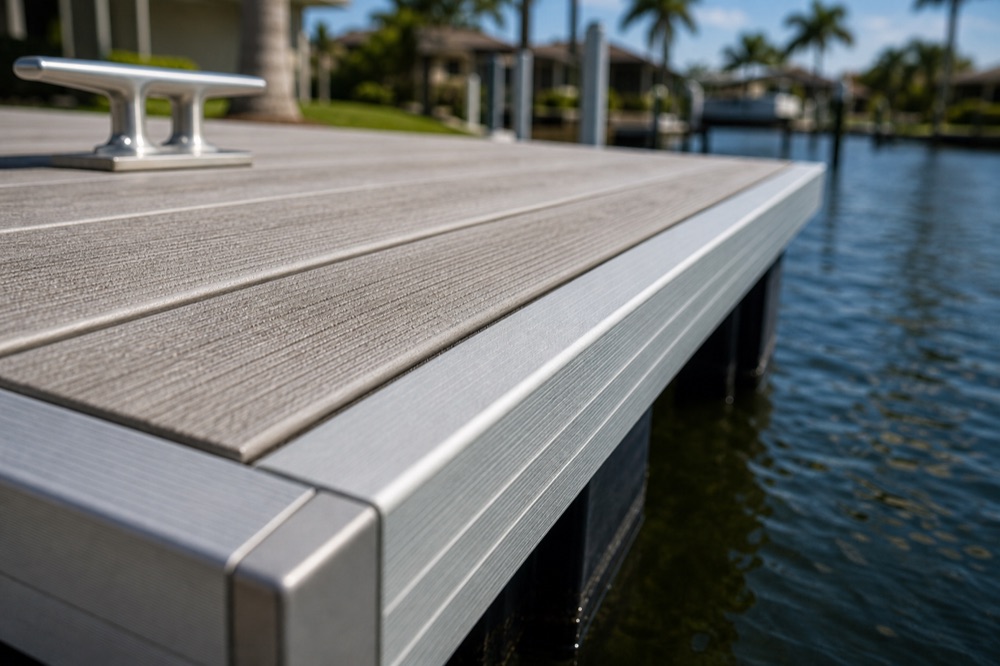
Key takeaways
- Cleats are where you tie off; bumpers and fenders are what keep the hull from grinding against the dock or a piling. A complete dock needs both.
- A long-standing rule of thumb sizes a cleat at about 1 inch of length for every 1/16 inch of line diameter — so a 1/2-inch dock line pairs with roughly an 8-inch cleat. Treat it as a starting point and confirm sizing for your boat on-site.
- Through-bolt cleats into the framing with a backing plate — lag screws into a single deck board can't handle the shock load of a boat surging against a spring line in a wake or blow.
- Place cleats so lines lead fair: bow and stern cleats plus spring-line cleats set fore and aft of the boat control surge in a canal.
- Protect the hull with the right tool for the spot — piling bumpers on the pilings, edge profiles along the dock edge, and a fender board to span between fenders on rough pilings.
Cleats, bumpers, and fenders are the unglamorous hardware that keeps your boat tied where you left it and your hull free of scuffs and gouges. They get almost no attention until a line chafes through in a blow or a poorly placed piling grinds a stripe down your gelcoat. On a Southwest Florida canal, where wakes, wind, and tide never really stop, getting this hardware right is worth the few minutes it takes to understand it.
This guide sorts out the two jobs — tying off and cushioning — and how to do each one properly. For where these fit among the rest of a dock’s outfitting, see our essential dock accessories roundup.
What cleats, bumpers, and fenders does a dock need?
A dock needs cleats to tie off to and edge protection to keep the hull from grinding against the dock or its pilings. Cleats handle the load of holding the boat; bumpers, edge profiles, and fender boards handle the contact.
Quick definitions, because the terms get muddled:
- Cleat — the metal fitting you tie a line to. Usually a horn cleat (the classic two-horned shape), sometimes a flush pull-up cleat that sits hidden until you lift it.
- Bumper / edge profile — fixed cushioning on the dock. Piling bumpers wrap the pilings; edge and corner profiles run along the dock’s edge.
- Fender — a cushion, often hung from the boat, that sits between hull and dock.
- Fender board — a plank hung horizontally to span two fenders or bridge rough, barnacle-crusted pilings so the hull rides on the board instead of the piling.
What size dock cleats do you need for your boat?
Match the cleat to your line, and the line to your boat. A long-standing rule of thumb sizes a cleat at about 1 inch of length for every 1/16 inch of line diameter — so a 1/2-inch dock line pairs with roughly an 8-inch cleat.
Treat that as a starting point rather than a hard spec. A bigger, heavier boat with more windage needs heavier lines and bigger cleats; a light skiff in a protected canal needs less. How you tie up matters too — a boat held on several well-led lines shares the load better than one snubbed hard on two. Here are the common cleat styles:
| Cleat style | Description | Best for |
|---|---|---|
| Horn (open-base) | Classic two-horn cleat, bolts to the deck | Most docks; easy to tie and inspect |
| Cast / heavy-duty | Beefier casting for bigger boats and loads | Larger vessels, exposed slips |
| Pull-up / flush | Sits flush in the deck, lifts when needed | Clean look, fewer stubbed toes |
| Piling cleat | Mounts on a piling rather than the deck | Tying off at the piling line |
Because the right size depends on your specific boat and how it sits in the slip, we confirm cleat and hardware sizing at the on-site estimate rather than guessing from a chart.
Should dock cleats be through-bolted or lag-screwed?
Through-bolted, every time, with a backing plate or large washers underneath. A boat surging against a spring line during a wake or a windy afternoon delivers a sharp shock load, and a cleat lagged into a single deck board can tear loose right when you need it most.
Through-bolting runs the fastener all the way through the decking and into — or backed against — the dock framing, spreading the load across structure instead of one board. Use 316 stainless bolts so the connection doesn’t corrode in the salt, and check them periodically; salt and cyclic loading work fasteners loose over time. This is exactly why cleats are best installed while a dock is being built, when the framing is accessible — a point we cover in essential dock accessories.
Where should cleats go on a dock?
Place cleats so every line leads fair — a straight, clean pull with no sharp angle that would chafe the line or wrench the cleat sideways. For a boat in a slip, that means cleats at the bow and stern plus spring-line cleats set fore and aft.
Spring lines are the ones that matter most in a canal. They run diagonally fore and aft to stop the boat from surging forward and back as wakes roll through and tide shifts — the motion that chews up fenders and dock edges when it’s not controlled. Good placement takes into account:
- Your boat’s length and cleat positions, so dock cleats line up for fair leads.
- Tide range, since lines need enough scope to let the boat rise and fall without going taut.
- Prevailing wind and wake direction in your canal, so the boat is held off the dock, not pinned against it.
Thinking this through is part of designing a slip that works — see our dock layout guide.
Piling bumpers, edge profiles, or fender boards — which protects your hull?
Use the one that matches where contact happens. Piling bumpers protect against the pilings, edge profiles protect along the dock edge, and a fender board bridges rough or spaced pilings so the hull never touches them directly.
- Piling bumpers wrap or mount to the pilings, cushioning the hull where it would otherwise rub bare wood or barnacles. Essential on any slip where the boat can swing into a piling.
- Edge and corner profiles run along the dock’s edge — vinyl or rubber trim that takes the scuffs so your decking and your gelcoat don’t. Corners get the worst of it, so protect them first.
- Fender boards are the old-salt solution for barnacle-crusted or widely spaced pilings: a horizontal plank hung so the boat rides on the smooth board instead of the rough piling. Simple, cheap, and very effective in a rough slip.
Cleats and cushioning are small line items that protect a big investment. Florida Lifts & Docks outfits every custom dock we build with properly sized, through-bolted hardware and the right hull protection for your slip — all in 316 stainless and marine-grade materials that hold up to the salt. For a dock built and equipped to keep your boat secure, we give free on-site estimates seven days a week from Cape Coral and Fort Myers to Naples. Call (239) 397-3400.