
Essential Dock Accessories & Upgrades for Florida Docks
The accessories that make a Southwest Florida dock safe, usable, and worth spending time on — and which ones to build in versus add later.
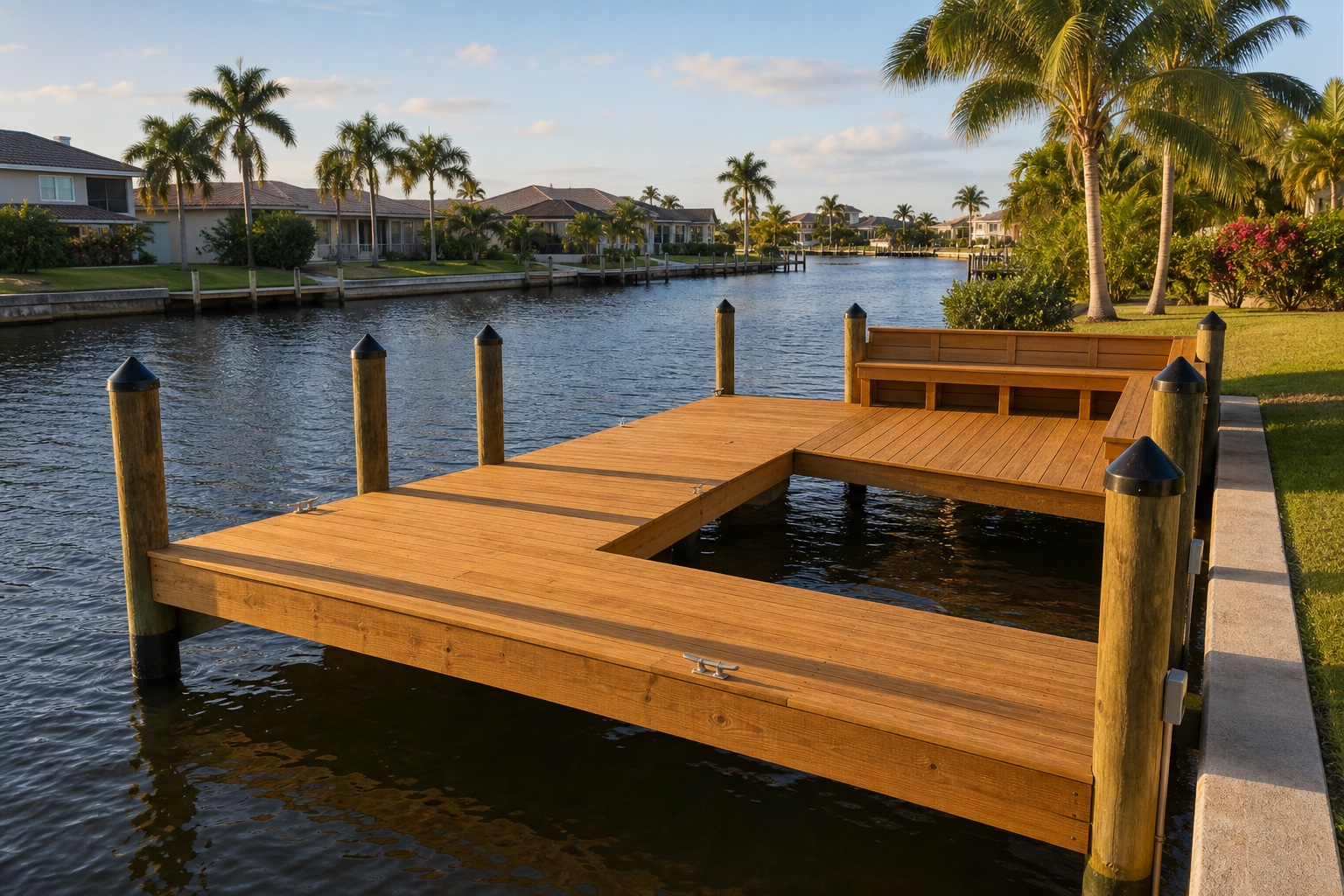
Key takeaways
- Every working Southwest Florida dock needs four basics: a safe ladder in and out of the water, solid cleats to tie off, edge protection where hull meets dock, and lighting so it's usable after dark.
- Build in anything that touches the structure — cleats, ladders, conduit for power and water, and rough-in for lighting — because retrofitting those later costs more and looks it.
- Save the plug-and-play items for whenever: fenders, a dock box, decoys, and most storage racks bolt on any time.
- In salt, spec matters more than the accessory itself — 316 stainless hardware, marine-grade aluminum, and UV-stable poly outlast the bargain versions by years.
- Accessories aren't in our dock configurator; we quote them free on-site so the number fits your dock and how you use the water.
A great dock is more than a platform over the water — it’s the sum of the small details that make it safe to walk, easy to tie up to, and genuinely pleasant to spend an evening on. On a Southwest Florida canal, where salt, UV, barnacles, and hurricane season test everything, the right accessories are what separate a dock you tolerate from one you actually love.
This guide walks through the upgrades that matter most on our coast — from the ladder and cleats you’ll touch every trip to the lighting, shade, and utilities that make a dock feel finished. Just as important, it covers which accessories to build in from day one and which to add down the road, so you spend where it counts.
What accessories should every Southwest Florida dock have?
At minimum, every working dock here needs a safe way in and out of the water, solid points to tie off, protection where the hull meets the dock, and light so it’s usable after dark. Everything past those basics is about how you personally use the water.
Here’s the full menu, from the four essentials to the upgrades that make a dock an outdoor room:
- A dock ladder — the safe exit from the water, sized to reach below the low-tide line. See our dock ladder guide.
- Cleats, bumpers, and fenders — where you tie off and where the hull is cushioned from the dock. See our cleats, bumpers, and fenders guide.
- A dock box — dry, lockable storage for lines, fenders, and safety gear. See our dock box buying guide.
- A power and water pedestal — freshwater washdown, shore power, and dedicated circuits for a lift and lights. See our dock utilities guide.
- A fish-cleaning station — a sanitary spot to clean the day’s catch. See our fish-cleaning station guide.
- Shade — a tiki hut, pergola, or covered section that makes the dock livable in July.
- Lighting — dock lights for safe footing and ambiance, plus underwater fish lights that draw bait and snook after dark.
- Small-craft storage — a jet-ski lift or a floating dock for kayaks, paddleboards, and PWCs.
Which dock accessories are safety must-haves?
Four accessories are non-negotiable: a ladder, secure cleats, edge protection, and lighting. They’re what keep people out of trouble around moving boats, deep water, and dark decking.
A ladder is the one accessory a dock should never skip. Our tides swing enough that a swimmer or someone who’s gone overboard needs a fixed way up even at low water, and a good ladder reaches a couple of rungs below the low-tide line so there’s always a foothold. A flip-up stainless model keeps the submerged rungs cleaner between uses — the details are in our dock ladder guide.
Cleats only do their job if they’re through-bolted into the dock framing rather than lag-screwed into a single board, because a spring line snubbing a boat against a wake load puts real shock on that hardware. Pair them with bumpers or fenders so the hull never grinds against the dock edge or a piling. Our cleats, bumpers, and fenders guide covers sizing and placement.
Lighting is a safety item as much as an aesthetic one — post and recessed deck lights keep footing visible on a wet dock at night. And because anything electrical over salt water demands care, dock circuits should be GFCI-protected and installed by a licensed electrician. If you’ve ever felt a faint tingle in the water near a dock, read our guide on dock electrical safety and electric shock drowning — it’s the one hazard on this list that can’t be seen coming.
Which upgrades make a dock more usable day to day?
Storage, utilities, a cleaning station, and shade turn a dock from a parking spot into a place you want to be. These are the accessories owners tell us they use the most once they have them.
- A dock box keeps lines, fenders, life jackets, and cleaning supplies dry, out of the sun, and off the deck. Poly or fiberglass both work here if they’re UV-stable — see our dock box guide.
- A power and water pedestal is the quiet game-changer. Freshwater at the dock means you rinse salt off the boat, the lift, and yourself every trip; power runs the lift, lights, and a phone charger. Our dock utilities guide explains what to run and when.
- A fish-cleaning station gives you a sanitary poly surface, a water supply, and drainage so you’re not cleaning fish on the tailgate. Placement matters — downwind and away from the neighbors, with a plan for the birds it attracts (our keeping birds off your dock guide helps). Full details in our fish-cleaning station guide.
- Shade is what makes a dock usable in a Southwest Florida summer. A tiki hut or covered section over part of the dock drops the temperature and the UV enough to actually sit out there at midday.
- Small-craft storage keeps kayaks, paddleboards, and jet skis out of the water and off the seawall. A jet-ski lift protects a PWC from barnacles and blistering, and a floating dock makes a stable launch for paddle craft.
Which accessories add the most curb appeal and value?
Lighting and clean, well-finished details do the most visible work. A well-lit dock reads as high-end from both the house and the water, and thoughtful finishes signal a dock that’s been built and cared for properly.
Dock lighting is the highest-impact upgrade for appearance — a lit dock and captain’s walk turn into an evening destination and a striking view from inside the home. Underwater fish lights add a glowing green signature to the water and a nightly show of bait and game fish. Beyond light, the decking itself carries a lot of the look; a cool-underfoot, low-maintenance surface finishes the whole structure (our dock decking materials guide breaks down the options for this climate).
Owners often ask whether these upgrades pay off at resale. A well-built, well-equipped dock is a genuine selling point on a Southwest Florida waterfront home — we cover the nuances in does a dock add home value in Florida. What we won’t do is put a number on it; value depends on your home, your waterway, and the buyer.
Should you build accessories in or add them later?
Build in anything that touches the structure or runs a utility; leave the plug-and-play items for whenever. The dividing line is simple — if adding it later means opening up decking, drilling pilings, or trenching for conduit, do it during construction. If it just bolts or sets on top, there’s no rush.
A full custom dock in our configurator runs roughly $22,000–$30,000 for a single-slip dock, $32,000–$44,000 for a captain’s walk, $46,000–$62,000 for a multi-slip dock, and $68,000+ for an estate dock. When accessories are scoped into that build — cleats through-bolted to the framing, a ladder, a pad for a dock box, conduit for power and water, and rough-in wiring for lights — they’re folded into the structure instead of bolted on afterward. Our custom dock cost guide has the full breakdown of what drives those numbers. Accessories added on their own aren’t in that configurator, so we quote them free on-site and price them to your dock and how you use it.
Here’s the quick call on what to build in versus retrofit:
| Accessory | Build in during construction | Fine to retrofit later |
|---|---|---|
| Cleats | Yes — through-bolted into framing | Possible, but weaker if surface-mounted |
| Ladder | Yes — clean mount, correct depth | Yes, with proper backing |
| Power & water pedestal | Yes — conduit and lines run in/along pilings | Costly — surface conduit, more labor |
| Lighting | Rough-in wiring at build time | Yes — see our retrofit guide |
| Fish-cleaning station | Yes if it shares the water/power run | Yes |
| Dock box | No need | Yes — sets on the deck |
| Fenders & bumpers | Optional | Yes — bolt or hang any time |
| Shade / tiki hut | Best if pilings are planned for the load | Sometimes — depends on structure |
If you already have a dock and want to add lighting after the fact, our guide on adding dock lighting to an existing dock shows how we run it cleanly without a full rebuild. Accessories are the last of the calls, though, not the first. The complete SW Florida custom docks guide works down to them from the use case, the shape and the piling field.
How do you choose the right accessories for your dock?
Start with how you actually use the water, not with a catalog. An angler prioritizes a fish-cleaning station, fish lights, and rod storage; a family prioritizes a wide ladder, shade, and safe lighting; a paddler wants a floating launch. Match the accessories to your real routine and you avoid paying for a dock full of things you never touch.
From there, the two rules that matter most on this coast are: build in what touches the structure, and spec everything for salt — 316 stainless, marine-grade aluminum, and UV-stable poly. Get those right and the accessories last as long as the dock.
Ready to make your dock genuinely yours? Florida Lifts & Docks has designed, permitted, and built custom docks across this coast since 2008, with our own local crew and a 5.0-star reputation. We give free on-site estimates seven days a week from Cape Coral and Fort Myers down to Naples and Marco Island. Tell us how you use the water and we’ll spec the accessories to match — call (239) 397-3400.