
Dock Decking Materials in Florida: Composite, PVC, Aluminum, Ipe & Marine Wood Compared
Capped composite, PVC, aluminum, ipe, and marine wood compared head to head for Southwest Florida docks — lifespan, heat, salt, slip, and installed cost, plus what we actually build with.
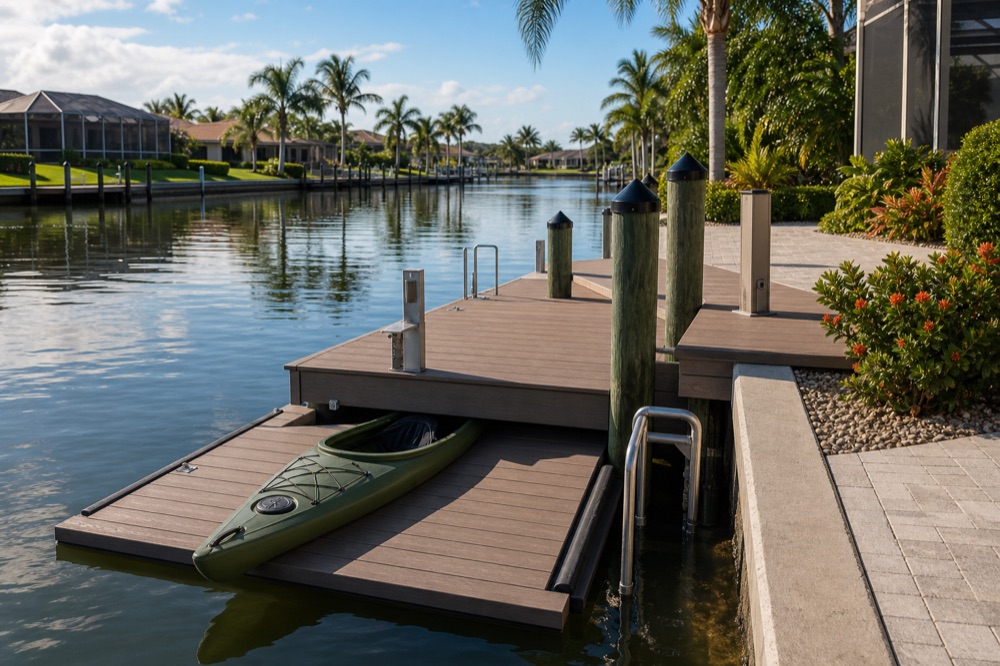
Key takeaways
- For most SW Florida saltwater docks we build with capped composite (TimberTech/Trex) on CCA-treated framing with 316 stainless fasteners — it's the best balance of lifespan, heat, salt resistance, and look.
- PVC/vinyl is the most heat- and stain-resistant and the lightest; aluminum is the most fireproof and dimensionally stable but the hottest underfoot.
- Ipe and tropical hardwoods are gorgeous and dense but need oiling and cost the most; pressure-treated marine wood is cheapest up front and shortest-lived in salt.
- The framing and fasteners under the deck matter as much as the surface — salt destroys cheap hardware first.
- Surface color drives barefoot comfort more than material brand; pick the lightest tone you like.
Decking is the part of your dock you actually live on. It’s the surface your bare feet hit on the walk out to the boat, where your guests stand at sunset, and the layer that takes the full daily beating of Southwest Florida salt, sun, and summer storms. Pick the right material and you forget about it for decades. Pick the wrong one and you’re sanding splinters, re-staining every year, or hopping across boards that are too hot to stand on by 10 a.m.
There are five materials worth talking about on our coast: capped composite, PVC (vinyl), aluminum, ipe and tropical hardwoods, and pressure-treated marine wood. This is the full decision framework — how each one actually holds up to a saltwater canal in Cape Coral, Fort Myers, Naples, and up into Charlotte Harbor — plus a straight answer on what we build with and why.
What does “dock decking material” actually mean?
Dock decking is the walking surface fastened across the top of your dock frame — the boards you see and stand on, as opposed to the pilings, stringers, and framing underneath. It’s the single biggest driver of how your dock looks, how comfortable it is barefoot, how much maintenance it demands, and how long it lasts before it needs replacing. Everything below the deck (the framing and fasteners) matters too, but the decking is the part you interact with every day, so it’s where the material decision counts most.
How do the five dock decking materials compare?
The short version: for most Southwest Florida docks, capped composite wins on overall value, with PVC close behind. Here’s how all five stack up across the factors that actually matter on a saltwater canal.
| Lifespan (SW FL salt) | Surface heat | Salt / UV resistance | Submersible (surge) | Slip resistance | Installed cost | |
|---|---|---|---|---|---|---|
| Capped composite (TimberTech/Trex) | Decades | Low–moderate (color-dependent) | Excellent | Yes | Good (textured cap) | $$$ |
| PVC / vinyl | Decades | Low (lightest colors) | Excellent | Yes | Good | $$$ |
| Aluminum | Decades | High (gets very hot) | Excellent | Yes | Good (ribbed/powder-coat) | $$$–$$$$ |
| Ipe / tropical hardwood | Long with care | Moderate–high (dark) | Very good, needs oiling | Yes (absorbs water) | Good when clean | $$$$ |
| Pressure-treated marine wood | Shortest in salt | Moderate (dark stain hotter) | Fair, needs sealing | Survives, but absorbs | Good when clean | $ |
Cost shown as relative tiers because dock decking is quoted as part of the whole build, not by the board. Your real number depends on dock size and layout, framing, and site access — we give you a firm figure on a free on-site estimate. (For the full breakdown of what a dock costs, see our custom dock cost guide.)
Why do we build with capped composite?
Capped composite is our default recommendation, and it’s what goes on the majority of the docks we build. It’s a wood-fiber-and-polymer core wrapped in a hard polymer “cap” that does the heavy lifting against salt, sun, and moisture.
Here’s why it earns the spot:
- It ignores our climate. Relentless UV, salt-laden air, and high humidity are exactly what destroy lesser materials. The cap won’t rot, splinter, or fade the way wood does.
- Zero annual maintenance. No sealing, no staining, no sanding. A rinse and the occasional wash keeps it looking new. (Here’s how to clean composite dock decking in saltwater.)
- It survives submersion. When a storm surge briefly puts your deck underwater during hurricane season, composite doesn’t care — it doesn’t soak up water and warp.
- The look and feel hold up. Modern capped boards from brands like TimberTech and Trex have realistic grain and a solid, substantial feel underfoot, not a hollow plastic one.
- Cooler in the right color. Quality caps are engineered to reflect heat, and a lighter board stays comfortable for bare feet most of the day.
The one honest trade-off is up-front cost — composite costs more than pressure-treated wood at install. But you skip a yearly maintenance bill and replace it far less often, so it usually costs less over the life of the dock. If you want the deeper two-way breakdown, we wrote a whole post on composite vs. wood docks.
When does PVC, aluminum, or hardwood make more sense?
Capped composite is the right call most of the time, but not every time. Each of the other materials has a situation where it pulls ahead.
PVC / vinyl decking is fully synthetic — no wood fiber at all — which makes it the lightest option and the most resistant to heat, stains, and mold. It’s an excellent pick if barefoot comfort in peak summer sun is your top priority, or if you want to keep deck weight down on a long captain’s walk. The trade-off is that it can look and sound a little more “plastic” than composite, and the very best PVC lines aren’t cheap.
Aluminum decking is the most fireproof and dimensionally stable material on the list. It won’t rot, warp, swell, or burn, it sheds water through the gaps between planks, and powder-coated marine aluminum laughs off salt. The catch is heat: bare aluminum in direct Florida sun gets hot, so it’s better suited to shaded docks, boathouse interiors, or owners who’ll always be in shoes. It also reads more industrial than natural.
Ipe and tropical hardwoods are the premium natural look — extraordinarily dense, beautiful, and tough enough to resist marine borers far better than softwoods. If you want real wood and you’re willing to maintain it, ipe is the top of that category. The honest trade-offs: it’s the most expensive material here, it needs periodic oiling to keep its rich color (let it go and it weathers to gray), and the dark tone holds more heat.
If staying cool barefoot is your single biggest concern, we go deeper on that in the best dock decking that stays cool barefoot in Florida. Decking is one chapter of a much longer decision: the complete SW Florida custom docks guide runs from use case and shape through pilings, permits and the lift.
Is pressure-treated marine wood still worth it?
It can be — if budget is the deciding factor and you accept the maintenance. Pressure-treated marine wood is the lowest-cost decking up front and gives you a genuine wood deck for less than any synthetic.
But our coast is hard on it. Here’s the reality:
- It’s the shortest-lived option in salt and sun. UV grays it, moisture cycles it, and over time it cups, checks, and can rot at the fasteners.
- It demands ongoing upkeep. To get a long life you have to seal or stain it on a schedule. Skip a year on a saltwater canal and it ages fast.
- Splinters and movement are part of the deal. As it weathers, the surface roughens — not ideal for bare feet and kids.
The piece people miss is that the framing under almost every dock we build is pressure-treated wood — specifically CCA-treated marine-grade lumber, which is rated to survive in the water and resist marine borers. That’s a different job than the walking surface. Using a tough treated frame under a composite or PVC deck gives you the best of both: a structure built to last in salt, topped with a surface that doesn’t need babysitting.
What goes under the deck matters as much as the surface
Whatever you choose up top, the deck is only as good as what holds it down. Salt water destroys cheap hardware first — and a beautiful composite deck on rusting fasteners and a failing frame won’t make it. That’s why our spec under every deck is the same:
- CCA-treated marine-grade framing rated for saltwater service
- 316 stainless fasteners and hardware that won’t streak, bleed rust, or fail in salt air
- Proper joist spacing so boards don’t sag or flex underfoot
This is also why redecking an old dock isn’t always a simple board swap — if the framing or pilings are tired, you fix those first. (If you’re staring at soft, graying boards, our dock repair team can tell you on-site whether you need a re-deck or a rebuild.)
So which decking should you choose?
For most Southwest Florida waterfront homes, our recommendation is capped composite on a CCA-treated frame with 316 stainless fasteners — it’s the best balance of decades-long life, low heat in a light color, total salt and UV resistance, and a look that fits a high-end coastal home. Step up to PVC if heat and weight are your top concerns, choose aluminum for shaded or boathouse decks where fireproof and bombproof matter more than barefoot feel, go ipe if you want real wood and will maintain it, and pick pressure-treated wood only when up-front budget rules and you’re committed to the upkeep.
The truth is the right answer depends on your dock — its size, its sun exposure, how you’ll use it, and your budget. We’ve built every one of these in this climate, so we can show you real boards, talk through the trade-offs for your specific canal, and give you a firm number with no surprises.
Ready to plan your deck? Explore everything we build on our custom docks page, and we’ll come out for a free on-site estimate seven days a week across Cape Coral, Naples, Fort Myers, and the rest of the coast. Call (239) 397-3400 and let’s get your dock right.