
How Much Does It Cost to Replace Dock Pilings in Southwest Florida?
Why there's no honest flat price for dock piling replacement on the SW Florida coast, the factors that actually move the number, and when to sister versus replace.
Key takeaways
- There's no honest flat per-piling price — cost depends on material, driven depth, canal-bottom substrate, equipment access, how many pilings, and whether the dock has to come up to reach them.
- One failing piling isn't a one-piling problem; it shifts its load onto its neighbors, so what looks like a single repair often becomes a system-wide job if you wait.
- Sistering or wrapping can extend a sound-but-aging piling, but a rotted, hollowed, or storm-loosened piling needs full replacement — patching it just delays the inevitable.
- Access is often the biggest hidden cost: a tight canal with no barge room or a piling buried under a finished dock costs far more to reach than open water.
- The only honest number comes from an on-site look. Florida Lifts & Docks gives free on-site estimates seven days a week — call (239) 397-3400.
When a dock piling starts to lean, rot at the waterline, or wobble after a storm, the first thing every owner wants is a number. It’s a fair question — pilings are the most expensive structural part of a dock, the part holding up your decking, your boat lift, and everything you’ve parked on it. But the honest answer to “what does it cost to replace a dock piling?” is the one no calculator will give you: it depends, and on more than you’d think.
That’s not a dodge. It’s the difference between a marine contractor who’s actually looked at your canal and one quoting you a fake flat rate over the phone. Below is exactly what drives the price of replacing dock pilings in Southwest Florida, when you can repair instead of replace, and why one failing piling is rarely a one-piling problem.
What is a dock piling, and why do they fail here?
A dock piling is the vertical structural post — wood, concrete, or composite — driven deep into the canal or bay bottom to carry the entire load of your dock and lift. Everything else (decking, framing, hardware) hangs off the pilings. When a piling fails, it’s not a cosmetic issue. It’s the foundation going soft.
In Southwest Florida, pilings live a brutal life. They sit in warm saltwater 365 days a year, get hammered by tide swings and boat wakes, bake in UV above the waterline, and face storm surge and wave loading every hurricane season from June through November. Three things take them out:
- Marine borers. Shipworms and other organisms tunnel into untreated or worn wood from the inside, hollowing a piling that still looks fine on the surface. By the time you can see damage, the inside is often gone.
- Rot and weathering at the splash zone. The waterline — wet, then dry, then wet again — is where wood pilings deteriorate fastest.
- Storm loading. Surge and wave action push, lift, and twist pilings until they lean, loosen in their seats, or snap.
Because all three are constant on the Gulf coast, piling replacement is one of the most common projects we handle. Our full breakdown of materials lives in our guide on wood vs. concrete vs. composite pilings.
What actually drives the cost of replacing dock pilings?
There’s no honest flat per-piling price — the cost is set by your specific site and material, not a menu. Here are the factors that move the number, roughly in order of impact.
Material. CCA-treated wood, concrete, and composite/fiberglass all carry different price points and lifespans. Wood is the most common and most economical up front; concrete and composite cost more but shrug off borers and rot. The right call depends on your water, your budget, and how long you want to forget the piling exists.
Driven depth and canal-bottom substrate. Pilings have to be driven to refusal — far enough to hit firm bearing so they don’t settle or wander. Southwest Florida bottoms range from soft, deep muck along parts of the Caloosahatchee to hard caprock closer to the Gulf. Soft bottom means longer pilings driven deeper; hard rock can require pre-drilling. The bottom under your dock directly changes material length and equipment time. We cover this in how deep should dock pilings be driven.
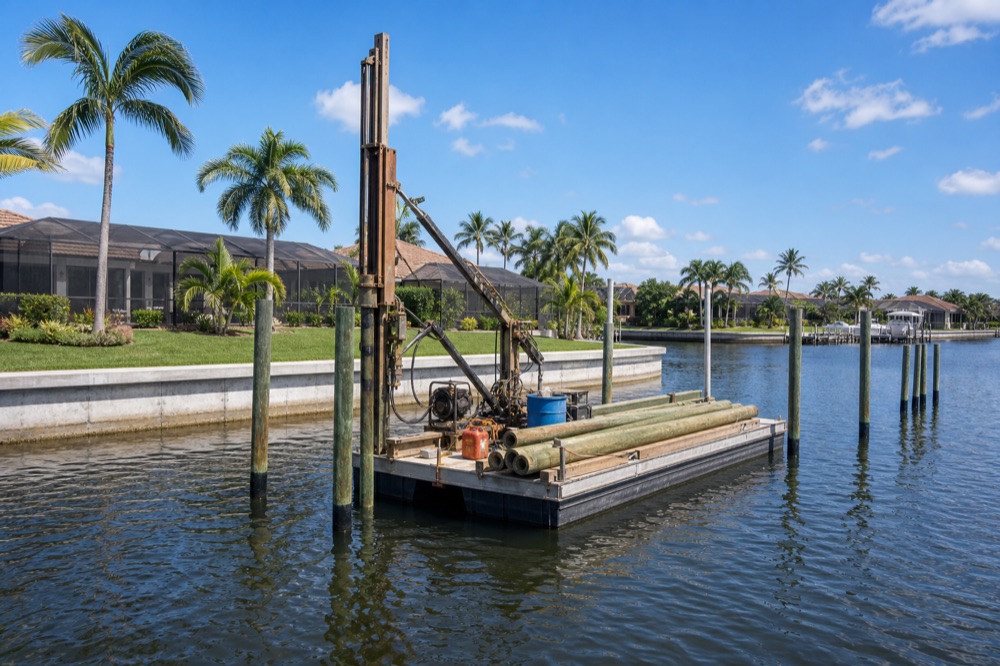
Equipment and barge access. This is the hidden cost that surprises people most. An open-water site we can reach from a barge or the seawall is straightforward. A narrow canal with no room to maneuver, a low bridge between us and your dock, or shallow water at low tide all complicate the rig — and that shows up in the price.
How many pilings. One piling is a service call. A full row under a long captain’s walk is a project. Volume changes mobilization, equipment time, and how we sequence the work.
Whether the dock has to come up. A piling on the outside edge of an open dock is easy to reach. A piling buried under finished decking means we may have to remove and reset boards to pull and re-drive it — added labor on both ends. If your decking is already aging, this is sometimes the moment to consider re-decking at the same time.
Because every one of these varies house to house, we don’t quote pilings sight-unseen. We give a free on-site estimate and price the actual job. See everything we do with dock pilings.
Should you repair (sister) a piling or replace it?
The short answer: repair when there’s enough sound material left to save, and replace when there isn’t. Patching a piling that’s already gone just hides the failure until a worse time.
Here’s how the two approaches compare:
| Approach | When it makes sense | What it doesn’t fix |
|---|---|---|
| Sister / wrap / reinforce | Piling is solid below the waterline and only weathered or worn on top; minor surface damage | A piling that’s rotted through, hollowed by borers, leaning, or loose in its seat |
| Full replacement | Piling is hollow, snapped, leaning, storm-loosened, or at the end of its service life | Nothing — it resets the foundation, but costs more than a repair when repair was an option |
Wrapping can genuinely extend the life of an aging-but-sound piling and is worth doing in the right case. The mistake is wrapping a piling that’s already hollow inside — you’ve spent money to make a failing post look fixed. The honest move is to assess what’s actually left of the wood before deciding, which is exactly what we do on-site. For storm-specific damage, see leaning or loose dock piling after a storm.
Why is one failing piling rarely a one-piling problem?
Because pilings share the load. When one piling weakens, the weight it was carrying doesn’t disappear — it transfers to the pilings on either side, which were never designed to carry extra. This is the single biggest reason a “just one piling” call turns into a larger job.
Think of it like a row of posts holding up a beam. Pull one, and its neighbors take the strain. They flex more under boat-lift load, work harder against every wake, and deteriorate faster. Wait long enough and you don’t have one failed piling — you have three, plus a dock that’s been quietly overstressed the whole time. The hidden cost of waiting is real:
- A single replacement done early is the cheapest version of this job.
- The same problem ignored for a season becomes a multi-piling replacement.
- A weak piling that fails during a storm can take the dock, the lift, and the surrounding pilings with it — turning a repair into a full rebuild and an insurance claim.
This is why we’d rather look early. Catching one piling before it overloads its neighbors is the difference between a focused fix and a full dock repair.
Two real decision scenarios
Scenario one: a single leaning piling after a blow. A summer storm pushes one outer piling out of plumb, but it’s still solid wood and sitting in firm bottom. The dock decking is open on that edge. This is close to a best case — often a single re-drive or replacement, reachable without tearing up the dock. Handled now, it stays a small job. Left alone, that lean lets the piling work loose, and the next storm finishes it.
Scenario two: system-wide rot under a captain’s walk. An older wood dock shows soft, weathered pilings at the waterline up and down the run, and a couple sound hollow when tapped. Several are buried under finished decking. This is a full-row replacement: more material, more equipment time, boards up and reset, and a real decision about whether to switch to concrete or composite while everything’s exposed. It costs more — but trying to save it one piling at a time would cost more still, because the neighbors keep failing.
Same question — “what does it cost to replace dock pilings?” — two completely different answers. That’s why the number has to come from your dock, not a chart.
Why does Florida Lifts & Docks quote pilings free on-site?
Because it’s the only honest way to give you a real number. Piling cost hinges on what’s under the water and behind the decking — substrate, depth, access, count, and the actual condition of each post — and none of that is visible from a phone call. A flat quote over the phone is either padded to cover the contractor’s risk or lowballed to win the job and changed later.
Since we were established in 2008, we’ve built and replaced pilings up and down the SW Florida coast — Cape Coral’s canal network, the Caloosahatchee, Charlotte Harbor, and the barrier islands — with our own local crew that we never sub out, and we handle permitting in-house. That means the person estimating your job is the person who understands your canal, and the price you’re quoted is the price for the work that’s actually needed.
If you’ve got a piling that’s leaning, rotting, hollow-sounding, or loose after a storm, don’t wait for it to overload its neighbors. We give free on-site estimates seven days a week across Cape Coral, Fort Myers, Punta Gorda, and the rest of the coast. See what we do with dock pilings, learn about dock repair, or call (239) 397-3400 and we’ll come take a look.