
How Long Do Dock Pilings Last in Florida Saltwater?
Honest lifespan ranges for wood, concrete, and composite dock pilings on SW Florida salt canals — why warm, high-salinity water shortens the clock, and the maintenance levers that add years.
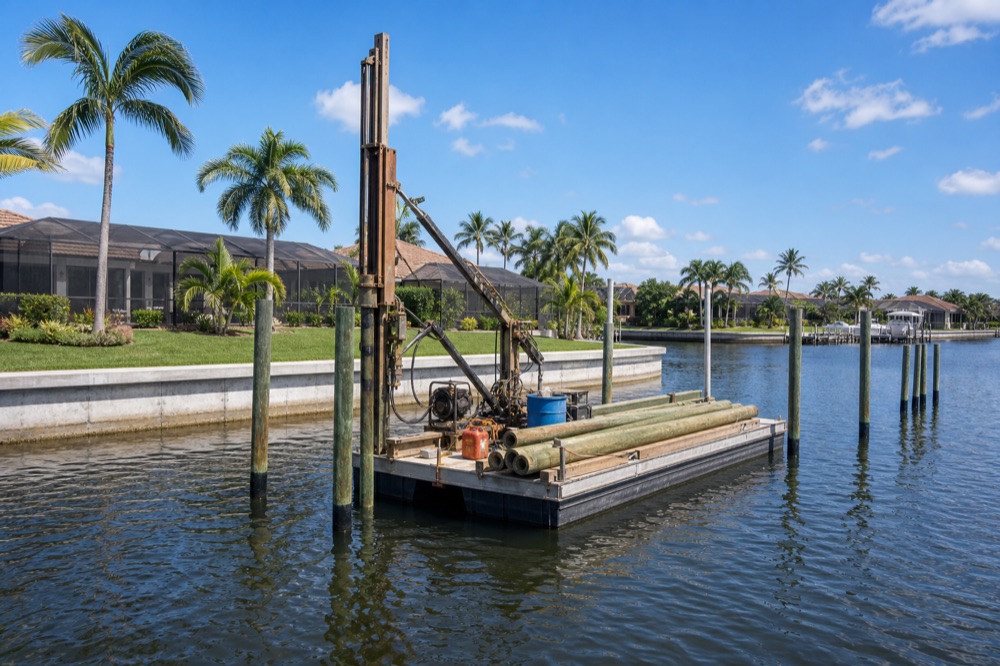
Key takeaways
- On a SW Florida salt canal, unwrapped wood pilings can fail in just a few years, properly wrapped 2.5 CCA wood lasts decades, and precast concrete commonly runs 50+ years; composite lasts decades with essentially zero upkeep.
- Warm, high-salinity canal water accelerates marine-borer attack — shipworms and gribbles stay active year-round here, so wood degrades far faster than it would in a cool northern lake.
- The single biggest lever on wood-piling life is a marine wrap below the waterline; the second is 316 stainless hardware that won't corrode and work the post loose.
- Inspect pilings yearly and after every named storm — a soft spot, a lean, or a loose post caught early is a repair, not a full replacement.
- Driven depth and bearing matter as much as material; a piling set short fails years early no matter what it's made of.
Your whole dock — the decking, the walkway, and the boat lift hanging off the side — stands on its pilings. So “how long do dock pilings last?” isn’t an idle question; it’s the difference between a foundation you can forget about and one that fails right when a hurricane finds the weak post. The honest answer is a range, and it swings wildly: from a few years for the wrong material to half a century for the right one.
Here’s what we actually see across Southwest Florida’s salt canals — the Caloosahatchee feeders, the Cape Coral spreader system, and Charlotte Harbor basins — broken down by material, why the water here is so hard on pilings, and the levers that add years.
What is a dock piling, and how long does it last?
A dock piling is the vertical post driven deep into the canal or bay bottom that carries the load of your dock, walkway, and lift. On a SW Florida salt canal, lifespan ranges from just a few years for unprotected wood to 50-plus years for concrete — the material, and whether wood is wrapped, decide where you land.
The post lives in three brutal zones at once: above water it fights UV and heat, at the waterline it takes a relentless wet-dry cycle, and below the surface it faces the real enemy here — marine borers. How well it survives all three comes down to what it’s made of and how it’s protected.
How long does each piling material last in saltwater?
On a full-salinity canal, plan on a few years for unwrapped wood, decades for wrapped 2.5 CCA wood, decades for composite, and 50-plus years for precast concrete. The ranges are wide because protection and install quality move the number as much as the material.
| Piling material | Typical life (SW FL salt canal) | Why |
|---|---|---|
| Unwrapped wood | A few years to ~15 | Borers attack the bare post below the waterline and hollow it out |
| Wrapped 2.5 CCA wood | Decades | Marine wrap seals out borers and the wet-dry cycle; needs upkeep |
| Composite / fiberglass | Decades, very long | Borer-proof and rot-proof; essentially zero maintenance |
| Precast concrete | Often 50+ years | Immune to borers; shrugs off the waterline cycle |
A few things worth knowing:
- Unwrapped wood is a gamble here. “2.5 CCA” pressure treatment (2.5 pounds of preservative per cubic foot — far heavier than fence wood) slows the attack but doesn’t stop borers in full salinity. Bare treated wood can look fine while it’s hollow inside.
- Wrapped wood is the value workhorse, while concrete and composite are borer-immune entirely — which is why they top the chart. For the full material breakdown, see our wood vs. concrete vs. composite pilings guide.
Why does SW Florida saltwater shorten piling life?
Because the water here is warm and salty year-round, and that’s exactly what marine borers want. A wood piling on a Gulf-coast canal ages far faster than the same post in a cool northern lake.
The number-one piling killer is marine borers — shipworms and gribbles. Shipworms are saltwater mollusks that tunnel into submerged wood and eat it from the inside; gribbles are tiny crustaceans that chew the surface into a honeycomb. Up north, cold winters slow them to a crawl. On the Caloosahatchee and Charlotte Harbor canals, the water rarely cools enough to stop them, so they feed nearly year-round — and full salinity means peak borer pressure.
The rest of the SW Florida environment stacks on top:
- The wet-dry waterline band that’s wet at high tide and dry at low takes the worst beating, while eight months of brutal UV degrade exposed wood and bleach its sealants.
- Storm-season surge. Hurricane season runs June through November, and surge shoves sideways on every post — and the failure point is almost always the piling already weakened by borers.
- Galvanic corrosion at the hardware. Cheap fasteners rust out and let a sound piling work loose, which is why we use 316 stainless throughout.
How do you make dock pilings last longer?
More than the material, lifespan comes down to things you control: protect the wood, use the right hardware, drive to the right depth, and inspect on a schedule. Catching a soft spot early is the difference between a repair and a full rebuild. A few non-negotiables, then a simple cadence:
- Wrap the wood. A marine wrap below the waterline is the single biggest lever on wood-piling life — without it, even 2.5 CCA wood is on the clock. More in our marine borers and wrapping guide.
- Use 316 stainless hardware. The wrong metal corrodes away and loosens an otherwise-sound post. Depth matters just as much — a piling driven short leans years early no matter the material (how deep they should go).
- Inspect yearly, and after every named storm. Push on each piling and check the waterline for a lean, a loose post, soft “punky” wood you can sink a screwdriver into, gribble honeycombing, or rust-stained fasteners.
- Address one bad piling now. A failing post throws extra load onto its neighbors — a targeted dock repair on one or two pilings is far cheaper than waiting until several go.
When the damage is widespread — multiple leaning posts, hollowed wood, or failing hardware throughout — replacement is the smart spend. A rebuild with the right material, proper depth, and 316 stainless hardware resets the clock for decades, and rolls naturally into any custom dock plans you’ve been putting off. For how that’s priced, see our dock piling replacement cost guide.
When age finally catches up
Eventually every wood piling reaches the end of its run, and on a heavy-salt canal an unprotected post gets there fast. But age alone isn’t a verdict. A wrapped piling with sound hardware can outlast a neglected one by decades, and concrete can outlive nearly everything around it. Condition is what matters, not the calendar.
The only way to know whether yours have ten more years or are quietly hollow is to have someone who builds these for a living put eyes — and a screwdriver — on them. Florida Lifts & Docks has driven, wrapped, and replaced pilings across Southwest Florida since 2008 with our own local crew (never subbed), in-house permitting, and a 5.0-star rating on Google. See our pilings page, explore Cape Coral, Punta Gorda, and Naples, or grab a free on-site estimate seven days a week. Call (239) 397-3400.