
Dock Utilities: Power Pedestals & Water on Your Dock
What power pedestals and hose bibs add to a private Florida dock — washdown, shore power, lift and light circuits — plus GFCI safety and build-in vs. retrofit.
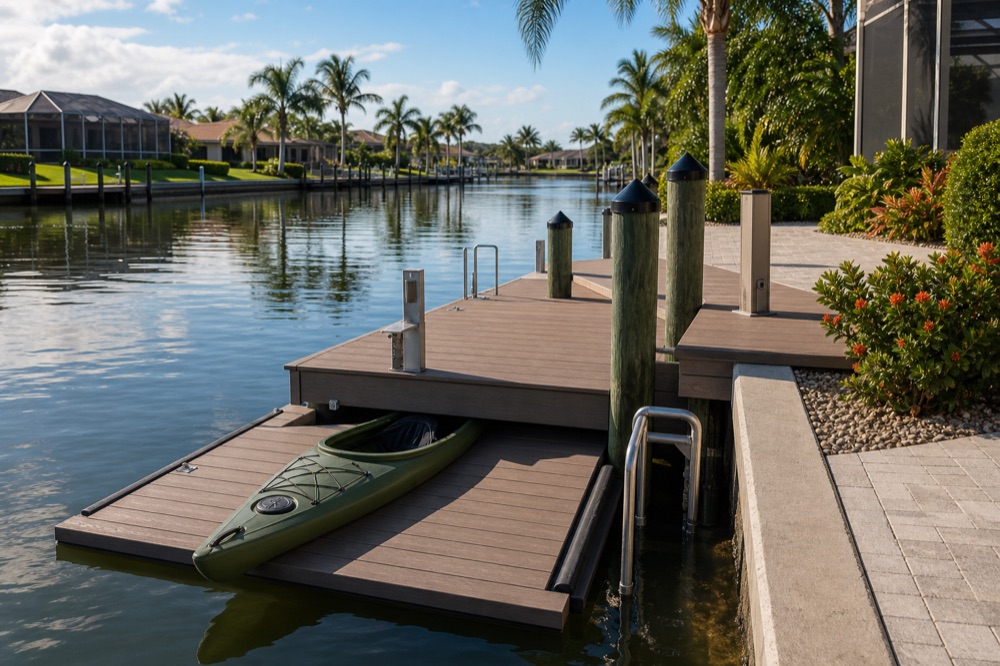
Key takeaways
- Power and water on a dock unlock the daily essentials: a freshwater washdown to rinse salt off the boat and lift, shore power for the boat, and dedicated circuits for a boat lift and dock lighting.
- A dock power pedestal bundles it into one weatherproof post — breaker, GFCI outlets, and often a hose bib and a light — right where you need it.
- Any dock electrical must be GFCI/ELCI-protected, properly bonded, and installed by a licensed electrician; stray current over salt water is a life-safety issue, not a convenience one.
- Run utilities while the dock is being built — conduit and water lines in or along the pilings — because retrofitting later means surface conduit and far more labor.
- Electrical and plumbing work on a dock typically needs permits and inspection; requirements vary by city and county, so confirm locally before you start.
Power and water are what turn a dock from a place you tie up into a place that works. A freshwater spigot means you rinse the salt off your boat, your lift, and yourself every single trip; a power pedestal means the lift runs, the dock lights come on, and shore power keeps the boat’s batteries topped without a tangle of extension cords from the garage. On a Southwest Florida canal, where salt is trying to destroy everything the moment you leave, that washdown alone pays for itself.
This guide covers what dock utilities enable, how a power pedestal packages them, the electrical safety that’s non-negotiable over salt water, and why it’s so much easier to run all of this while the dock is being built. It’s one part of fully outfitting a dock — see our essential dock accessories guide for the rest.
What do power and water on a dock let you do?
They unlock the day-to-day essentials of waterfront ownership: rinsing salt off your gear, powering a boat lift and lights, and plugging the boat into shore power. Each one is a small thing you’ll use constantly.
Here’s what utilities at the dock actually get you:
- Freshwater washdown — a hose bib to rinse salt off the hull, the boat lift, the deck, and your hands after every outing. This is the single biggest thing you can do to extend the life of everything on the water.
- Shore power for the boat — keep batteries charged and onboard systems running without hauling cords from the house.
- A dedicated boat-lift circuit — power to run the lift reliably instead of borrowing from a distant outlet.
- Dock and fish lighting circuits — clean power for dock lights and underwater fish lights, wired to last in the salt.
- Convenience power — an outlet for a pressure washer, a phone charger, or tools while you work on the boat.
What is a dock power pedestal?
A dock power pedestal is a weatherproof post that brings electricity — and often water and a light — out to your dock in one tidy place. Instead of separate runs and improvised cords, you get a single unit with a breaker, GFCI-protected outlets, and frequently a hose bib and a small light built in.
You’ll recognize them from marinas, but they make just as much sense on a private dock. The pedestal puts power and water right where you use them — at the slip — in an enclosure built to take sun, salt spray, and rain. Better units use corrosion-resistant housings and 316 stainless hardware so they hold up in our environment rather than rusting out in a couple of seasons. For a dock that will have a lift, lights, and a washdown, a pedestal is the clean way to serve all three from one point.
Do dock electrical circuits need GFCI protection?
Yes — without exception. Any electrical over or near salt water must be GFCI-protected (and whole-dock and shore-power circuits are often protected with an ELCI too), so power cuts in a fraction of a second if current begins leaking. This is a life-safety requirement, not a nicety.
The hazard is electric shock drowning — stray current in the water can paralyze a swimmer with a level far below what would hurt you on dry land, and there’s usually no warning you can see. Salt air and humidity corrode marine wiring, connectors, and grounds faster than anything inland, which is exactly how leaks start on our coast. Our guide on feeling a tingle in the water and dock electrical safety covers the warning signs in detail. The defenses are consistent:
- GFCI / ELCI protection on dock and shore-power circuits, so power cuts the instant current strays.
- Equipotential bonding that ties the dock’s metal together so voltage can’t build between dock and water.
- Marine-grade wiring and sealed fixtures that resist the corrosion behind most failures.
- A licensed electrician doing the work — dock power is not a DIY project.
Test any GFCI monthly, and if a breaker keeps tripping or you ever feel a tingle in the water, cut the power and get it inspected before anyone swims.
Should you run utilities during construction or retrofit later?
Run them during construction whenever you can. Conduit for power and lines for water can be routed cleanly in or along the pilings while the dock is being built — far cheaper, tidier, and more durable than opening things up to add them afterward.
Retrofitting isn’t impossible, but it usually means surface-mounted conduit, more labor, and a less finished result. The comparison is straightforward:
| Approach | Cost & effort | Result |
|---|---|---|
| Run at build time | Lower — conduit and lines go in with the structure | Clean, concealed, durable |
| Retrofit later | Higher — surface conduit, added labor | Workable, but more exposed hardware |
The lesson: if a lift, lights, a fish-cleaning station, or a washdown are anywhere in your plans — even a few years out — rough in the conduit and water now. If you already have a dock and need to add lighting after the fact, we do it cleanly; see adding dock lighting to an existing dock for how that works.
Do you need a permit for dock power and water?
Usually, yes. Electrical and plumbing work on a dock typically requires permits and inspection, and marine electrical carries specific code requirements — for good reason, given the water. It’s part of doing the job right, not an obstacle.
The exact requirements vary by city and county across Southwest Florida, so confirm what’s needed with your contractor and local building department before the work starts. When we scope a dock, permitting and inspection for utilities are handled as part of the project, so it’s built into the plan rather than a surprise at the end.
Power and water are what make a dock genuinely livable — and they’re much easier to do right the first time. Florida Lifts & Docks designs, permits, and builds custom docks with utilities and lighting done to marine code, using our own local crew and 316 stainless throughout. We give free on-site estimates seven days a week from Cape Coral and Fort Myers to Naples and Punta Gorda. Call (239) 397-3400 and we’ll plan the power and water your dock should have.