
Can You Add Lighting to an Existing Dock? Retrofit Guide for SW Florida
Yes — almost any standing dock can be lit. Here's how a retrofit actually works in SW Florida, from mounting fixtures to finding power, plus what makes one easy versus tricky.
Key takeaways
- Yes — almost any existing dock can be retrofitted with lighting; the work is mounting fixtures and routing low-voltage wire back to one transformer, not rebuilding the dock.
- The single biggest variable is power — an existing GFCI outlet near the seawall makes a retrofit easy, while no nearby power means trenching a new circuit across the yard.
- Long runs and finished, capped-composite decking add labor because the wire has to be fished rather than stapled to open framing.
- Bundle fish lights into the same project — they run on their own circuit and transformer, but doing both in one trip saves on labor and trenching.
- If the decking or pilings are soft or deteriorated, fix the structure first so you're not wiring lights to wood that's on its way out.
You finally got the dock the way you want it, and the only thing missing is light. The canal goes pitch black at sundown, loading the boat before a dawn run is a fumble in the dark, and the whole waterfront disappears at the exact hours you’d most like to be out there. The good news: you don’t have to tear anything out to fix it. Almost any existing dock in Southwest Florida can be retrofitted with lighting.
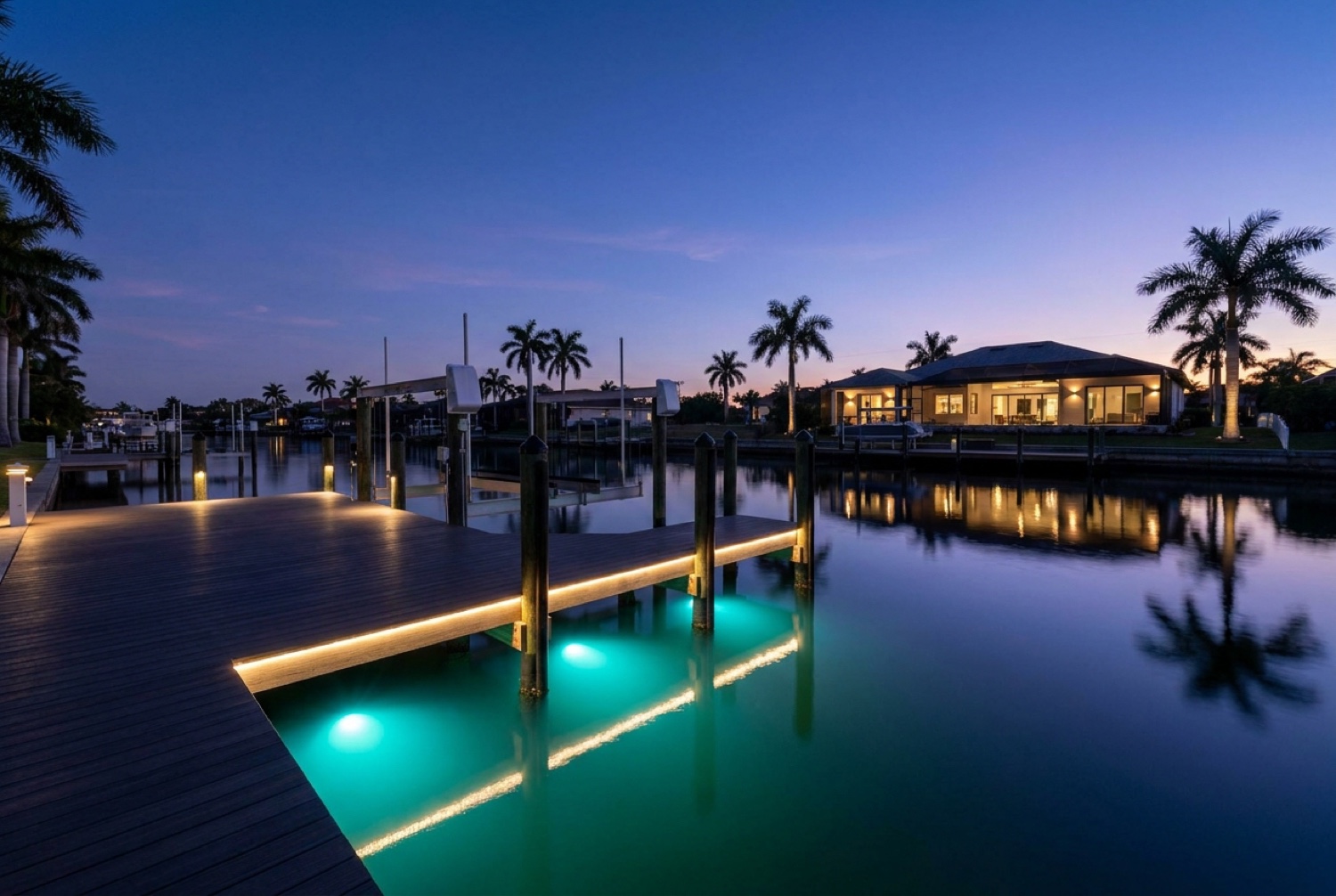
A dock-lighting retrofit means adding fixtures to a dock that’s already standing — mounting marine-grade lights to your pilings, decking, or seawall, then routing low-voltage wire back to a transformer and a power source. Done right, you get a dock that lights itself at dusk, and the only sign of the work is the glow. Here’s exactly how it goes, and the honest notes on what makes a retrofit easy versus tricky on a SW Florida canal.
Can you really add lighting to a dock that’s already built?
Yes. In the vast majority of cases, an existing dock takes lighting beautifully with no structural changes at all. The retrofit is about wiring and mounting, not rebuilding.
The fixtures attach to what you already have. Pathway and recessed deck lights go into the decking, step lights mount on the stringers, piling-cap lights cap your existing pilings, and accent or wash lights can fasten to the seawall. From there it’s a matter of getting low-voltage wire back to one transformer. The dock doesn’t care that it was built years ago — what matters is whether it’s sound and where the nearest power lives.
Where does the power come from on an existing dock?
Power comes from the closest reliable source: an existing outlet near the seawall, an open circuit in your electrical panel, or a brand-new dedicated circuit run out to the dock. This single question drives most of your cost and timeline.
There’s a big difference between three common scenarios:
- Power already at the waterline. If you’ve got a GFCI outlet by the seawall — common on docks that already have a boat lift or a shore-power pedestal — we tie into it and the run is short. This is the easy case.
- Power at the house only. If the nearest outlet is back at the lanai or garage, we run a low-voltage line across the yard to reach the dock. That can mean trenching and conduit, which adds labor.
- No usable nearby power. Sometimes the cleanest fix is a new dedicated circuit from the panel. It’s more up-front work but gives you a properly sized, code-correct supply that won’t trip every time the lift runs.
Every fixture on the dock is low-voltage — the transformer steps household 120V down to 12V before it ever heads out over the water, which is exactly what you want around a saltwater canal.
How is the wire routed back to the transformer?
All the fixtures feed back to a single low-voltage transformer mounted at the power source, usually near the seawall or on the house wall. The wire is hidden along framing, under decking, or inside conduit so the finished look is clean.
This is where the type of dock decking matters most:
| Dock construction | Wire routing | Retrofit labor |
|---|---|---|
| Open wood framing (CCA-treated) | Wire stapled along joists and stringers | Easiest — framing is accessible |
| Finished wood decking | Fished under boards or run in conduit | Moderate |
| Capped composite (TimberTech / Trex) | Fished through framing, hidden in conduit | More labor — nothing can show |
On a new build we set the wire while the joists are open and it’s nearly free. On a finished dock — especially a sealed, capped-composite one — we fish the wire so there’s nothing visible up top. It takes longer, but the result is identical: a clean deck with no wiring in sight. (If you’re weighing materials for a future project, our dock decking materials guide breaks down the trade-offs.)
Can you put the lights on a timer?
Yes, and you should. We wire the transformer to a photocell or smart timer so the dock lights itself at sunset and shuts off on a schedule — no flipping a switch, no lights burning all night.
A simple dusk-to-dawn photocell is the workhorse: it senses darkness and turns everything on automatically. If you want more control, a smart timer or app-based controller lets you set hours, dim the dock, or run zones independently — for instance, pathway lights on all evening but accent lights only when you’re entertaining. For a snowbird, automatic control also means the dock looks lived-in while you’re up north. (See our salt-water dock lighting maintenance guide for keeping it all running through hurricane season.)
Should you add fish lights at the same time?
If you fish or just love watching the show, yes — bundle them. Underwater fish lights run on their own circuit and transformer, separate from your above-deck lights, but installing both in one project shares the labor, the trenching, and the trip.
Fish lights are a heavier-duty marine system, sized and aimed for the water rather than the deck, so they’re scoped as their own part of the job. But the wire run from the house is the expensive part of any retrofit, and digging one trench for two systems beats digging two. Many owners light the dock and drop underwater fish lights in the same visit. If you’re curious how they perform on our canals — and whether they really pull fish — start with our underwater fish lights guide.
When should you fix the dock before lighting it?
When the structure is failing. There’s no sense wiring fixtures to decking that’s soft underfoot or pilings that wobble — you’d be installing lights on something that needs work first.
Out here, the salt and sun are relentless: untreated or aging wood gives way to marine borers below the waterline, UV cooks the boards above it, and storm surge loosens pilings. Before any retrofit we look at the bones of the dock. If the decking is cupping, boards flex when you step, or a piling has play in it, we’ll tell you straight — it’s usually smarter to handle that through dock repair first, then light a dock you know will be standing for the next twenty years. A sound dock takes lighting in stride; a tired one is telling you something.
Light the dock you already have
A retrofit is one of the highest-impact, lowest-disruption upgrades you can make to a waterfront home. You keep the dock you’ve got, and you get back every hour after sunset. The path is simple: a quick on-site look at your decking, pilings, and power, and we’ll lay out fixtures, the wire run, and whether to bundle fish lights — with a real number, not a phone guess.
We do dock lighting retrofits across Cape Coral, Naples, Fort Myers, and the rest of the SW Florida coast, with our own crew and free on-site estimates seven days a week. Call (239) 397-3400 and let’s get your dock lit.