
Electric vs. Manual Jet Ski Lift: Is the Motor Worth It?
Remote-button convenience versus fewer failure points and a lower price — how to pick between an electric and manual PWC lift on a Southwest Florida canal.
Key takeaways
- An electric PWC lift raises your ski at the push of a button; a manual lift hand-cranks it up in a minute or two. Both lift the same skis at the same price band — $3,000–$5,000 installed.
- Electric wins on daily convenience and guests; manual wins on reliability and cost, with no motor or control box to corrode in salt air.
- An electric lift needs a GFCI-protected circuit run out to the dock, which adds cost and another thing to maintain.
- Most PWC lifts are modular — you can start manual and bolt on an electric winch later, so the choice isn't permanent.
- For a single ski you ride a few times a month, manual is plenty; for daily riders, two skis, or anyone who can't comfortably crank, the motor earns its keep.
A jet ski lift is the easiest way to keep your ski out of Southwest Florida’s brackish, barnacle-friendly water, and once you’ve decided to add one the next question is almost always the same: electric or manual? Do you crank it up by hand, or raise it with the push of a button?
It’s less about which is “better” and more about how you ride, who else uses the lift, and what you want to spend. Here’s how we walk Cape Coral, Naples, and Fort Myers owners through the call — including the part most people miss, which is that you don’t always have to decide up front.
What’s the difference between an electric and manual jet ski lift?
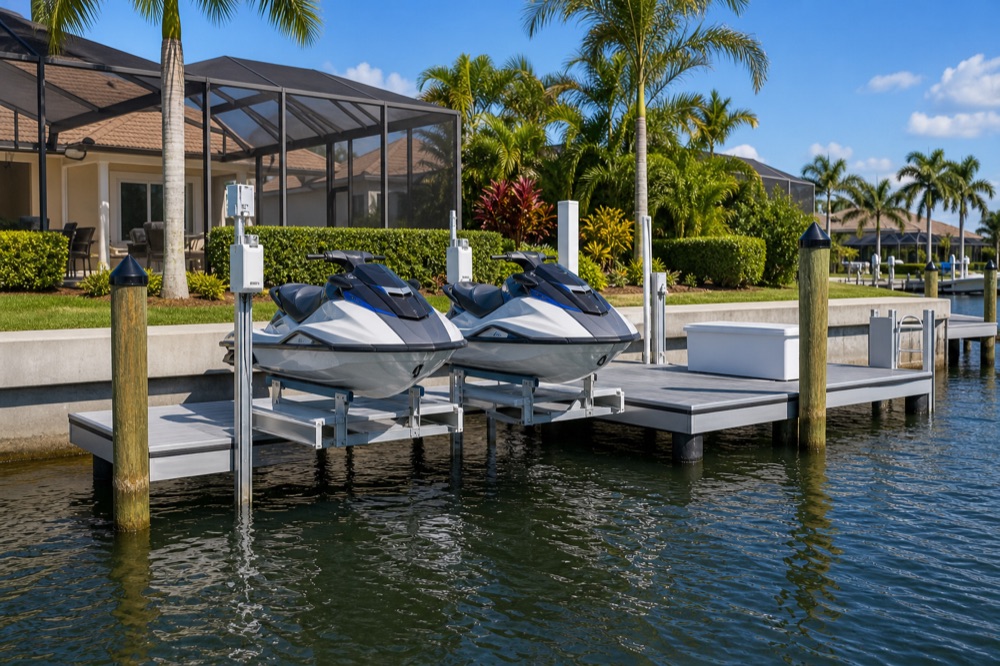
The frame, cradle, and bunks are essentially the same — the only real difference is how the cradle goes up and down. A manual jet ski lift uses a geared hand-crank winch you turn yourself; an electric jet ski lift uses a sealed motor and a remote or wall switch to do that work for you.
Both raise the identical ski on the identical pilings, and both land in the same price band — a PWC lift runs $3,000–$5,000 installed either way, with electric toward the upper end once you add the motor and power run. You’re not buying a bigger lift with electric; you’re buying convenience, and a little more complexity to get it.
Is an electric jet ski lift worth the convenience?
For daily riders, guests, and anyone who can’t easily hand-crank, yes — the button pays for itself. For an occasional rider with one ski, the convenience is real but optional.
Picture the end of a hot August day on the Caloosahatchee. You’re sunburned, the kids are wiped, and the ski needs to come out before the bottom starts growing. With electric, you tap a button and walk away. With manual, you crank for a minute or two in the heat — not hard, but a chore, and it lands on whoever’s home.
Electric makes the most sense when:
- You launch and retrieve several times a week — small frictions add up
- Guests or kids use the ski and you don’t want them wrestling a crank
- Someone in the house has limited strength or mobility
- You run a double lift, with two skis to raise every outing
If most of those don’t apply, the convenience is a nice-to-have, not a need.
Is a manual jet ski lift more reliable?
Yes — fewer parts means fewer things to fail. A manual lift has no motor, no control box, and no wiring exposed to salt air, so there’s less that can break or corrode.
That matters more here than almost anywhere. Saltwater canals, brutal summer humidity, relentless UV, and a June-through-November hurricane season are all hard on electronics mounted near the water. A motor and its control box are the components most likely to need service over a lift’s life, and they’re the parts a storm surge can reach. Strip them out and you’re left with a geared winch and stainless cable — about as simple and storm-tolerant as marine hardware gets.
A manual lift also wins on cost twice over: no motor or power run up front, and nothing electrical to maintain or replace later. For a single ski you ride a few times a month, that simplicity is hard to beat.
What does running power to the dock involve?
An electric lift needs a dedicated, GFCI-protected circuit run from your panel out to a weatherproof box on the dock — and on a saltwater canal that has to be done to code by a licensed electrician.
This is the hidden cost people forget. The lift price is only part of it; if you don’t already have proper power at the dock, you’re also paying to get it there. A few things to know:
- GFCI protection is non-negotiable. Electricity and water are a dangerous mix, and faulty dock wiring is a real safety hazard — the circuit has to trip instantly on a fault.
- Run length matters. A long pull from the panel to the end of a dock adds labor and wire. The farther the water, the more it costs.
- The hardware lives in salt air. Even a weatherproof box and sealed marine motor face humidity, spray, and the occasional surge, so connections have to be marine-grade and well sealed.
None of this is a dealbreaker — it’s done on docks across the coast every day — but it belongs in your budget from the start. If your dock has aged or you’re already redoing wiring, our dock repair crew can sort the power and the lift in one trip.
Electric vs. manual jet ski lift: side by side
Here’s the trade-off at a glance.
| Factor | Manual | Electric |
|---|---|---|
| Day-to-day convenience | Hand-crank, ~1–2 min | Push-button, hands-off |
| Up-front cost | Lower | Higher (motor + power run) |
| Failure points | Fewest | Motor, switch, wiring |
| Salt-air / surge exposure | Minimal | Motor + control box exposed |
| Needs GFCI power at dock | No | Yes |
| Best for | Occasional single-ski rider | Daily riders, guests, doubles |
Neither column is the “right” answer — it’s a budget-and-lifestyle call. The same spec rides under both: marine-grade aluminum frame and 316 stainless cable and hardware, plus a sealed marine motor if you go electric.
Can I start manual and add a motor later?
Yes — most PWC lifts are modular, so you can install a manual lift now and bolt on an electric winch down the road. This is the answer that takes the pressure off the decision entirely.
If you’re unsure how much you’ll use the ski, or want to keep the first invoice lean, starting manual is a smart play. Ride it a season. If the crank gets old, you add a second ski, or you simply want the button, you upgrade then — as long as the frame supports a motor and you can get GFCI power to the dock. (That power run is the same job now or later, so plan the route up front.) The flip side holds too: if you already know you’ll want the button, there’s no reason to crank for a year first.
The bottom line for SW Florida riders
For a single ski you ride a handful of times a month and want the fewest parts exposed to salt, manual is plenty. For daily riders, two skis on a double, guests and kids, or anyone who can’t comfortably crank, the motor earns its keep — and because the lift is modular, you can always change your mind later.
Want help making the call for your dock? Florida Lifts & Docks has been building jet ski lifts on these canals since 2008, with our own local crew — never subbed — and in-house permitting. We’ll look at your ski, your dock, and your power and give you a firm number on a free on-site estimate, seven days a week, across Cape Coral, Naples, Fort Myers, and the rest of the coast. Call (239) 397-3400.