
What Size Jet Ski Lift Do I Need? PWC Capacity by Model Weight
A fast model-to-capacity lookup for PWC lifts in Southwest Florida — match your ski's loaded weight to the right lift, then decide one ski or two.
Key takeaways
- PWC lifts are rated in pounds — most singles 1,200–1,500 lb, doubles 2,300–4,500 lb — and nearly every modern ski fits a single.
- Sea-Doo Spark is ~400–450 lb dry; a full-size Sea-Doo or Yamaha runs ~750–1,050 lb dry. Build to the loaded weight.
- Add fuel (~6 lb/gal), gear, and water, then a margin — a loaded full-size ski often lands around 950–1,100 lb.
- Hull length and beam must sit fully supported on the bunks, not just the weight rating.
- A PWC lift runs $3,000–$5,000 installed; a double is usually cheaper than two singles bought separately.
If you ride a personal watercraft on a Southwest Florida canal, a lift is the single best thing you can do for it. Leaving a ski floating in our brackish, barnacle-friendly water rots the bottom, fouls the pump, and bakes the seat in the sun — and after a storm surge it becomes a battering ram against your dock. A lift solves all of it, but only if it’s the right size.
Here’s the good news: sizing a PWC lift is simpler than sizing a boat lift. There are far fewer weight classes, and almost every modern ski fits a single. This guide gives you a quick model-to-capacity lookup, shows you how to build to your real loaded weight, and ends with the one decision that actually matters — one ski or two.
How are jet ski lifts rated?
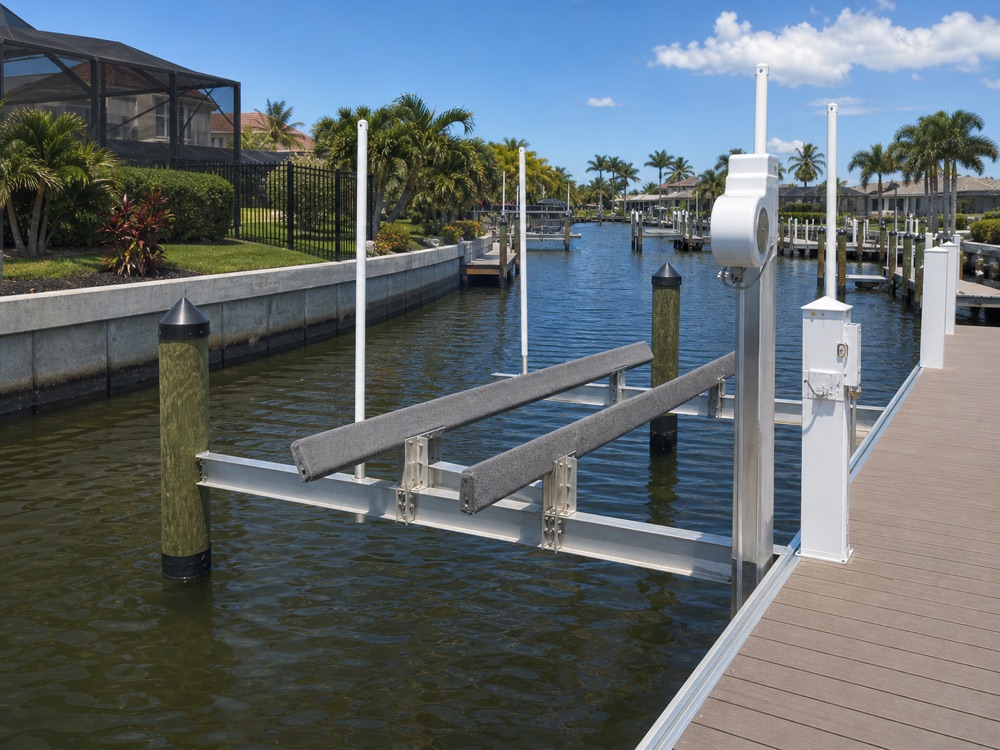
PWC lifts are rated in pounds of capacity, just like boat lifts — that number is the maximum loaded weight the lift will safely raise and hold. A personal watercraft (PWC) lift is a smaller, lighter cradle built specifically for skis, sitting lower in the water than a boat lift and using bunks shaped to a PWC hull.
Two ratings cover almost everyone:
- Single PWC lift: roughly 1,200–1,500 lb. This covers virtually every ski on the market, with margin to spare.
- Double PWC lift: roughly 2,300–4,500 lb. Two skis side by side on wider bunks.
Because the lightest skis weigh a fraction of a single’s rating, the weight number is rarely the limiting factor — the hull fit is. More on that below.
What does a jet ski actually weigh?
Most skis fall into two camps: featherweight rec-lite models and full-size three-seaters. Here are typical dry weights by class.
| PWC class | Example models | Typical dry weight |
|---|---|---|
| Rec-lite | Sea-Doo Spark | ~400–450 lb |
| Mid / full-size | Sea-Doo GTI, Yamaha VX | ~600–750 lb |
| Full-size performance / luxury | Sea-Doo GTX/RXT, Yamaha FX | ~750–1,050 lb |
Dry weight is the starting point, not the finish line. The number on the spec sheet assumes an empty tank and nothing on board — which is never how your ski sits on the lift.
How do I build to the loaded weight?
Add everything that rides with the ski — fuel, gear, and water in the hull — then a margin. That loaded number, not the dry weight, is what you size to.
Work it out like this:
- Fuel. Gas weighs about 6 lb per gallon. A full-size ski holds 15–18 gallons, so a full tank adds 90–110 lb.
- Gear. Ropes, anchor, cooler, fenders, a wet board or tube, life jackets — call it 20–50 lb.
- Trapped water. A ski rarely drains bone-dry; add a few pounds.
- Margin. Always leave headroom for wear, a heavier future ski, and uneven loading — round up.
So a full-size Sea-Doo or Yamaha at ~850 lb dry, with a full tank and gear, lands around 950–1,100 lb loaded — still comfortably inside a 1,200–1,500 lb single. A Sea-Doo Spark loaded barely clears 500 lb. The single handles both; you’re never short on a properly rated PWC lift.
Does the ski’s length and beam matter?
Yes — the lift is rated by weight, but the hull has to physically fit the bunks. Length and beam need to sit fully supported, with the ski centered and not hanging off either end.
Two fit checks matter:
- Length on the bunks. A short Spark and a long three-seater have very different footprints. The bunks should cradle the running surface evenly so weight isn’t concentrated at one point.
- Beam (width). This is the big one for doubles — two full-size skis side by side need enough deck width to load and unload without bumping. We size the cradle to your exact models so both skis sit clean.
This is why we always confirm the lift against your specific make, model, and year. A capacity number alone won’t tell you if your hull rides right.
One ski or two?
If you own two skis — or might add a second — a double is almost always the smart call. Installing one double costs less than coming back to add a second single, and it shares pilings, power, and a single permit.
Quick decision guide:
- One ski, no plans for a second: a single PWC lift (1,200–1,500 lb) is all you need.
- Two skis now, or likely soon: go double (2,300–4,500 lb) and save the second mobilization.
- Tight canal or limited dock frontage: a double’s side-by-side footprint can actually use space more efficiently than two separate singles — we’ll check your frontage on site.
Whichever way you go, the hardware spec is the same one we put on every install: marine-grade aluminum frame, 316 stainless cable and hardware, and a sealed marine motor if you go electric. On a saltwater canal that spec is the difference between a lift that lasts decades and one that seizes in a couple of seasons. (Manual or electric? See our electric vs. manual jet ski lift guide.)
What it costs and what’s next
A PWC lift typically runs $3,000–$5,000 installed. Where you land in that range depends on whether you already have sound pilings, your water depth and tide swing, the electrical run, and single versus double. If your canal goes skinny at low tide, that shapes the design too — our shallow-water jet ski lift guide walks through the options. Want the real two-ski number? Start with double jet ski lift cost.
Florida Lifts & Docks has been building lifts on these canals since 2008, with our own crew — never subbed — and in-house permitting. Get a firm size and price with a free on-site estimate, seven days a week, across Cape Coral, Naples, Fort Myers, and the rest of the coast. See everything we build on our jet ski lifts page, or call (239) 397-3400.