
Jet Ski Lift Maintenance in Salt Water: A Simple Upkeep Routine
A do-this-monthly routine that stops the salt-water corrosion and barnacle growth that strand a ski — built for Southwest Florida's warm, brackish canals.
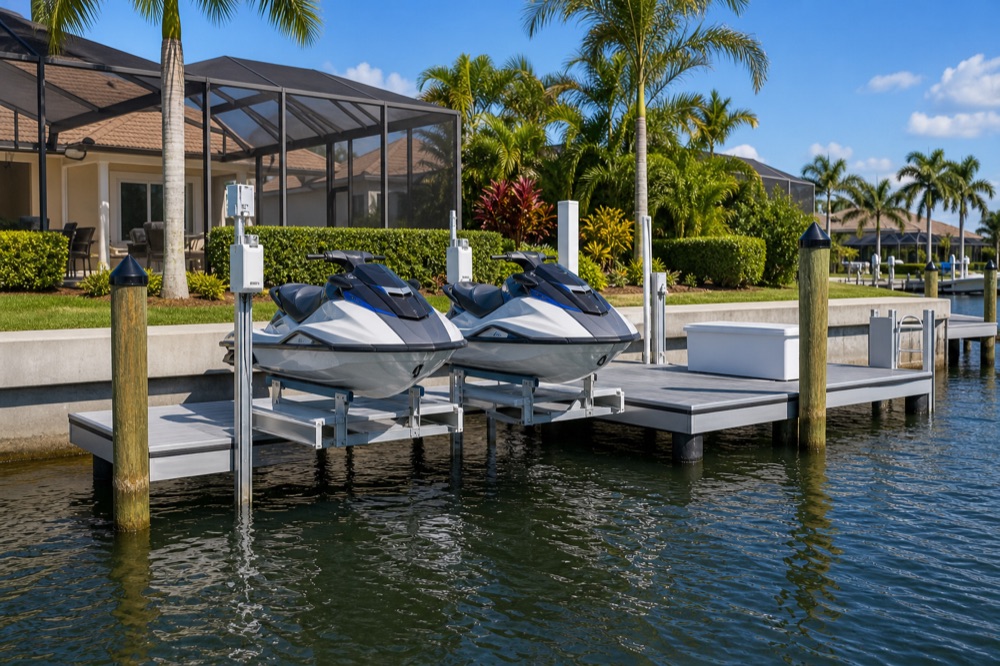
Key takeaways
- Rinse the cradle, cables, and bunks with fresh water after every ride — salt that dries on stainless cable is the number-one cause of a stranded ski.
- Park the ski fully raised so the hull and bunks sit above the waterline; growth never starts on parts the water can't reach.
- In SW Florida's warm brackish canals, scum and barnacles can take hold in days, so this is a monthly routine, not a yearly one.
- Check the sacrificial anode and stainless hardware monthly, lube the pulleys and gears quarterly, and book a pro inspection every quarter.
A personal watercraft is the easiest thing to own on a Southwest Florida canal — drop it, ride it, raise it, done. The lift that holds it lives a much harder life. It hangs in the splash zone of warm, salty, brackish water and cycles up and down constantly, carrying a machine that gets ridden on a whim instead of on planned trips. That mix of constant use and a harsh environment is exactly how a neglected PWC lift seizes, corrodes a cable, and drops your ski at the worst possible moment.
The fix is a short routine you actually run on a schedule. Jet ski lift maintenance in salt water comes down to one idea: never let salt or growth sit long enough to do damage. On the Gulf coast, that means thinking in days and weeks, not seasons. Here’s the simple monthly rhythm that keeps a PWC lift running for years.
What makes a jet ski lift different from a boat lift?
A jet ski lift is a lighter-duty lift built for a few hundred to a couple thousand pounds, and its parts sit lower and get used far more often than a big boat lift. That combination means salt and barnacles attack it faster, so it needs a tighter upkeep schedule.
Most PWC lifts use a cradle or a pair of bunks that the ski drives onto, raised by stainless cables and a small sealed motor (or a hand winch on a manual unit). Because a jet ski is light and fun, it gets ridden on a whim — a quick blast around Charlotte Harbor, an evening run up the Caloosahatchee — so the cables cycle constantly and SW Florida’s warm brackish water never lets up. The result is a lift that needs attention more often than its bigger cousin. (Still choosing one? Our electric vs. manual jet ski lift guide covers the tradeoffs.)
Why do you have to rinse it after every ride?
Because salt that dries on stainless cable and aluminum is the number-one thing that corrodes a lift and frays a cable from the inside out. A two-minute fresh-water rinse after each ride flushes it off first.
Keep a hose at the lift and make rinsing part of putting the ski away. Hit the parts that take the worst of it:
- Cables — run water the full length, top to bottom
- Cradle, bunks, and frame — where salt and grit collect
- Pulleys and sheaves — the moving points that grind when gritty
- Motor housing — rinse the outside only; never blast water into vents or seals
This matters more for a PWC lift than almost anything else on the water, because the cables are thin and the duty cycle is high. Salt left to dry is what turns a healthy cable into a frayed one in a single season.
How do you keep barnacles and scum off the lift?
Park the ski fully raised every time so the hull and bunks sit above the waterline. Growth can’t start on metal and carpet the water never touches — and in our warm brackish canals, scum and barnacles take hold in days.
This is the habit that separates a lift that lasts from one that’s a slimy mess by next month:
- Raise it all the way. Lift the ski clear of the water between every use. A hull left floating collects barnacles and blistered gelcoat, and the bunks under it never dry out.
- Watch the parts that still get submerged. On many lifts the lower frame and the bottom of the cables stay in the water even when the ski is up. Those spots are where barnacles colonize first — scrape or pressure-wash them off before they build up, since growth on stainless cable traps grit and moisture against the wire.
Anything in the splash zone is fair game for our marine life. The less time those parts spend wet, the less you’ll fight.
What should you check, lube, and inspect — and how often?
Run a quick visual every month, lube the moving parts every quarter, and have a pro inspect the whole lift quarterly. PWC lifts cycle so often that this faster cadence catches a worn cable or a dead anode before it strands your ski.
Here’s the schedule that works on a SW Florida canal:
| Task | How often | What you’re looking for |
|---|---|---|
| Fresh-water rinse | After every ride (min. weekly) | Salt flushed off before it dries |
| Visual inspection | Monthly | Frayed cable, barnacles, white corrosion, rust streaks |
| Lube pulleys, gears, pivots | Quarterly | Smooth, quiet operation with marine grease |
| Anode / corrosion check | Monthly | Sacrificial anode still has metal left |
| Professional inspection | Quarterly | Cable, cradle, motor, alignment, pilings |
A few specifics that matter on a PWC lift:
- Cables. Scan the 316 stainless cable for fraying, broken strands (“fishhooks”), kinks, or rust streaks. One broken strand means stop using the lift and replace the cable — they’re thin, and they fail suddenly.
- The sacrificial anode. That dull metal block (zinc or aluminum) is bolted on to corrode instead of your frame and hardware. Check it monthly and replace it once it’s eaten down to roughly half. A missing anode lets galvanic corrosion attack the parts you can’t easily swap.
- Lubrication. Grease the pulleys, gears, and pivot points with a marine grease that stays put in wet, salty conditions — about quarterly, more if you ride daily.
Why book a quarterly professional inspection?
Because a trained eye catches what a quick look misses — cable wear at the drum, motor and bearing condition, alignment, and piling integrity — and a PWC lift’s constant cycling wears those out faster than a boat lift’s.
A jet ski lift is bolted to pilings and often shares a dock, so it’s only as solid as what’s under it; that’s where dock repair frequently overlaps. Our crew is local and never subbed out, so the same people who build it keep it tuned. Four checks a year is a small, predictable cost that protects your ski and everyone who rides it.
Want a lift built for this environment, or a pro to tune the one you have? We give free on-site estimates seven days a week across Cape Coral, Naples, and the rest of the coast. See what we build on our jet ski lifts page, or call (239) 397-3400.