
How Deep Are Boat Lift and Dock Pilings Driven in Florida?
Why there's no single "right" depth — how soil, load, water depth, and storm exposure decide embedment per site, and why a cheap shallow set fails in surge.
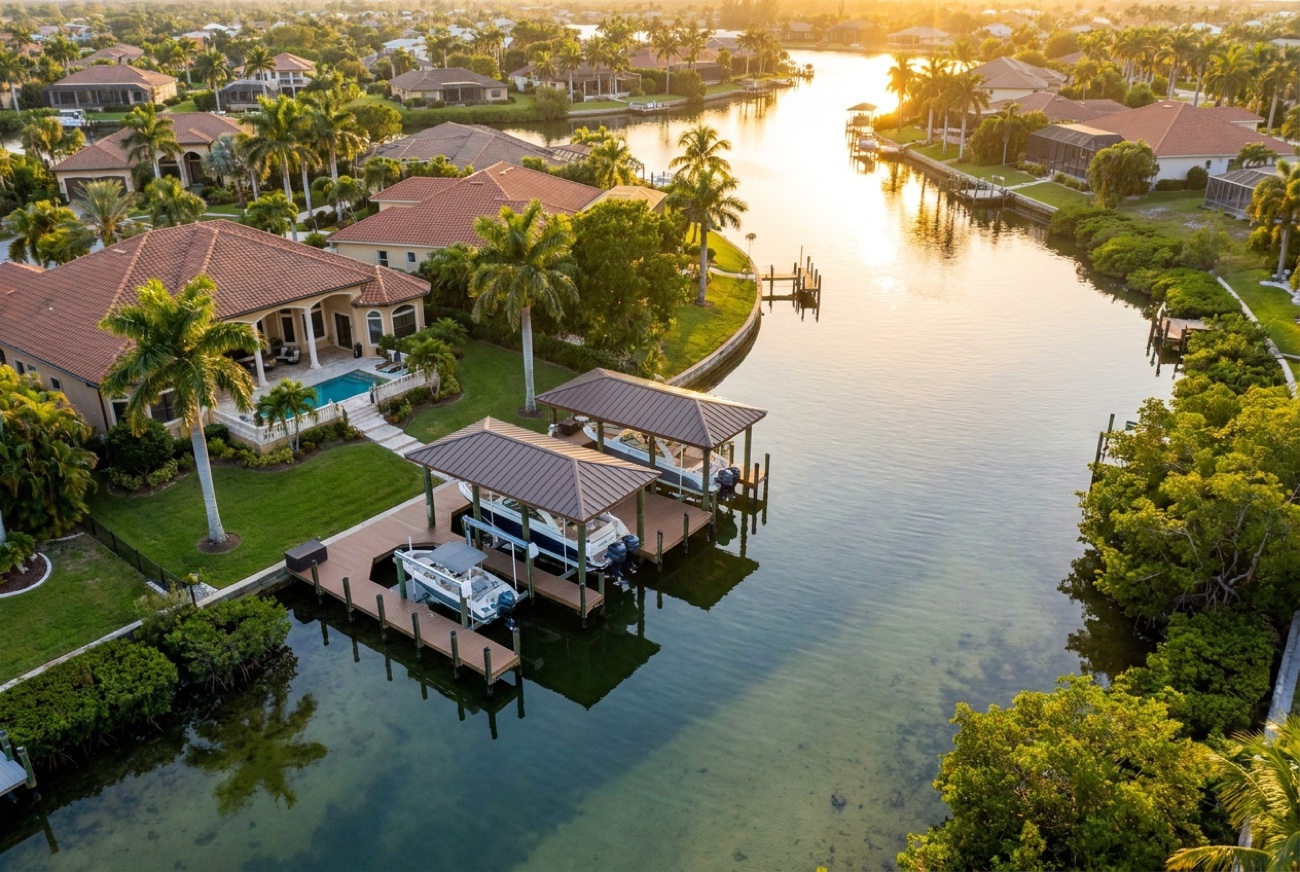
Key takeaways
- There is no universal depth — how deep a piling is driven is decided per site by the soil it has to grip, the load it carries, water depth, and storm-surge exposure.
- Boat-lift pilings are usually driven deeper than walkway pilings because they carry the shock and cyclic load of a hung boat, not just decking.
- Loose canal sand and soft muck need MORE embedment, not less, because they grip the piling poorly — depth has to make up for weak soil.
- In SW Florida crews typically jet the piling to depth, then drive the final feet so it locks into firm, undisturbed bearing soil.
- A cheap shallow set doesn't usually snap in a hurricane — it leans, lifts, and walks out of the bottom when surge gets under the structure.
Search “how deep are dock pilings driven” and you’ll find people quoting a single number, as if every canal in Florida had the same bottom. It doesn’t. On the Southwest Florida coast — Cape Coral’s dredged canals, the soft systems off the Caloosahatchee, the harder ground near Charlotte Harbor — the bottom can change from one lot to the next. The honest answer is that depth is decided per site, not by a fixed number, and a builder who quotes you a depth over the phone is guessing.
That matters, because depth is the difference between a lift that rides out hurricane season and one that walks out of the bottom in the first real surge. Here’s what determines how deep your pilings go, and why a cheap shallow set is the most expensive shortcut on the water.
What does “piling depth” actually mean?
Piling depth that matters is embedment — how far the piling is driven into the canal bottom, not how tall it stands above the water. A 22-foot piling with only a few feet in the mud is a short piling, no matter how long it looks from your dock.
Embedment is what does the real work, resisting two storm forces at once: lateral load (surge, wind, and wake shoving the piling sideways) and uplift (surge floating the structure and dragging the pilings straight up). Buried length and the soil packed around it stop both — which is why “how deep” can’t be answered until someone reads your bottom.
Why is there no single “right” depth?
Because every factor that sets embedment changes site to site. Depth is a calculation, not a default, and four things drive it:
- Soil type. How well the canal bottom grips a piling. Loose sand and muck grip poorly; firm marl or limestone caprock grips hard.
- Load. What the piling has to carry — light decking versus a boat hung in the air on a lift.
- Water depth and tide. Deeper water and big tide swings mean more piling exposed above the bottom, so it needs more buried below to stay stable.
- Exposure. A piling on an open stretch facing Charlotte Harbor or the Gulf takes more surge and wake than one tucked deep in a sheltered canal.
Change any one and the right depth changes with it. Your neighbor’s dock isn’t a reliable guide — their bottom, their boat, and their exposure aren’t yours. For how the target depth is figured, see our companion guide on how deep dock pilings should be driven.
How does soil type change the depth?
Soil is the biggest variable, and it’s counterintuitive: softer bottoms need MORE embedment, not less. Loose material grips a piling far less than firm soil, so you drive deeper to build the same holding power. Here’s how the bottoms across SW Florida behave:
| Canal bottom | What it means for depth |
|---|---|
| Loose canal sand | Driven deeper for friction — sand flows and grips weakly until packed tight around the piling |
| Soft silt / muck | Driven through the soft layer until the tip reaches firm bearing soil below |
| Firm sand or marl | Reaches solid bearing higher up; often the shallower end of the range |
| Limestone caprock | Can refuse (stop) on the rock; setting it into hard caprock takes the right method, not brute force |
Many SW Florida canals have a soft surface layer over firmer material below. A piling that stops in that top layer feels “set” but has almost no grip — it’ll lean the first time surge leans on it. The whole job is pushing through the soft stuff into firm bearing soil underneath.
Are boat lift pilings driven deeper than dock pilings?
Usually, yes. Boat-lift pilings generally go deeper than walkway pilings because they carry shock and cyclic load, not just static weight.
A walkway piling holds up decking that mostly sits still. A boat-lift piling holds your boat suspended in the air and absorbs a jolt every time it’s raised, lowered, or rocked by a passing wake — season after season. That cyclic load demands more embedment and firmer bearing. It’s why the original dock pilings often aren’t deep enough when you add a lift, and why a proper install checks whether new, deeper pilings are needed rather than hanging weight on old ones.
What is the jetting-then-driving method?
It’s how most pilings go into SW Florida’s mix of sand and rock, and the two steps grip very differently:
- Jetting uses high-pressure water to wash the piling down fast, fluidizing the loose sand so it sinks quickly to depth.
- Driving pounds the piling with an impact hammer, compacting soil tight around it for maximum grip in undisturbed material.
Jetting alone is efficient but risky — the fluidized soil has to re-set firmly afterward, and if it doesn’t, you’re left with a piling that’s buried but loose. A good crew jets to depth, then drives the final feet so the piling locks into firm, undisturbed soil. That last stretch of driving is what turns a buried piling into a set one. (More on the work itself in how dock pilings are installed.)
Why does a cheap, shallow-set job fail in surge?
Because it skips the part that does the work. A shallow piling doesn’t usually snap in a hurricane — it leans, loosens, and lifts straight out of the bottom when surge gets under the structure and floats it.
This is where cut-rate quotes come from. Stopping a piling in the soft surface layer, jetting without driving the final feet, or shaving a foot to finish faster all look identical the day the job is done — your dock stands, your lift cycles, the bill is lower. Then the first serious surge of hurricane season finds the weak grip, and once one piling walks, the structure can unzip. The right piling material matters, but no material saves a piling driven too shallow.
Because we run our own local crew — never subbed out — the people reading your bottom are the people building your dock, with no third party incentivized to shave depth to make their day go faster.
Get a real depth answer for your bottom
You can’t read your canal bottom from a price sheet, and neither can anyone else. Florida Lifts & Docks has been driving pilings into nearly every bottom this coast has — loose sand, soft muck, firm marl, and limestone caprock — since 2008, across 18 SW Florida cities, with in-house permitting and marine-grade materials built to outlast the salt.
The only way to know how deep your pilings need to go is to put a crew on your dock and read the bottom under it. Start with our pilings page, see how we build storm-ready lifts across Cape Coral, Punta Gorda, and Naples, then book a free on-site estimate, seven days a week, or call (239) 397-3400.