
How Are Dock Pilings Installed in a Tight Canal? Jetting, Driving, and Barge Access
Pilings go in by jetting or driving, set from a shallow-draft barge so a crew can reach narrow Cape Coral canals and seawalled lots. Here's how the process works.
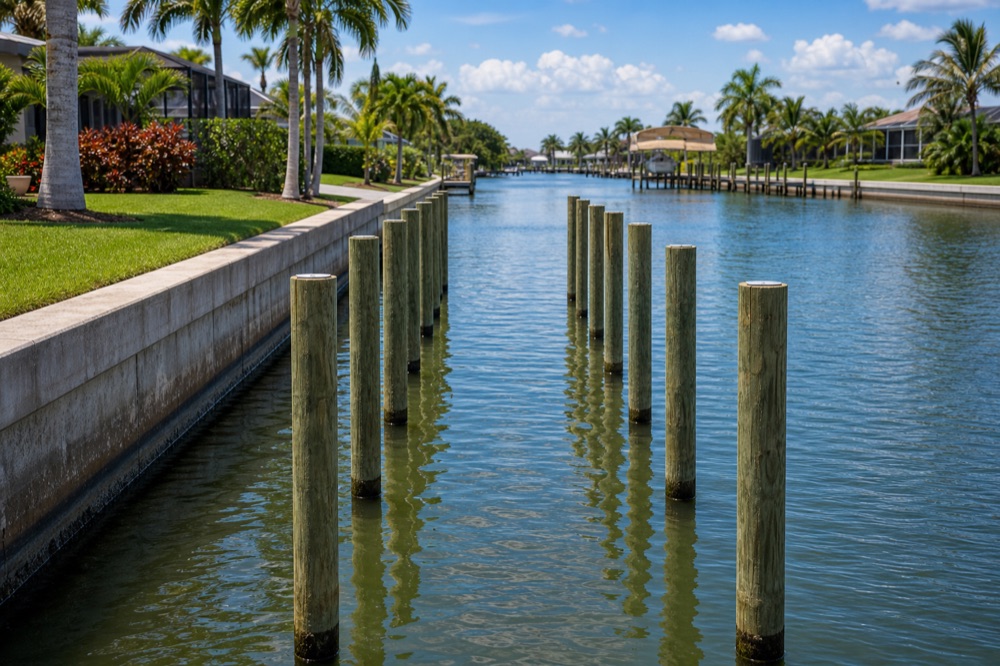
Key takeaways
- Pilings are installed two main ways — jetting (high-pressure water in sandy bottoms) and driving (vibratory or impact in denser substrate) — and most SW Florida jobs use a mix of both.
- A shallow-draft barge carries the crew, pile, and rig in by water, which is how a tight Cape Coral canal or seawalled lot gets reached without tearing up your yard.
- Your canal's bottom type, water depth, and the structures next door dictate the method and equipment, not the other way around.
- A typical residential piling set takes about a day; you'll hear the rig, see the barge, and the bottom may cloud temporarily, but the disruption is short.
- An in-house crew with its own barge and rig controls access, method, and schedule — the things that actually go wrong on narrow canals.
Pilings are the foundation of everything we build on the water — your dock, your boat lift, your boathouse all stand on them. So when an owner on a tight Cape Coral canal asks whether their narrow waterway is even buildable, the real question underneath is: how do you get a piling and the equipment to drive it into a spot a truck can’t reach?
The short answer: pilings go in two ways — by jetting and by driving — and the crew reaches your seawall by water, on a shallow-draft barge. Here’s how that works, and what you’ll experience when it happens at your place.
What is a dock piling, and how is it installed?
A dock piling is a vertical post — wood, concrete, or composite — driven deep into the canal bottom to carry the weight and resist the forces of everything built on top of it. It’s installed by sinking that post to firm holding ground, either with high-pressure water (jetting) or a hammer (driving), usually both.
The goal is the same no matter the method: get the pile down past the soft, shifting surface material into dense, stable substrate that won’t let go when a storm surge or a strong tide pushes on your dock.
How does jetting install a piling in a sandy bottom?
Jetting pumps high-pressure water down alongside or through the pile, which liquefies the loose sand around the tip and lets the piling sink under its own weight and a little guidance. It’s the go-to method where the canal bottom is sandy or soft — common across much of Southwest Florida.
When the water is shut off, the sand settles and packs back tightly around the pile, gripping it in place. In practice the crew often jets the piling most of the way down and then switches to driving for the final few feet, so the tip seats into firmer material below.
Jetting is favored when:
- The bottom is sand or soft sediment rather than rock or hardpan
- You want to minimize vibration near a seawall, an existing dock, or a neighbor’s structure
- The pile needs to reach a depth that driving alone would struggle with in loose material
How does driving work in denser substrate?
Driving forces the pile down with a hammer instead of water — either a vibratory driver that shakes it into the ground or an impact hammer that pounds it. It’s the method for denser, harder bottoms where jetting alone won’t seat the pile, and it’s how the final lock-in usually happens regardless of bottom type.
A vibratory driver uses rapid vibration to settle the pile through firmer sand and sediment with less brute force. An impact hammer delivers heavy repeated blows when the substrate is genuinely tough. On many SW Florida canals you’ll see the hybrid approach: jet down, then drive home.
| Method | Best for | What you notice |
|---|---|---|
| Jetting | Sandy, soft bottoms; near sensitive structures | Water pump running; bottom clouds temporarily |
| Vibratory driving | Firmer sand and sediment | Steady humming vibration; faster than impact |
| Impact driving | Hard, dense substrate; final lock-in | Rhythmic pounding; the loudest of the three |
Why does a tight canal need a barge?
Because you can’t drive a rig down a seawall. A shallow-draft barge floats the crew, the pilings, and the driving or jetting equipment up the canal and parks it right at your dock line — so nothing crosses your yard, your landscaping, or a neighbor’s property.
This is what makes narrow Cape Coral canals and fully seawalled lots buildable at all. Plenty of waterfront homes have no land route to the water’s edge wide enough for heavy equipment — the gate, the pool cage, the side yard, the neighbor’s fence all get in the way. A barge sidesteps every bit of that by approaching from the water. Shallow draft matters here specifically because SW Florida canals can run thin at low tide, so the barge has to float and work without grounding out.
Access is where a lot of dock projects quietly go sideways. The crew has to read the canal width, the tide window, overhead obstructions, and the structures on both sides before a single pile goes in — which is why we run our own pilings crew and equipment rather than subbing it out. We control the barge, the method, and the schedule.
How do my canal conditions decide the method?
They decide all of it. Your bottom type, water depth, and the structures next door dictate which method and equipment the crew uses — the site drives the plan, not a one-size-fits-all approach.
The big factors:
- Bottom type. Sand and soft sediment lean toward jetting; rock and hardpan demand driving. Most canals are a layered mix, which is why hybrid installs are the norm.
- Water depth and tide. Shallow stretches and big tide swings set the barge’s working window and can affect pile length. (Shallow water shapes dock and lift design too — see fixed vs. floating docks in a shallow canal.)
- Neighboring structures. A seawall, an existing dock, or a piling next door may push the crew toward low-vibration jetting to avoid disturbing what’s already there.
- What’s going on top. Pilings for a heavy boat lift or a boathouse are spec’d differently than pilings carrying only a walkway — load and spacing flow back into the install. (More in how many pilings your dock needs and proper spacing.)
What will I experience during the install?
You’ll know it’s happening, but it’s quick. A typical residential set of pilings goes in over about a day once the barge is on site, and the noticeable disruption is short and contained to the water.
Expect the barge to position at your seawall, the steady sound of a pump or the rhythm of a driver while pilings are set, and the canal bottom to cloud up around the work — that’s normal and settles out within a tide cycle or two. Because the crew works from the water, your yard, driveway, and landscaping stay untouched. The longer part of the timeline is almost always the upstream work: pulling permits and scheduling the barge. We handle permitting in-house, so the install itself is the fast part.
Once the pilings are set and proven, the rest of the build — framing in CCA-treated lumber, capped composite decking like TimberTech or Trex, a lift on 316 stainless cable — has a foundation it can stand on for decades in the salt.
Wondering whether your canal can be reached and what your bottom will take? That’s exactly what a site visit answers. We give free on-site estimates seven days a week across Cape Coral, Fort Myers, Naples, and the rest of the SW Florida coast. See everything we build on our pilings page and our custom docks page, or call (239) 397-3400.