
Hurricane Prep for Docks, Boat Lifts & Seawalls in Southwest Florida
A practical, season-long checklist for protecting your dock, boat lift, and seawall before a storm — and exactly what to do after one hits.
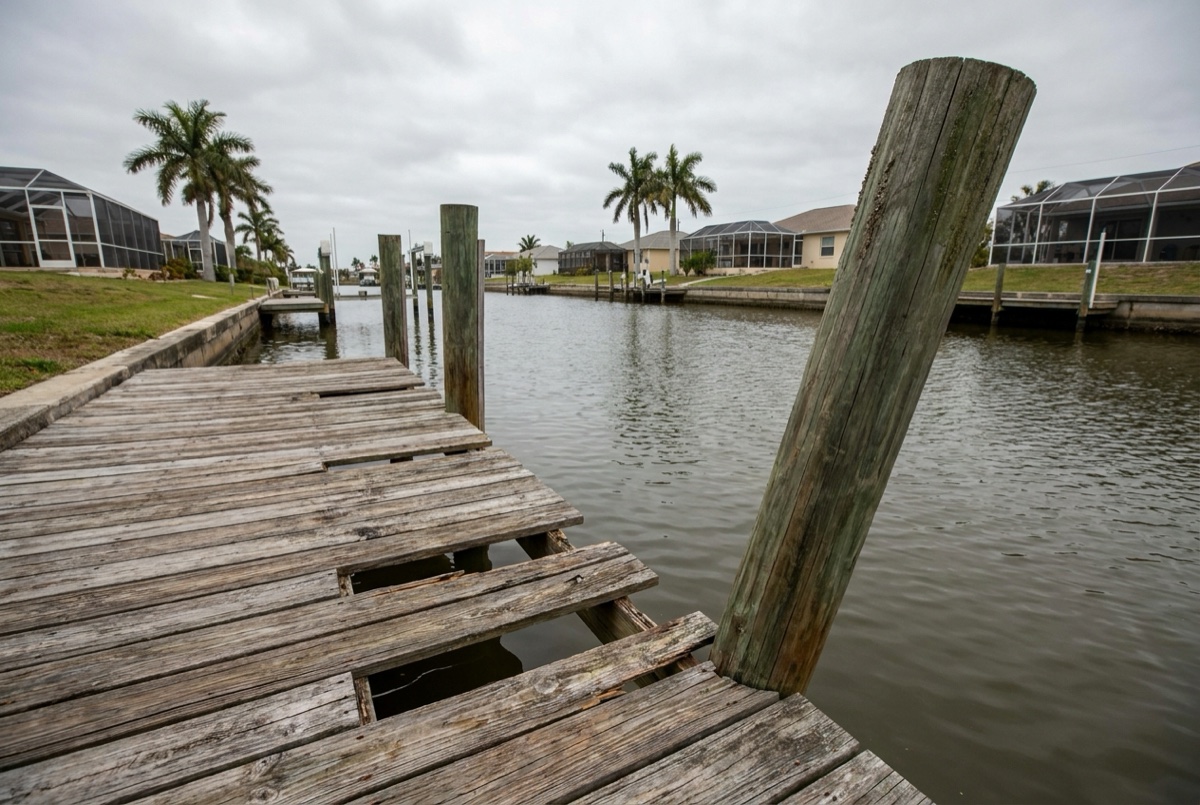
Key takeaways
- SW Florida hurricane season runs June 1–November 30 — inspect pilings, cables, bunks, and your seawall cap before it starts.
- Have a boat plan and set the lift to its storm position per your lift maker's guidance.
- A sound seawall and rip-rap are your first defense against surge.
- After a storm, prioritize safety, photograph all damage for insurance, then get a professional assessment.
If you own waterfront property in Southwest Florida, hurricane season isn’t an abstraction — it’s a fact of the calendar. The season runs June 1 through November 30, and the smartest thing you can do is treat your dock, boat lift, and seawall as a system you maintain before the wind shows up, not a problem you scramble to solve when a storm is already churning in the Gulf.
The good news: a little preparation goes a long way. Most storm damage we see traces back to a weak point that was there all along — a corroded cable, a cracked seawall cap, soil quietly washing out behind a wall. Catch those early and you’re starting any storm from a position of strength. Here’s a straight, practical checklist for the whole season.
Before the season: inspect and fix the weak points
The time to find a problem is in the spring, while the water’s calm and crews have availability. Walk your waterfront and look hard at:
- Pilings. Check for cracks, splintering, rot at the waterline, and any wood that’s gone soft. Loose or leaning pilings are a red flag.
- Lift cables and hardware. Inspect cables for fraying, rust, and flat spots, and check that bolts, pulleys, and brackets are tight and corrosion-free.
- Bunks and the lift frame. Worn bunks and a flexing frame won’t hold a loaded boat in heavy weather.
- Seawall cap and panels. Look for cracking in the cap, gaps between panels, rust stains, and — critically — any sinkholes or depressions in the yard behind the wall.
- Dock decking and connections. Loose boards and failing fasteners become projectiles in high wind.
If you spot trouble, address it early. A small dock repair in April is routine; the same repair with a named storm three days out may be impossible to schedule. If your waterfront takes water from a river as well as from the bay, the season looks different, so hurricane prep for Estero waterfront homes walks that version on its own.
Securing your boat: know your plan in advance
Your boat is usually the most valuable thing on the water, and the worst time to decide what to do with it is the night before landfall. Pick your plan now and write down the steps:
- Haul it out. Getting the boat completely out of the water and onto a trailer or into dry storage removes it from surge entirely. Ramps and storage fill up fast as a storm approaches, so reserve early.
- Move it to a hurricane hole. A protected, well-sheltered basin can be a good option if you have access to one and time to get there.
- Secure it on the lift — carefully. This one comes with a caveat: opinions genuinely differ on leaving a boat on a lift during a hurricane. If you go this route, follow your lift manufacturer’s storm guidance for your specific model, set the lift to its recommended storm position, and don’t freelance.
Whatever you choose, before the storm: remove all canvas, biminis, covers, and loose gear, strip electronics where practical, and clear the dock of anything that can blow away. Loose items don’t just disappear — they slam into your dock, your neighbor’s, and your seawall.
Your seawall as the first line of defense
When surge and wave energy arrive, your seawall is what stands between the water and your land. A sound wall does its job; a compromised one can fail when it’s needed most — and seawall failures often cascade, taking dock structure and soil with them.
Going into the season, you want a seawall that’s structurally sound with no significant cracking, no soil loss behind it, and a solid cap. If you’re seeing warning signs, don’t wait — our guide on the signs your seawall is failing walks through what to watch for, and seawall repair vs. replacement helps you understand your options. A layer of rip-rap at the base of the wall is one of the best defensive upgrades you can make: that armor stone absorbs wave energy and reduces the scour that undermines a wall during a storm.
After the storm: safety, then documentation
Once a storm passes, the instinct is to rush down to the water and check things out. Slow down — the post-storm period is when people get hurt.
- Safety first. Assume any downed line is live and stay far away from it. Don’t walk onto a dock that may be structurally compromised, and keep clear of leaning pilings or a buckled seawall.
- Document everything. Before you move or clean up anything, photograph all the damage from multiple angles — pilings, cables, decking, the seawall, the lift, and any debris. Wide shots and close-ups both help.
- Get a professional assessment. Damage isn’t always visible. A wall can look fine and have hidden soil loss behind it; a lift can look intact and have a stressed cable. Have it properly evaluated before you trust it with a boat.
Insurance: estimates that actually work for your claim
Storm damage and insurance go hand in hand, and good documentation is what moves a claim forward. The photos you take matter, and so does the estimate you submit. Florida Lifts & Docks does storm-damage repair across Southwest Florida and provides detailed, itemized estimates written to work for insurance claims — clear scope, clear pricing, the documentation your adjuster needs. We’re a local crew with our own people (we never sub the work out), we handle permitting in-house, and we cover Cape Coral, Fort Myers, Naples, Marco Island, Venice, Punta Gorda, Port Charlotte, Englewood and beyond.
A final word: no one can guarantee any structure will come through a major hurricane untouched. But a well-maintained dock, a properly secured boat, and a sound seawall backed by rip-rap give you the best odds — and a far easier recovery if the worst happens.
Storm damage already done? We repair it and document it for your insurance claim. Start at our dock repair page or call (239) 397-3400 for a free on-site estimate, seven days a week.