
Marine Borers Are Eating Your Dock Pilings: How Wrapping Stops Them
How shipworms and gribbles hollow out a wood piling from the inside while it looks fine on the outside — and how a proper PVC/HDPE wrap, run from above high tide to below the mudline, stops them cold for 20+ years.
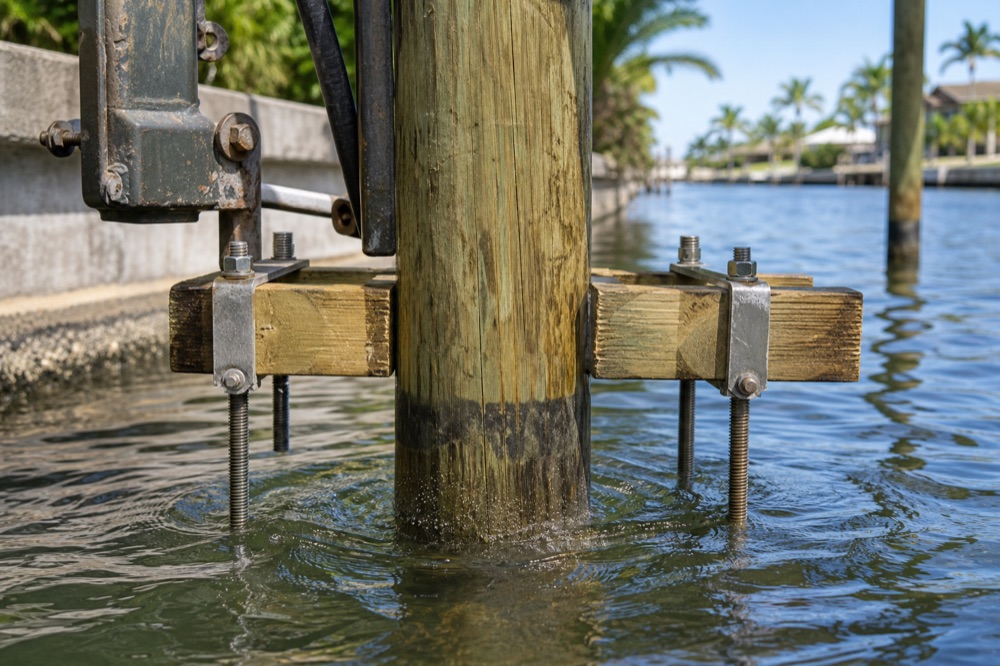
Key takeaways
- Marine borers are saltwater organisms — shipworms (teredo) and gribbles (limnoria) — that tunnel into wood at and below the waterline and hollow a piling from the inside while the outside still looks solid.
- A piling wrap is a tough PVC or HDPE sleeve sealed around the post from above high tide down to below the mudline; by cutting off oxygen and physically sealing the wood, it kills and blocks borers.
- Existing wood pilings can be retrofitted — divers scrape off barnacles and growth, then wrap the cleaned post in place, no need to pull and re-drive it.
- A properly installed wrap routinely lasts 20+ years and is the single detail that separates a wood piling that survives decades from one that fails early on a SW Florida canal.
- The danger is that borer damage is invisible from the dock; a piling can be structurally hollow and still look fine until it snaps under storm surge or lift load.
Your dock can look perfect from the seawall and still be standing on pilings that are quietly turning to honeycomb under the water. On Southwest Florida canals, the number-one thing eating wood pilings isn’t rot or UV — it’s marine borers, saltwater organisms that drill into the wood at and below the waterline and hollow the post out from the inside. The cruel part is they do their worst work where you can’t see it, so a piling can be structurally shot while the part above the surface still looks solid.
The good news: there’s a proven fix that doesn’t require ripping out your dock. A proper piling wrap seals the wood off, cuts off the borers, and routinely lasts 20-plus years — and it works on new pilings and the ones already in your canal.
What exactly are marine borers?
Marine borers are saltwater organisms that bore into and consume submerged wood. On Southwest Florida canals the two that matter are shipworms (teredo) and gribbles (limnoria) — the main reason an unprotected wood piling fails down here.
They’re not “worms” in the garden sense. Shipworms are actually a saltwater clam that rasps tunnels deep into the wood; gribbles are tiny crustaceans that chew away the surface around the waterline. So they hit a piling from two directions — shipworms hollow it from within, gribbles eat the outer wood thin — and both thrive in the warm, full-salinity water of the Caloosahatchee, Charlotte Harbor, and the canals off the Gulf.
Why is borer damage so dangerous — if I can’t even see it?
That’s precisely the danger: borer damage is mostly invisible from the dock, so a piling can be structurally hollow and still look completely normal above the surface.
Shipworms enter through a hole the size of a pinhead and tunnel inside the wood, leaving a thin shell around a hollow core. It holds up under everyday weight, then snaps when it’s loaded hardest — a king tide, storm surge during hurricane season (June through November), or a loaded boat lift. Common signs borers may already be at work:
- Soft or “punky” wood near the waterline that a screwdriver pushes into easily
- A piling that sounds hollow when you tap it, versus the solid thunk of good wood
- Sawdust-like residue or fine wood pulp around the waterline
- Sagging or movement in the dock, or a lift that’s started to lean under load
Don’t wait for the next storm to find the weak post. Our guide on a leaning or loose piling after a storm covers repair versus replacement.
How does wrapping a piling stop marine borers?
A piling wrap is a tough PVC or HDPE sleeve sealed tightly around the post, running from above the high-tide line down to below the mudline. It works two ways: it physically seals the wood off so borers can’t reach it, and it cuts off the oxygen they need to live — killing the ones already inside and blocking new ones from getting in.
The coverage line is what makes it work. The wrap starts above the high-tide line, so it’s never underwater even at the highest tide, and runs down past the mudline into the bottom — sealing the entire band where borers and the wet-dry cycle do their damage. Stop short at either end and you’ve left them a doorway back in.
A properly installed wrap routinely lasts 20 years or more in Southwest Florida salt water — the single biggest factor in whether a wood piling survives decades on a full-salinity canal. For how wrapped wood compares to concrete and composite, see our wood vs. concrete vs. composite pilings breakdown.
Can you wrap pilings that are already in the water?
Yes — existing wood pilings can be wrapped in place if the post is still structurally sound, no need to pull and re-drive them. The retrofit happens right at your dock:
- Inspect and probe near the waterline to confirm there’s enough sound wood to keep.
- Scrape off the barnacles and growth. A diver cleans the piling to bare wood so the wrap seals flush — barnacles left underneath leave gaps that let water and borers back in.
- Wrap from above high tide to below the mudline, then seal and fasten it tightly top and bottom so nothing gets behind it.
The catch is honest assessment: wrapping protects sound wood, but it can’t restore wood that’s already hollow. If borers got there first and the core is shot, you’re looking at piling replacement instead — and we’ll tell you straight which your post needs. (On the cleaning step, see how to remove barnacles from dock pilings.)
Wrap, replace, or build immune? Your real options
When borers are the threat, you’ve got three honest paths — and the right one depends on how much sound wood is left.
| Option | Best when | What you get |
|---|---|---|
| Wrap existing wood | Pilings are still structurally sound | Borer protection in place, 20+ years, no re-drive |
| Replace with wrapped wood | Core is hollow but you want value | New post, sealed from day one, best price |
| Replace with concrete or composite | You want zero borer worry forever | Materials borers can’t touch at all |
If a piling is already hollowed, replacement is the only real fix — and that’s the moment to decide between wrapped CCA wood and stepping up to concrete or composite, both of which borers physically cannot eat. We size that call to your salt exposure and how long you’ll own the home in our how long do dock pilings last guide.
Protect your pilings before the next storm
The pilings are the foundation everything else stands on — your dock, your walkway, your boat lift — and borers don’t announce themselves. The only way to know whether yours are sound, wrappable, or due for replacement is to look at them.
Florida Lifts & Docks has been building and protecting docks, lifts, and seawalls across Southwest Florida since 2008, with our own local crew — never subbed — and 5.0 stars on Google. We’ll inspect your pilings, tell you straight whether a wrap will do the job, and handle the permitting in-house. We give free on-site estimates seven days a week across Cape Coral, Naples, Fort Myers, and the rest of the coast. See what we do on our pilings page and dock repair page — or call (239) 397-3400.