
How Often Do You Need to Re-Thatch a Tiki Hut Roof in Florida?
How often a natural palm tiki hut roof needs re-thatching on the Southwest Florida coast, the warning signs it's due, what re-thatching costs versus rebuilding, and the upkeep that buys you extra years.
Key takeaways
- Plan on re-thatching a natural palm tiki hut roof roughly every 3–6 years in Southwest Florida, with exposed waterfront huts on the short end and shadier, well-built ones on the long end.
- The tell-tale signs it's due are thinning that lets daylight through, drips during rain, sagging or matted fronds, and mold, rot, or pest and bird activity in the thatch.
- Re-thatching usually means refreshing the worn top layers over a sound frame, which costs far less than rebuilding the whole hut — it's a maintenance job, not a teardown.
- A steeper pitch, good airflow, sun, and routine debris clearing all stretch the interval; deep shade and trapped moisture shorten it.
- If you're tired of the cycle, switching to synthetic thatch ends re-thatching for the life of the hut.
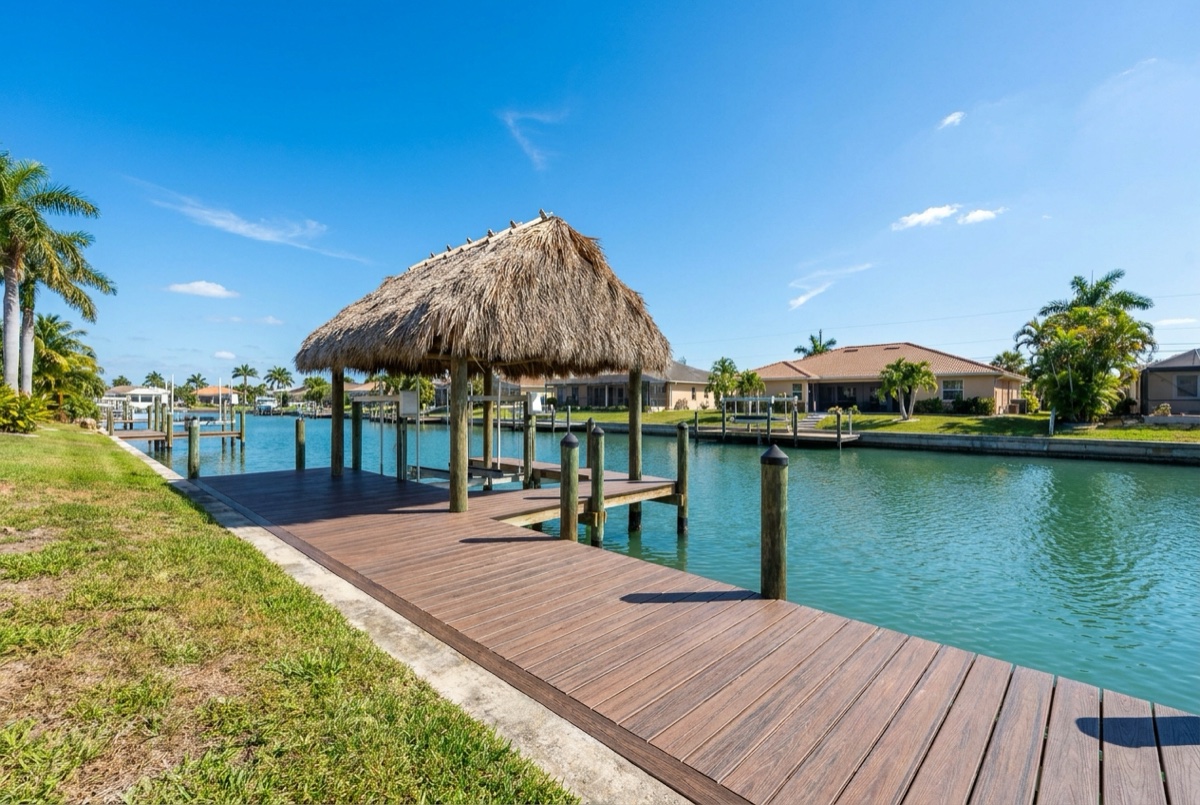
If you’ve already got a tiki hut on a Southwest Florida canal or in the backyard, the question isn’t whether you’ll re-thatch the roof — it’s when. Natural palm thatch is a beautiful, authentic roof, but it’s an organic material on the harshest coast in the state: relentless UV, salt air off the canals and the Gulf, summer humidity, and a hurricane season from June through November. All of that works on the fronds, and eventually the top of the roof gives out.
The good news is that re-thatching is routine maintenance, not a teardown. Here’s how often it’s actually due, the signs your roof is telling you it’s time, what it costs versus rebuilding, and the upkeep that buys you extra years.
How often do you need to re-thatch a tiki hut roof?
Plan on re-thatching a natural palm tiki hut roof roughly every 3 to 6 years in Southwest Florida. Huts in full sun and salt wind right on the water trend toward the short end; shadier, steeper, well-built huts in protected yards can stretch it longer.
First, the core term: re-thatching means refreshing the worn outer layers of palm thatch over a frame that’s still sound — it’s not replacing the hut. Natural thatch, usually sabal palm (the Florida state tree), is laid in overlapping rows and wears from the top down. The uppermost layer takes the full beating of sun and rain and goes first, while the layers beneath keep working, so re-thatching restores the weatherproof skin without touching the structure underneath.
Where your hut lands in that range comes down to exposure, pitch, airflow, and upkeep. A roof in full sun and salt wind ages fastest; a steeper, breezier, well-maintained one lasts longest.
What are the signs my tiki hut roof needs re-thatching?
Your roof tells you when it’s due. The clearest signs are daylight showing through the thatch, drips during rain, sagging or matted fronds, and visible mold, rot, or pest activity.
Don’t wait for a full-blown leak — by then water has been working on the layers below for a while. Look up at the underside on a sunny day, then again during the next rain, and run this checklist:
- Light coming through. Pinpoints of daylight from underneath mean the top layers have thinned past the point of shedding water.
- Leaks or drips. Water reaching the underside, or whatever’s below, is the roof telling you plainly.
- Thinning at the ridge and edges. The peak and most exposed faces wear first — look for bald, patchy, or wind-stripped spots.
- Sagging or matting. Fronds that have collapsed, flattened, or clumped no longer drain the way fresh thatch does.
- Mold, rot, or pests. Dark staining, a musty smell, soft crumbling fronds, or insects and birds nesting in the thatch all signal trouble.
One symptom alone can be watched. Several together — or any active leak — mean it’s time.
Is re-thatching cheaper than replacing the whole tiki hut?
Yes, and it isn’t close. Re-thatching refreshes the worn top layers over a frame that’s still sound, so you’re paying for thatch and labor, not a new structure. A full rebuild only enters the picture if the frame, posts, or pilings have actually failed — which is why we inspect the structure, not just the roof. Thatch is consumable and wears out on a several-year cycle; a properly built frame lasts far longer.
| Situation | What’s happening | The fix |
|---|---|---|
| Worn top layers, sound frame | Normal thatch wear | Re-thatch (the common case) |
| One exposed face gone, rest intact | Uneven sun/wind wear | Partial re-thatch |
| Frame solid, thatch fully spent | End of a thatch lifespan | Full re-thatch |
| Rotted posts, storm-damaged frame, failed pilings | Structural failure | Repair or rebuild |
Because thatch wears from the top down and from the most exposed faces first, a partial re-thatch of just the worn layers or the sun-and-wind side is often all a roof needs. We price tiki work free, on-site, after confirming the frame is sound. For how the overall numbers break down, see our tiki hut cost guide.
How can I make tiki hut thatch last longer?
Keep it dry and airy. Most premature thatch failure on the coast comes down to trapped moisture and accumulated debris, and both are easy to stay ahead of. Simple upkeep that stretches the interval:
- Clear debris. Pull leaves, twigs, and litter off the roof so it drains and breathes. Wet debris holds moisture against the thatch and invites rot.
- Trim overhanging branches. Limbs that drop litter and cast deep shade are the enemy of long-lasting thatch. Open it up to sun and breeze.
- Address mold and pests early. A small mold patch or a nesting insect problem is cheap to handle now and expensive to ignore.
- Check it after storms. Hurricane season is the wild card — a strong blow can strip fronds and turn a roof with a couple of good years left into one that needs attention now. Patch stripped sections before they spread. (More in our hurricane prep and repair guide.)
None of this is hard, but it’s the difference between a roof that goes the long end of the range and one that’s leaking in three.
When does it make sense to switch to synthetic instead?
A re-thatch is the moment to consider it. Quality synthetic thatch is rated for decades and never needs re-thatching — it doesn’t rot, mold, or feed insects, so the clock simply stops. You’re already paying for labor on the roof, so it’s worth asking whether you’d rather be done with it. Synthetic costs more to install, but you skip every future re-thatch bill, and on an exposed waterfront lot — the same harsh spot that drives the cost of any custom dock — that durability pays off fastest. If you love the authentic look and don’t mind the upkeep, natural palm is still a great roof; our palm vs. synthetic comparison weighs both in full.
Wondering whether your tiki hut roof is just weathered or genuinely failing? We’ll come tell you. We give free on-site estimates seven days a week across Cape Coral, Naples, Fort Myers, and the rest of Southwest Florida — and as a local crew building and maintaining these huts since 2008, never subbed out, we’ll tell you straight whether you need a quick re-thatch, a partial refresh, or something more. See our tiki huts page, or call (239) 397-3400.