
Natural Palm vs. Synthetic Thatch for a Tiki Hut: Which Lasts Longer in Florida?
Real sabal-palm thatch or synthetic thatch for your Southwest Florida tiki hut? Here's how each holds up to salt, sun, and hurricane season — and how to choose.
Key takeaways
- Natural sabal-palm thatch lasts about 5–15 years and needs periodic re-thatching; synthetic thatch is rated for roughly 15–50 years with near-zero upkeep.
- Natural palm costs less up front and gives the authentic Old-Florida look; synthetic costs more up front but usually costs less over the life of the hut.
- Synthetic resists wind blow-off, salt, UV, mold, and insects better — a real edge on exposed waterfront and during hurricane season.
- Whichever roof you pick, the frame, fastening, and permit-driven engineering matter as much as the thatch — we build to code and permit in-house.
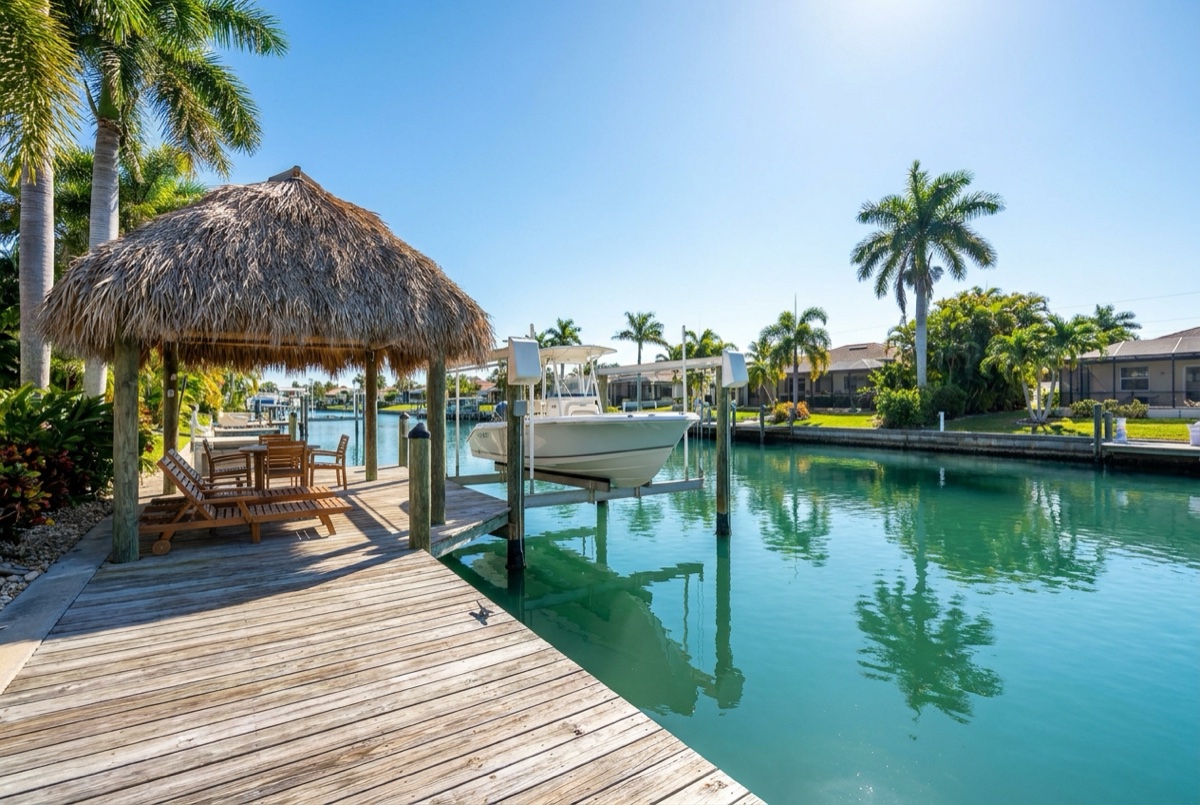
A tiki hut turns a hot, exposed backyard or dock into the spot everyone actually wants to be — shade over the grill, a dry place to ride out an afternoon downpour, and that unmistakable Old-Florida feel a few steps from the water. Once you’ve decided you want one, the first real fork in the road is the roof: natural palm thatch or synthetic thatch?
First, the term: thatch is the woven roofing layer that gives a tiki hut its look — the weatherproof skin laid over the frame in overlapping rows. You’ve got two ways to build it. Natural palm thatch uses real dried palm fronds, most often sabal palm (the Florida state tree) or thatch palm, hand-tied in layers — the authentic, traditional Seminole-style roof. Synthetic thatch uses molded plastic or polyethylene “fronds” engineered to mimic the real thing; from a few feet away most people can’t tell, while up close it reads a touch more uniform. Both make a beautiful hut. The difference is almost entirely in how each holds up on the Southwest Florida coast — the relentless UV, salt air off the canals and Gulf, summer humidity, and hurricane season from June through November.
Which lasts longer in Florida?
Synthetic thatch lasts far longer. A natural palm roof typically goes about 5 to 15 years in our salt-and-sun climate before it needs re-thatching, while quality synthetic is rated for roughly 15 to 50 years and barely notices the weather.
Our coast is brutal on natural materials. UV bakes them, salt air degrades them, humidity invites mold, and palm fronds are organic — so insects, birds, and rot all have an opening. Natural thatch works, but it wears, and the top layer goes first. Synthetic thatch is plastic, so salt, sun, mold, and bugs have nothing to eat. Here’s the head-to-head:
| Natural palm thatch | Synthetic thatch | |
|---|---|---|
| Up-front cost | Lower | Higher |
| Lifespan in salt + sun | ~5–15 years | ~15–50 years |
| Re-thatching | Periodic (every several years) | Essentially none |
| Maintenance | Ongoing; debris, rot watch | Near-zero; occasional rinse |
| Wind / blow-off resistance | Good; fronds can shed | Better; molded, fastened tight |
| Mold, insects, birds | Vulnerable | Resistant |
| Look & feel | Authentic, natural | Very close, slightly uniform |
| Cost over the life of the hut | Higher (re-thatch bills) | Lower |
Why owners choose natural palm
Natural palm isn’t the wrong answer — it’s a different set of trade-offs, and plenty of owners love it:
- Authentic look and feel. Nothing matches the texture, color variation, and smell of a real palm roof. If you want true Old-Florida character, this is it.
- Lower up-front cost. A natural thatch roof is generally cheaper to install than synthetic.
- Repairable in layers. You don’t always replace the whole roof — often you re-thatch the worn top layer and extend the life of what’s underneath.
The catch is the ongoing commitment. You’ll re-thatch on a schedule, watch for trapped moisture and rot, and clear debris so the roof breathes and drains. Skip that upkeep on a saltwater canal and the roof wears out years sooner. If you love the real thing and you’re fine with maintenance, it’s a wonderful choice — we just want you going in with eyes open. (Our re-thatch guide walks through the schedule.)
Why synthetic thatch wins on durability
If lifespan and low maintenance top your list, synthetic is hard to beat — especially on an exposed waterfront lot:
- Decades of life. Rated for roughly 15 to 50 years, it outlasts several natural re-thatch cycles.
- Near-zero maintenance. No re-thatching, no sealing — an occasional rinse and you’re done.
- Better blow-off resistance. Molded fronds fastened to the frame hold tighter in high wind than loose natural fronds — it matters through hurricane season.
- It doesn’t absorb water. Synthetic sheds rain and dries instantly, so you skip the mold-prone, slow-drying underside that plagues neglected natural roofs.
- No food for pests. Salt, UV, mold, insects, and nesting birds have nothing to feed on.
The trade-off is honest: synthetic costs more up front, and to a sharp eye it looks a hair more uniform than a hand-tied palm roof. But because you skip the re-thatch bills, it typically costs less over the life of the hut — you pay once instead of every few years.
How should SW Florida salt, sun, and storms steer your choice?
Let your site and your tolerance for upkeep decide: the more exposure your hut faces, the more synthetic earns its premium. A hut right on the water — over a dock, on a seawall, or on an open canal-front lot taking full sun and salt wind — sees the harshest exposure, so durability pays off and synthetic makes sense. (Yes, you can often put a hut over a dock, site and permits allowing.) A tucked-in, shadier backyard is friendlier to natural palm, as long as you mind airflow and pitch so trapped moisture doesn’t invite rot. Either way, a steeper roof sheds rain and dries faster, which helps both materials last.
Does the frame matter more than the thatch?
Yes — the roof you see is only half the hut, and the frame is what makes a tiki hut survive a hurricane. A well-built hut handles wind better than people expect, because the open sides let gusts pass through instead of catching like a wall.
That engineering is the whole game. We build to current Florida wind-load code, fasten the structure properly, and handle the entire permitting process in-house — tiki huts in Southwest Florida are regulated and the rules vary by city and county. A roof, natural or synthetic, is only as safe as the frame and connections under it.
So which should you choose?
For maximum lifespan, near-zero maintenance, and the best storm and salt resistance — especially on the water — we lean synthetic thatch. The re-thatch bills you’ll never pay usually make it the better value over time, even with the higher up-front cost. If you want the authentic Old-Florida look and don’t mind re-thatching every several years, a natural palm roof is a beautiful choice and costs less to start. There’s no wrong answer — just the right one for your site and your appetite for upkeep.
We won’t put a hard dollar figure on your hut from a blog post — too much rides on size, location, water exposure, and your thatch choice. For real numbers see our tiki hut cost guide, and remember the roof is just one piece; the frame and permitting factor in too. We handle the permits in-house so you’re not chasing paperwork.
Ready to compare natural and synthetic for your own backyard or dock? We give free on-site estimates seven days a week across Cape Coral, Naples, and the rest of the coast. See everything we build on our tiki huts page, or call (239) 397-3400.