
Jet Ski Lifts for Shallow Water & Low Tide in Southwest Florida
Will a jet ski lift work in your skinny canal? How much water a PWC really needs, why cheap setups strand at low tide, and the styles built for a 2.5-ft swing.
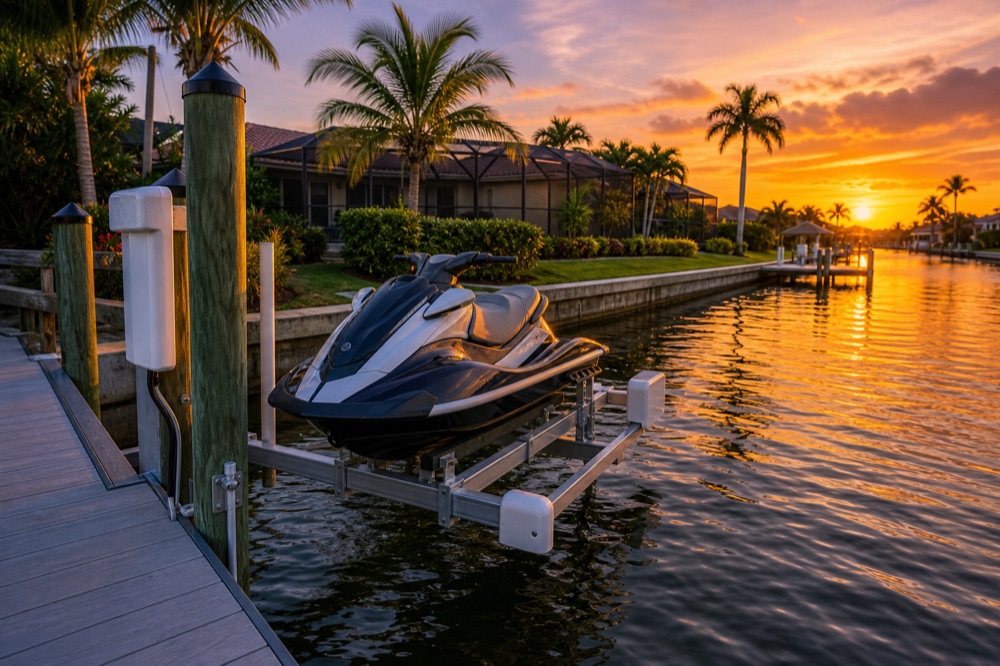
Key takeaways
- A jet ski lift can absolutely work in a shallow canal — the trick is designing around your depth at mean low water, not the depth you see at high tide.
- A loaded PWC needs only a couple of feet to float and a little extra to drive on and off, far less than a powerboat, which is why lifts work in skinny water where boats can't.
- Many SW Florida canals swing up to ~2.5 ft between Gulf-driven tides; a cheap fixed lift set for high water leaves the cradle stranded above the PWC at low tide.
- Two styles solve it: a shallow-water/elevator jet ski lift that drops the cradle low at any tide, or a drive-on floating port that rests on the bottom at low tide and refloats as the water returns.
- Measure your slip depth at the lowest tide of the cycle before you buy — that single number decides the right product.
If your canal goes skinny at low tide, you know the worry: the jet ski floats fine at high water, but drop a foot or two and the bottom of your slip turns to exposed mud. Plenty of Cape Coral and Charlotte Harbor owners assume that means a lift is off the table. The good news is that a personal watercraft is the easiest thing on the water to lift in shallow conditions, because it barely draws any water to begin with.
So the question almost every owner asks — will a jet ski lift work in my shallow canal? — has an honest answer: yes, in nearly every case, as long as the lift is designed around your real low-tide depth. Here’s how much water a PWC actually needs, why cheap setups strand at low tide, and the two styles built for a Southwest Florida canal that swings up to about two and a half feet.
How much water does a jet ski actually need to float and load?
A loaded personal watercraft floats in roughly two feet of water and needs only a little more to drive on and off — far less than any powerboat. That low draft is exactly why lifts work in skinny canals where a boat would be stuck.
A jet ski lift is a small version of a boat lift: two piling-mounted legs and a cradle that a motor (electric, hydraulic, or hand-crank) raises and lowers. Because a PWC weighs only a few hundred to a thousand-plus pounds and draws inches, the cradle doesn’t need to drop nearly as deep as a boat lift’s. A center console might need 3+ feet at low tide to clear its lower unit, so a canal that’s “too shallow for a boat” is often fine for a jet ski. The catch: “fine” depends entirely on your depth at the lowest tide — not the comfortable depth you see at high water.
Why does a cheap jet ski lift strand the craft at low tide?
Because a basic fixed lift is set for high water, so when the tide falls a foot or two the cradle can’t drop far enough to float the craft — it sits stranded until the tide returns.
Southwest Florida canals fed by the Caloosahatchee, Charlotte Harbor, and the Gulf routinely swing up to about 2.5 feet between tides, and storms push water far beyond that. A cheap, short-travel lift legged for the high-water line has nowhere to go when the water leaves. Several things make it worse on our coast:
- Tide range. A 2-plus-foot swing means the cradle has to travel much farther than on a still-water lake.
- Bottom composition. Soft Charlotte Harbor mud lets a cradle settle in; hard sand or rock limits how low it can safely drop.
- Wrong style. A standard lift often can’t be set both high enough to clear surge and low enough to float at dead low.
This is a design problem, not a motor problem — a bigger motor won’t lower the cradle past where the legs allow. You need a lift built for the swing.
Which jet ski lift styles handle a shallow, low-tide canal?
Two designs solve skinny water reliably: a shallow-water or elevator-style jet ski lift that drops the cradle low at any tide, and a drive-on floating port that rests on the bottom at low tide and refloats. Both keep the PWC out of the salt at every stage of the tide.
A shallow-water / elevator jet ski lift is engineered for long cradle travel. The cradle drops well below the high-tide line so the craft floats on and off even at dead low, then lifts the whole hull clear of the water between rides. It’s piling-mounted, so you get the same full-out-of-the-salt protection as a standard lift.
A drive-on floating port takes a different path: a buoyant HDPE platform tethered to your seawall that you gun the throttle to climb onto. Because it floats, it rides the tide automatically — and in a canal that goes truly skinny, it rests gently on the bottom at low tide and refloats. No power, no pilings, no stranding.
Here’s how the two compare:
| Factor | Shallow-water / elevator lift | Drive-on floating port |
|---|---|---|
| Handles ~2.5-ft tide swing | Yes — long cradle travel | Yes — follows the tide |
| At dead low tide | Cradle drops low to float craft | Rests on bottom, refloats |
| Keeps hull out of salt | Fully out between rides | Hull at waterline, mostly out |
| Needs power | Optional (electric/hydraulic/manual) | None |
| Needs pilings | Yes | No — anchors to seawall/dock |
| Typical installed cost | $3,000–$5,000 | Quoted free on-site |
Rule of thumb: choose a shallow-water lift if you have power and want the hull bone-dry 24/7, and a floating port if you have no shore power or a canal too tight for piling-mounted legs. Our neutral jet ski lift vs. floating dock guide covers the full trade-offs.
How do I measure my slip depth at mean low water?
Measure the depth in your slip at the lowest tide of the cycle — that mean-low-water number decides the product, not the depth at high tide. Do this before you shop, and bring the numbers to your estimate:
- Pull a tide chart for your area, find the lowest low of the next few days, and measure then.
- Measure at dead low with a weighted line or a marked pole, right where the cradle or port will sit.
- Note the bottom — soft mud, firm sand, or rock affects how low a cradle can drop and how a port settles.
- Know your loaded weight, since that drives the lift capacity (see jet ski lift size by weight).
The same low-water logic scales up if you also run a boat off the dock (see boat lift for shallow water and low tide), and on a tight canal, seawall-mounting saves room.
Built to last in skinny SW Florida salt water
Whichever style fits your canal, the materials decide how long it survives our hurricane-season surge and relentless UV — a unit built for fresh-water lakes won’t last on a brackish, sun-baked Gulf-coast canal. Everything we install is spec’d for salt: marine-grade aluminum frames that won’t rust through, 316 stainless cable and hardware, and sealed marine motors on powered units. Floating ports get UV- and saltwater-rated HDPE and corrosion-resistant anchoring. As a Cape Coral-based crew working these canals since 2008, we never sub the work out, and permitting is handled in-house.
The bottom line: a skinny canal is rarely a reason to leave a jet ski floating in the salt. The right shallow-water lift or floating port gets it up and out at every tide — and the only way to know which fits your slip is an on-site look at your low-water depth, seawall, and bottom. We give free on-site estimates seven days a week across Cape Coral, Naples, Fort Myers, and up into Charlotte Harbor. See what we build on our jet ski lifts page, explore floating docks, or call (239) 397-3400.