
How to Keep Birds Off Your Dock & Boat Lift Canopy
Pelicans, cormorants, and herons treat your canopy like a perch. Here's what actually keeps SW Florida waterfront birds off your dock and lift, ranked by how well it really holds up.
Key takeaways
- A monofilament line system, strands of fishing line strung a few inches above the canopy frame and piling caps, is the single most effective bird deterrent on SW Florida docks.
- Bird droppings are acidic, they stain composite and wood decking, break down canopy fabric over time, and film over fish-light lenses so they go dim.
- Reflective and spinning deterrents (flash tape, spinners, reflective rods) work at first but birds get used to them within weeks; rotate and reposition them.
- Decoys (owls, alligator heads, coyotes) only keep working if you move them every few days, a decoy that never moves becomes a perch.
- The most reliable setup is a combination, monofilament as the backbone plus a rotated visual deterrent, not any single gadget.
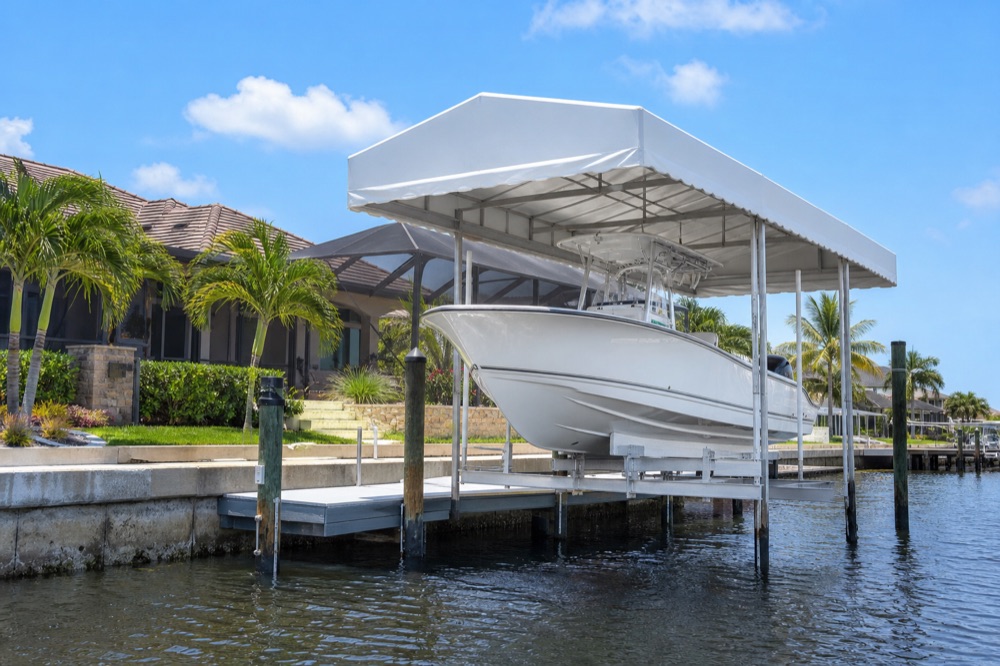
If you own waterfront in Southwest Florida, you know the routine. You detail the boat on a clean Saturday, and by morning your lift canopy, piling caps, and a stretch of decking are streaked white. Pelicans, cormorants, herons, ospreys, and gulls all see your dock the way you’d see a bench at a bus stop, a place to rest, dry their wings, and watch the canal. From Cape Coral’s canals to the Caloosahatchee, it’s one of the most constant, least-talked-about annoyances of waterfront life.
The good news: you don’t have to live with it. Below we rank the deterrents that actually work here, with honest notes on what holds up and what fades.
What’s the single most effective way to keep birds off a dock and boat lift?
A monofilament line system, lengths of heavy fishing line strung a few inches above the canopy frame, ridge, and piling caps, is the most effective and longest-lasting deterrent we see. It removes the flat landing spot birds want without harming them, and it works year after year.
A monofilament (mono) system is just clear, heavy-gauge fishing line run taut across the top of your canopy and over your piling caps, a few inches off the surface. When a pelican or cormorant comes in to land, the line catches its wings or feet just enough to make the spot feel unstable, so they move on without getting hurt.
Why it beats everything else:
- It’s nearly invisible, so it doesn’t ruin the look of a nice dock or boathouse.
- Birds don’t habituate to it. Unlike a spinner or a fake owl, there’s nothing to “get used to”, the physical obstacle is the same every time.
- It’s cheap and serviceable. Mono is inexpensive, and a snapped strand is a five-minute fix.
The one catch in our salt-and-UV climate: sun and salt break monofilament down over time. Walk the lines a couple of times a year, plus after any storm, and re-tension or replace any that have gone brittle.
How do spinning and reflective deterrents compare?
They help at first but fade fast. Reflective flash tape, spinning rods, hanging CDs, and pinwheels startle birds for a few days to a few weeks, then most figure out the flash is harmless and come right back.
These work on a bird’s instinct to avoid sudden flashes of light and movement, and on a breezy canal they buy real short-term relief for very little money. The problem is habituation, SW Florida birds see your dock every day, and once nothing bad ever happens near the spinning thing, they ignore it.
To get the most out of them:
- Rotate and reposition every week or two so the “threat” stays unpredictable.
- Place them where wind and sun hit so they actually move and flash.
- Treat them as a supplement to a mono system, never a replacement.
Do decoys like owls and alligator heads work?
Only if you move them. A plastic owl, a floating gator head, or a coyote silhouette can scare birds off for a few days, but the moment they realize it never moves, they’ll perch right on top of it.
Decoys play on a real fear, ospreys and herons genuinely avoid owls and gators. But the illusion only lasts as long as the decoy seems alive. The biggest mistake we see is bolting a plastic owl to a piling and walking away. Within a week it’s an expensive bird perch.
To keep decoys earning their keep:
- Move them every two to three days to a new spot on the dock.
- Choose decoys with motion, bobble heads, wind-spun wings, or drifting gator heads hold up far better than a static statue.
- Combine predator types and swap them out so the birds never settle on a routine.
Which deterrents actually last? A quick comparison
Here’s how the main options stack up on a real SW Florida dock, where salt, UV, and year-round birds test everything.
| Deterrent | How well it works | How long it lasts | Best use |
|---|---|---|---|
| Monofilament line system | Excellent | Months to years (re-tension after storms) | The backbone of any setup, canopy + piling caps |
| Spinning / reflective | Good at first, fades | Days to a few weeks before habituation | Supplemental layer; rotate often |
| Decoys (owl, gator, coyote) | Good only if moved | Days, unless repositioned constantly | Extra deterrent; move every few days |
| Bird spikes | Good on flat rails | Long, but limited coverage | Narrow rails and ledges, not fabric canopies |
The takeaway most owners land on: run monofilament as your foundation, then add a rotated visual deterrent on top. No single gadget wins alone, but that combination keeps even the boldest pelicans honest.
Why do bird droppings matter this much?
Because they’re acidic and corrosive, and on a dock they do real, lasting damage. Bird droppings stain decking, break down canopy fabric, attack hardware, and film over fish-light lenses, so this isn’t just an eyesore, it’s a longevity problem. Here’s what they’re actually doing on the water:
- It stains and degrades decking. On capped composite like TimberTech or Trex, dried droppings leave marks that are a pain to remove; on wood, the acid works into the grain. See our guide to cleaning composite dock decking in saltwater.
- It eats your canopy. Acidic droppings baked on by the sun shorten canopy-fabric life, exactly the surface birds target most.
- It corrodes hardware. Paired with salt air, droppings accelerate corrosion, one more reason we build with 316 stainless and marine-grade aluminum.
- It dims your fish lights. Droppings and the algae they feed coat underwater lenses, cutting the glow that draws bait and snook. If yours have gone dim, our fish-light cleaning guide walks through the fix.
The simple rule: rinse droppings off with fresh water before they bake on. It takes two minutes, saves scrubbing, and fits the same routine you already run for salt-water boat-lift maintenance.
Get a dock built to take it, birds and all
A dock built for this coast also fights birds for you, fewer flat perches, capped composite decking that wipes clean, and 316 stainless hardware that shrugs off acidic droppings. Well-capped pilings even make a monofilament system easier to run. It won’t make the birds vanish, but it stacks the deck in your favor.
Florida Lifts & Docks has built and serviced docks and lifts across this coast since 2008, with our own local crew, in-house permitting, and a 5.0-star reputation. Explore our boat lifts and custom docks, or see what well-placed fish lights can do for your dock. We give free on-site estimates seven days a week across Cape Coral, Naples, and the rest of Southwest Florida. Call (239) 397-3400 and let’s talk.