
How Much Does Rip-Rap Cost Per Linear Foot in Southwest Florida?
The honest, line-by-line breakdown of what rip-rap actually costs per foot on a SW Florida shoreline — and the site factors that move the number up or down.
Key takeaways
- Rip-rap is priced per linear foot because shoreline protection is measured along the waterline — but the real per-foot number depends entirely on your site, so every shoreline is quoted free on-site. Longer continuous runs trend cheaper per foot; tough access and heavy earthwork push it higher.
- The biggest cost drivers are linear footage, rock size/class, equipment access (barge vs. land), filter fabric and bedding stone, slope grading, and permitting.
- A rip-rap revetment is usually cheaper per foot than a vinyl or concrete seawall, because it's placed armor rock instead of an engineered wall with pilings, cap, and tiebacks.
- There's no honest flat per-foot price online — your real number depends on your bank, your water, and your access, which is why every job is quoted free on-site.
If you’re protecting an eroding bank or armoring the toe of a tired seawall, the first question is always the same: what does rip-rap cost per linear foot? It’s a fair question, and most contractors dodge it with a vague “it depends.” We’ll give you the honest answer up front, then show you exactly what moves the number — so when you get a quote, you understand every dollar in it.
Here’s the honest part most competitors won’t put in writing: there is no accurate flat per-foot price for rip-rap, because no two shorelines are the same. What we can do is walk you through the site factors that decide whether your shoreline lands on the economical end or the expensive end — and then quote your exact lot free on-site, across Cape Coral, Fort Myers, Naples, and up into Charlotte Harbor.
What does rip-rap cost per linear foot in Southwest Florida?
There’s no honest flat per-foot price for rip-rap, because no two shorelines are the same — so we quote every job free on-site. What we can tell you is exactly what moves the number: linear footage, rock class, access, fabric, slope, and permitting.
That’s a wide set of variables on purpose, because the inputs genuinely vary. A long, straight run on a calm canal with a clean yard to drive equipment through prices very differently than a short, isolated stretch you can only reach by barge. That’s why we don’t publish a flat number — your shoreline writes the quote.
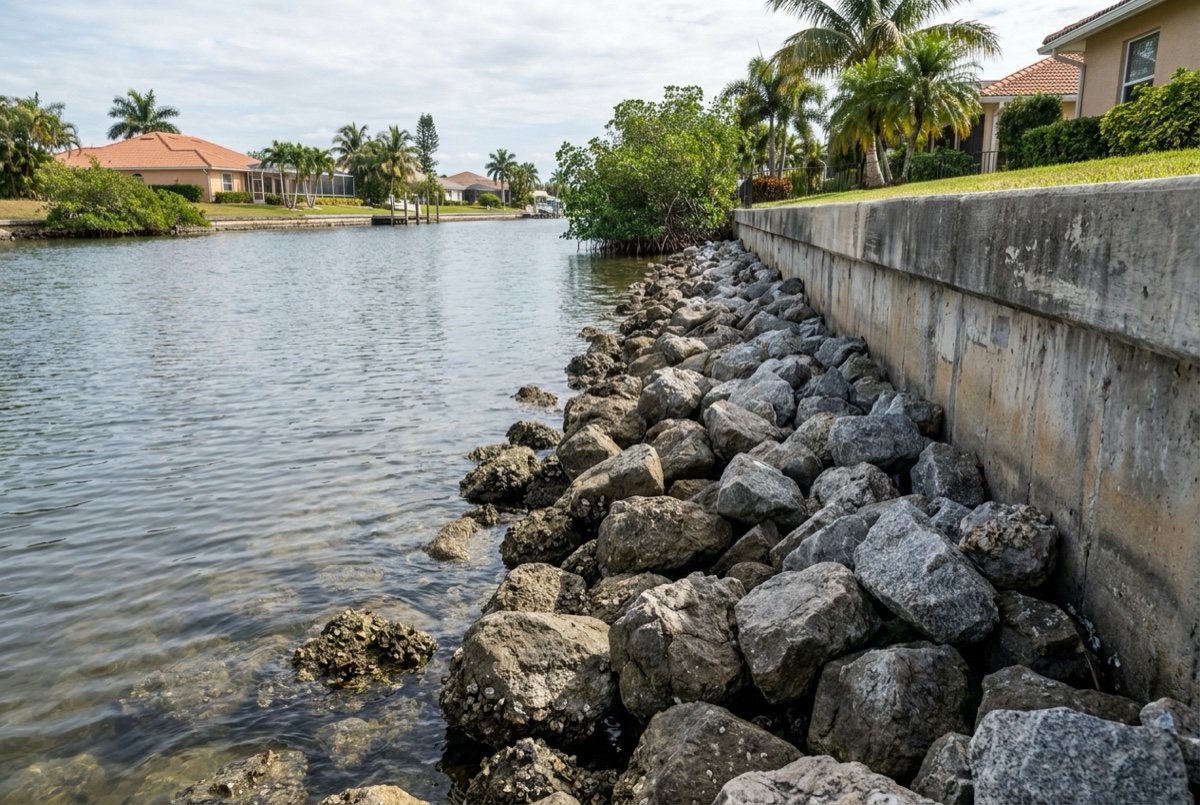
First, a quick definition so the rest makes sense. Rip-rap (also called a rock revetment) is a sloped layer of heavy armor stone placed along your shoreline. Instead of fighting wave energy with a rigid vertical face the way a seawall does, rip-rap absorbs and dissipates it across a sloped pile of interlocking rock. The water climbs the slope, loses its punch in the gaps between stones, and runs back out — so the bank behind it stops washing away. If you’re still weighing the two approaches, our rip-rap vs. seawall guide breaks down which fits which shoreline.
What actually drives the per-foot price?
The per-foot number moves with six main factors: linear footage, rock size and class, equipment access, filter fabric and bedding, slope grading, and permitting. Each one can shift your quote up or down meaningfully.
Here’s how each one plays out on a real Southwest Florida shoreline:
- Linear footage. This is the biggest lever, and it works in your favor on longer jobs. Mobilizing a crew, an excavator, and rock delivery costs roughly the same whether your run is 40 feet or 140 feet — so spreading that fixed cost across more footage drops the per-foot price. Short, isolated runs almost always price higher per foot.
- Rock size and class. Armor stone is sold by size and gradation. A protected canal that only sees boat wakes needs smaller, lighter stone than an exposed lot on open water or near the Caloosahatchee or Charlotte Harbor, where storm surge and chop demand larger, heavier rock. Bigger armor stone costs more to buy, haul, and place — and it’s heavier to set correctly.
- Equipment access. Can we drive an excavator down your side yard to the bank, or is the only way in by water? Land access is far cheaper. Barge work — staging rock on the water and placing it from a floating platform — adds real cost in mobilization and time, but on tight canal lots or homes with no yard access, it’s the only way to do the job right.
- Filter fabric and bedding. Under the visible armor rock, a proper revetment needs a layer of geotextile filter fabric and often a bedding layer of smaller stone. This is what keeps your soil from washing through the gaps in the rock over time. Skipping it is how cheap rip-rap fails in a few seasons. It’s a modest material cost that protects the whole investment.
- Slope grading. If your bank is already a reasonable slope, prep is light. If it’s a steep, undercut, or actively collapsing edge — common on lots where erosion has been ignored for years — we have to regrade and shape it before any rock goes down. The more earthwork, the higher the cost.
- Permitting. Shoreline work requires permits, and depending on the waterway, the city, county, or state may be involved. We handle this in-house, but it’s part of the project scope, not an afterthought.
How does rip-rap pricing compare to a seawall?
Per linear foot, rip-rap is usually the cheaper of the two. A revetment is placed armor rock, while a seawall is an engineered structure with driven pilings, panels, a poured cap, and tiebacks — far more material and labor.
That said, the comparison isn’t apples to apples, because the two protect your shoreline in different ways and take up different amounts of space. Rip-rap slopes into the water and needs room; a seawall holds a clean vertical edge in a tight footprint. Here’s the quick contrast:
| Factor | Rip-rap revetment | Seawall |
|---|---|---|
| Relative cost per linear foot | Often lower | Often higher |
| Footprint | Slopes 10–20 ft into the water | Tight, vertical edge |
| What it does | Absorbs wave energy across a slope | Holds the waterline rigidly |
| Permitting in SW FL | Generally smoother (favors natural slopes) | More scrutiny on new vertical hardening |
| Components that can fail | Few — no cap, panels, or tiebacks | Cap, panels, tiebacks all wear in salt |
If your existing wall is leaning or scouring at the base, rip-rap is also a common, cost-effective way to armor the toe and buy years of life — sometimes instead of a full seawall replacement. The right call depends on what the wall is actually doing, which we assess on-site.
What does rip-rap cost on a typical Cape Coral canal lot?
For a standard Cape Coral canal lot — roughly 80 feet of straight, accessible waterline on a calm saltwater canal — rip-rap usually lands toward the more economical end of what we quote, because the run is long enough to spread mobilization but the site isn’t difficult.
Let’s walk a realistic scenario so you can see how the factors stack:
- The lot: ~80 linear feet of seawall-line on a protected Cape Coral canal, with a side yard the excavator can reach the bank through.
- The water: A calm canal that sees boat wakes, not open-water chop — so standard armor stone, not the heaviest class.
- The bank: Some erosion at the base but no full collapse, so moderate grading.
- The build: Filter fabric and a bedding layer under graded armor rock, sloped from the top of the bank into the water.
A lot like that prices on the more favorable side — long enough to spread mobilization, but with normal grading, fabric, and bedding.
Now change one variable. Make it a 35-foot run boxed in by a pool cage and a neighbor’s dock so the only access is by barge, and the same work prices noticeably higher per foot — fewer feet to spread costs across, plus water-staging and barge time. That’s exactly why we don’t publish a single number: your shoreline writes the quote, not a spreadsheet.
Why won’t you just give me a flat per-foot price?
Because an honest number requires seeing your shoreline. Rock class, slope height, access, fabric, and permitting all change the math, and a flat price online would either overcharge the easy jobs or under-budget the hard ones.
We’d rather under-promise and quote you accurately than quote a teaser rate and “discover” costs later. When we come out, here’s what we’re actually measuring:
- Your linear footage and the shape of the run
- How exposed your water is — canal calm vs. open-water chop
- How we get rock to the bank — drivable yard vs. barge
- The condition and slope of your existing bank
- Whether rip-rap should tie into an existing dock, lift, or seawall
That last point matters more than people expect. A revetment doesn’t have to block boating access — we routinely design docks and lifts that span a rip-rap slope on pilings driven through and beyond the rock to reach deeper water. It takes planning, but rock protection and full waterfront use work together all the time on SW Florida shorelines.
A properly built revetment — graded slope, filter fabric, bedding, correctly sized and seated armor stone — is one of the most durable, lowest-maintenance shoreline solutions there is. It has no cap to crack, no panels to corrode, and no tiebacks to fail. Built right the first time, it flexes and settles with the seasons and protects your bank through hurricane season and decades of tide, salt, and UV. Built cheap, it slumps and lets your yard wash into the canal. The spec is where the value lives.
Get a real rip-rap number for your shoreline
Rip-rap is one of the best values in shoreline protection — but the only price worth trusting is one based on your actual bank, water, and access. We’re a local Cape Coral crew that’s been armoring Southwest Florida shorelines since 2008, we never sub the work out, and we handle permitting in-house.
See everything that goes into a proper revetment on our rip-rap page, then let us come measure your shoreline. We give free on-site estimates seven days a week across Cape Coral, Naples, Fort Myers, and the rest of the coast — no fabricated totals, just a straight number for your lot. Call (239) 397-3400 to set it up.