
Can Rip-Rap Save a Failing Seawall? Stopping Toe Scour With Rock
Toe scour quietly undermines more Southwest Florida seawalls than any other cause. Here's how a row of armor rock at the base stops it and buys your wall years.
Key takeaways
- Toe scour — current and wave action carving away the sand at the base of the wall — is the number-one cause of seawall failure on SW Florida canals, because it removes the support the wall stands on.
- A band of properly sized armor rock (rip-rap) placed against the toe absorbs wave energy and stops the scour, protecting the foundation and often adding years of life to an otherwise sound wall.
- Rock at the toe is a smart stopgap when the wall itself is still straight and structurally intact; it is not a fix for a wall that is already leaning, bowing, or losing panels.
- Rip-rap has no cap to crack, no tiebacks to corrode, and no panels to fail — it flexes and settles instead of fighting pressure, so it ages gracefully in salt water.
- An on-site look at the toe, the cap, the joints, and the soil behind the wall is the only way to know whether rock buys you years or you're past the point of repair.
If your seawall is starting to settle, crack, or tip toward the canal, the culprit is very often hiding underwater where you’d never think to look — right at the base of the wall, below the waterline. It’s called toe scour, and it’s the single most common reason seawalls fail on the Southwest Florida coast. The good news: when scour is the problem and the wall itself is still sound, there’s a fix far less invasive and far cheaper than tearing out the whole structure — a band of armor rock placed at the toe.
This is the companion to our diagnostic guide on the signs your seawall is failing. That one tells you how to spot trouble. This one is the rip-rap fix — when rock at the toe can save your wall, how it works, and when the wall is too far gone and replacement is the smarter call.
What is toe scour, and why does it cause seawalls to fail?
Toe scour is the erosion of the soil at the base — the toe — of your seawall, carved away by current, boat wakes, tides, and storm surge. Because it happens underwater, it quietly undermines the wall’s foundation long before you see anything wrong at the surface.
Here’s the mechanism. Your seawall isn’t just a wall standing in the water; it’s a wall standing on the soil beneath it, counting on that soil for support. On a Southwest Florida canal the water never stops moving — twice-daily tides, wakes from every passing boat, and storm surge during hurricane season from June through November. When that moving water hits a flat vertical wall, it rebounds downward and scoops sand out of the bottom right at the toe.
Lose enough of that sand and the wall has nothing to stand on. It settles, the cap cracks, joints pull apart, and eventually the whole structure tips toward the canal. Scour is so dangerous precisely because it works below the waterline where you can’t see it — by the time the wall is visibly leaning, the foundation has been failing for a while. (It’s also a frequent driver of the erosion and sinkholes that open up behind a seawall.)
How does rip-rap at the toe stop the scour?
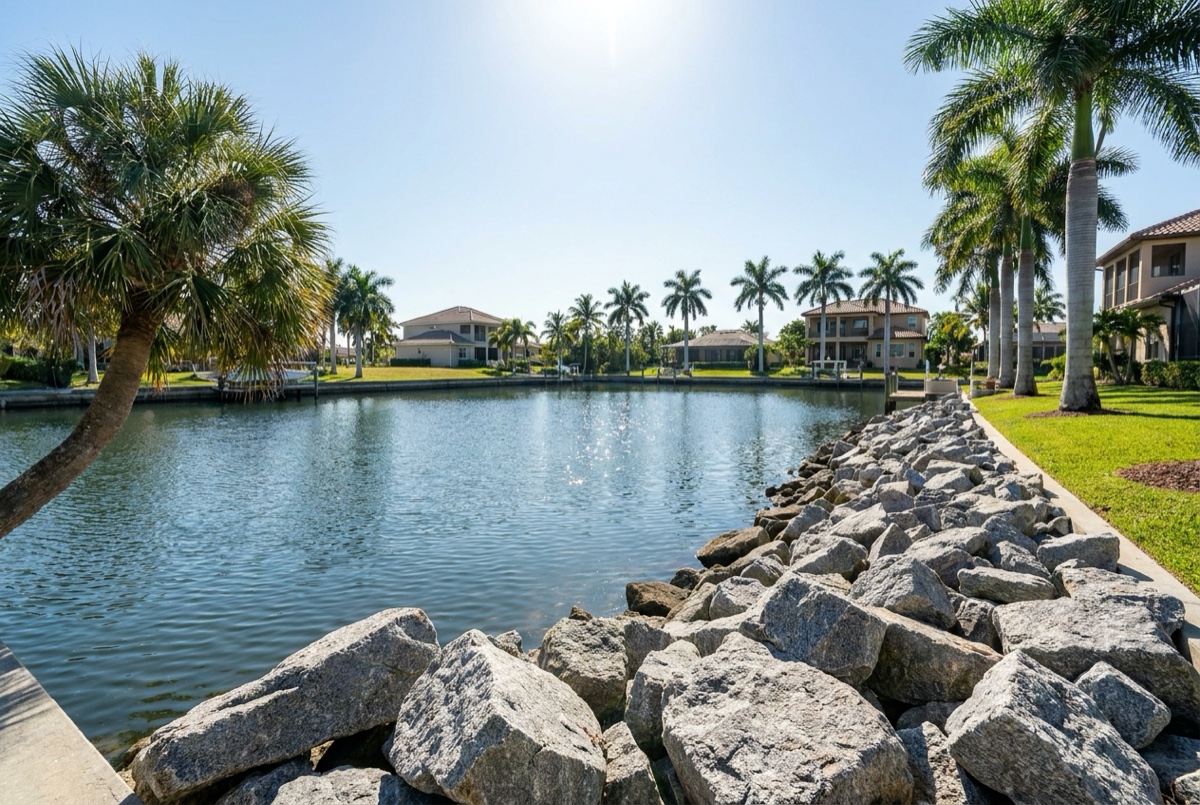
Rip-rap is a pile of heavy, angular armor rock placed against the base of the wall. It works by absorbing wave and current energy before that energy can reach the bare soil and carve it away.
Instead of water slamming into a flat vertical face and rebounding straight down into the sand, it now hits a sloped, irregular mound of rock. The energy dissipates through the gaps between the stones, scattering and slowing down instead of digging. With the force spent, the scouring stops — and the foundation soil at the toe finally stays put.
A few things make this such a durable fix:
- It armors the exact spot that’s failing — the rock sits right where the water is doing its damage, shielding the toe and the soil under it.
- It has nothing to corrode or crack. Unlike the wall itself, rip-rap has no concrete cap to spall, no panels to fail, and no steel tiebacks to rust through in salt water.
- It flexes instead of fighting. Rock settles to find its footing rather than holding rigid against pressure, which is why a well-built revetment ages so gracefully on a saltwater shoreline. (More on that trade-off in our rip-rap vs. seawall guide.)
The payoff: a sound wall, protected at its weakest point, can gain years of service life.
When is rock at the toe a smart stopgap — and when isn’t it?
Rip-rap at the toe is a great fix when the wall is still straight and structurally intact and the real problem is scour at the base. It is not a fix for a wall that’s already leaning, bowing, or losing panels — that wall is moving and needs repair or replacement.
The honest distinction comes down to what’s actually failing. Rock protects the foundation; it can’t straighten a wall whose structure has already given way:
| Situation | Is rip-rap the right fix? |
|---|---|
| Wall is straight and sound, but soil is washing out at the base | Yes — armor the toe and stop the scour |
| Early settling or hairline cracks traced to scour | Often yes, caught in time |
| Wall is visibly leaning or bowing toward the water | No — the structure is already moving |
| Large or growing cracks through the cap and panels | No — that’s structural failure |
| Joints separating, panels shifting independently | No — usually past the point of a toe fix |
| Tiebacks (deadmen) have corroded and let go | No — the wall needs anchoring or replacement |
If you’re seeing the items in the “No” rows, rock at the toe won’t pull the wall back. At that point you’re weighing repair against a full rebuild, which we break down in seawall repair vs. replacement.
What does adding rip-rap to a seawall involve?
It’s a controlled placement job, not just dumping rock at the waterline. Done right, the stone is sized to your wave exposure and built into a stable slope that holds through storm surge.
- Sizing the stone. The rock has to be heavy enough that wakes and surge can’t roll it away. Too small and it washes out, so we match the stone to your canal’s exposure.
- Building the slope. The rock is set at a stable angle against the toe, often over a filter layer that lets water pass through while keeping the soil behind it from escaping.
- Protecting dock and lift access. Rip-rap takes up space as it slopes into the water, so if you have a dock or boat lift, the layout is planned around your access.
- Permitting. Placing rock along a shoreline is regulated work in Florida, and the city, county, or state may be involved. We handle the entire permitting process in-house.
Why this matters so much on the SW Florida coast
In a calm, freshwater setting, a little scour might take years to become a problem. On a saltwater canal feeding the Caloosahatchee, Charlotte Harbor, or the Gulf, it won’t. Tides flush sand from the toe twice a day, boat wakes pound the same spot all season, and one storm surge can do a year’s worth of scouring overnight — all while salt water works on the wall’s steel and concrete from the other side.
That’s why catching scour early is everything. A toe protected with rock before the wall starts moving is a modest, targeted project. The same wall left alone until it’s leaning is a full replacement. The most expensive seawall you’ll ever own is the one you waited too long to protect.
Not sure whether rock can save your wall or it’s already past the point? We’ll tell you straight. Florida Lifts & Docks has built and protected shorelines across Southwest Florida since 2008 with our own local crew — never subcontracted — and our on-site estimates are free, seven days a week. We’ll look at the toe, the cap, the joints, and the soil behind the wall, then give you an honest answer. Explore our rip-rap page and seawalls page, see what we cover in Cape Coral and Punta Gorda, or call (239) 397-3400.