
Seawall Boat Davits in Southwest Florida: The Full Guide
Mounting boat davits straight to a seawall with no dock — what the cap has to handle, how they fit a narrow canal, and keeping them alive in salt air.
Key takeaways
- Yes, you can mount boat davits directly to a seawall with no dock — but only if the cap and panels are sound enough to carry the cycling load.
- The compact footprint is davits' big advantage on a narrow Southwest Florida canal; they tuck the boat in tight against the wall.
- Davits are light-duty — for dinghies, tenders, and small skiffs. A loaded center console or bay boat needs a piling-mount or four-post lift instead.
- Rinse and inspect the arms, winch, cable, and strap regularly; salt spray and UV are what age seawall davits.
- In a serious storm, the safest move is usually to pull the boat and trailer it inland rather than leave it hanging in straps.
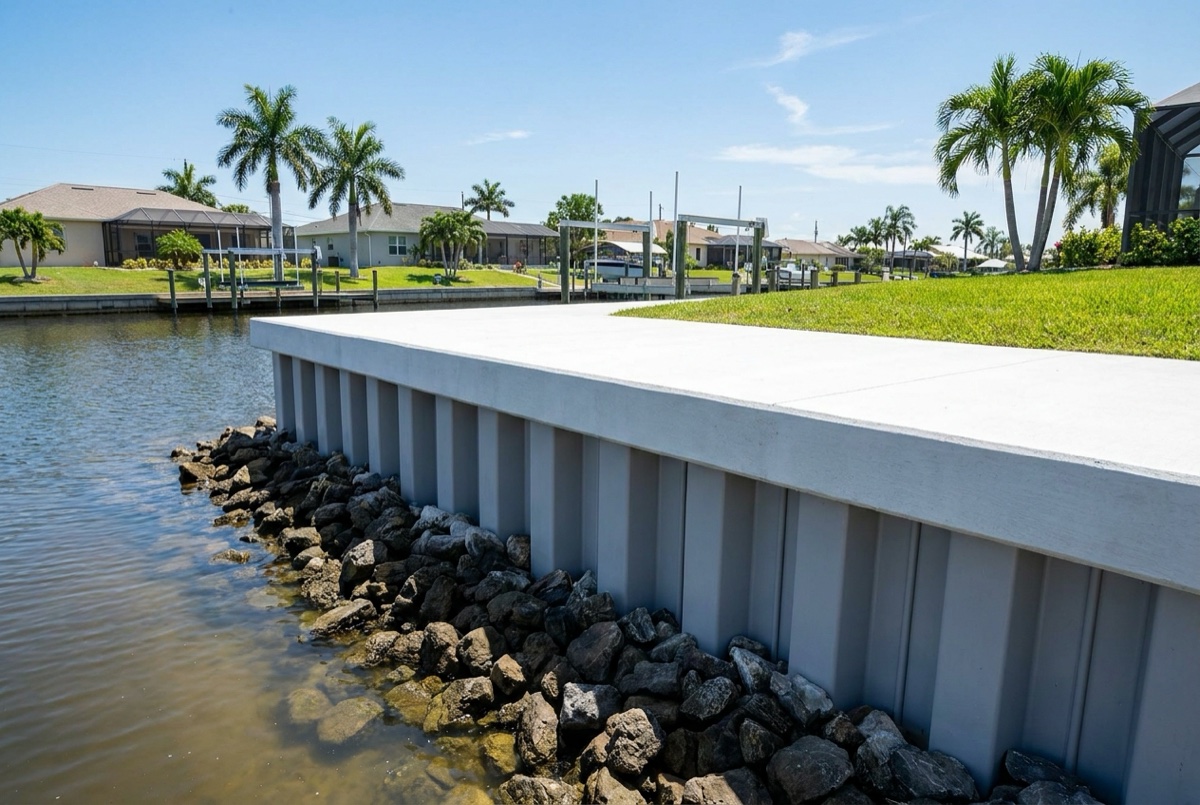
Plenty of Southwest Florida canal homes have a capped seawall and no dock — and for a light boat, a pair of davits bolted straight to that wall is the simplest way to get the hull up out of the salt. No deck, no four-piling field, just two arms that swing the boat up and over. But hanging a load off a seawall has real rules, and the wall’s condition decides whether it’s even an option.
This guide covers what it actually takes: whether your wall can carry davits, how they fit a skinny canal, what they can and can’t lift, and how to keep them running in the salt.
Can you mount boat davits directly on a seawall?
Yes — for a light boat, davits bolt to a sound seawall cap and panels and swing the hull up with no dock at all. The one non-negotiable is that word “sound”: the wall has to be strong enough to carry the cycling load.
A davit is a pivoting crane arm, installed as a bow-and-stern pair with a winch and a strap under the hull. The seawall cap is the concrete beam running across the top of the wall that ties the panels together and takes the mounting hardware. Every time you raise the boat, the davits push a real, repeating load into that cap and the panels below it — which is exactly why the wall matters as much as the davits. For a heavier boat where davits won’t do, a piling-mount setup off the wall is the move, covered in our guide to a boat lift on a seawall with no dock.
Does my seawall cap need to be in good shape first?
Yes — cap and panel condition is the single biggest factor. We inspect the wall before mounting anything, because a tired seawall is not the place to hang a boat.
Before we ever bracket davits to a wall, we check:
- The cap for cracks, spalling, or movement
- Panel joints for separation or bowing
- Whether the wall leans or soil is washing out behind it through clogged weep holes
- The age and material — vinyl, concrete, or older poured walls carry load differently
If the wall isn’t up to it, you’re not out of luck. We either address the seawall first or run the lift on its own pilings so the boat’s weight skips the wall entirely — and we can look at both the wall and the davits in one visit.
Will davits fit my narrow canal?
Usually, yes — a compact footprint is davits’ biggest advantage on a skinny Southwest Florida canal. They mount flat to the wall and swing the boat in tight against it, barely intruding on the waterway.
On canals where a four-post lift would eat half the channel or crowd a neighbor’s setup, davits keep your boat tucked against your own wall. Just remember that local rules limit how far any structure can reach toward the channel, and davits still swing a boat outboard while you load it — so the usable width matters. We confirm the fit on site so you’re not fighting for room every trip.
How much boat can seawall davits actually hold?
Davits are light-duty — they’re built for dinghies, tenders, jon boats, and small skiffs, not loaded center consoles. Match the pair’s rated working load to your boat’s fully-loaded weight with margin, and when the boat’s too heavy, move up to a lift.
Here’s how the three seawall-mount options stack up:
| Setup | Best for | Mounts to |
|---|---|---|
| Seawall davits | Dinghies, tenders, small skiffs off a sound wall | Seawall cap and panels |
| Piling-mount lift | Heavier boats off a seawall, no dock | Its own pilings just off the wall |
| Four-post lift | Center consoles, bay boats, cruisers | Four pilings (needs slip room) |
Size davits to your boat plus fuel, water, and gear — never the dry hull weight on the brochure. Our guide to what size davit your boat needs walks the math, and if you’re torn between the two approaches, boat davits vs. a boat lift lays out the trade-offs.
How do you maintain seawall davits in salt air?
Rinse the moving parts, watch the strap, and keep the marine hardware protected. Seawall davits live right in the salt spray, so a little routine upkeep is what buys you decades instead of seasons.
- Rinse the arms, winch, and cable with fresh water after salty spray, and keep them lubricated as the maker specifies
- Inspect the strap or sling for UV wear, chafe, and salt stiffening — replace it before it fails, not after
- Check the stainless fasteners and cap anchors for corrosion or any loosening
- Rinse the hull too — barnacles and growth that ride up on the boat drop onto your wall
It’s lighter-touch than the submerged parts of a full lift, but salt and UV never take a day off on this coast.
How should I prep seawall davits for a storm?
The safest move in a serious storm is usually to pull the boat and trailer it inland. A boat hanging in straps is fully exposed to wind and surge, so if it can leave the water entirely, it should.
Hurricane season runs June through November, and surge can lift a small boat right out of loosely rigged davits while wind works it against the wall. If trailering isn’t possible, lower and secure the boat as much as your setup allows and add lines — but understand that straps alone are not a storm plan. Every wall, tide range, and boat is different, so confirm exactly what to do for your setup with your contractor well before a storm is on the cone.
Seawall davits are a clean, low-cost way to get a light boat out of the salt when you’ve got a wall and no dock — but only on a wall that’s up to the job. We’ll check your cap, your canal, and your boat’s weight free on-site and tell you straight whether davits, a piling-mount lift, or a repair comes first. Florida Lifts & Docks has worked this coast since 2008 with our own crew. See our seawalls page and boat lifts page, book a free on-site estimate in Naples or anywhere we serve, or call (239) 397-3400.