
Boat Davits vs. Boat Lift: Which Is Right in SW Florida?
When a pair of davits is the smart, low-cost way out of the salt for a light boat — and when your boat really needs a four-post cradle lift.
Key takeaways
- Davits are a pair of pivoting arms that swing a light boat up on straps; a boat lift is a four-piling cradle that holds a heavier boat steady. Davits cost less and fit tighter spots.
- Choose davits for small, light boats — dinghies, tenders, jon boats, small skiffs — on a tight budget or a narrow seawall lot with no room for a four-post lift.
- Choose a four-post lift for center consoles, bay boats, and cruisers, for boats exposed to wind, or for a boat you run most days.
- A four-post lift for a typical bay boat runs about $8,000 to $13,500; davit pricing depends on your boat and seawall and is quoted free on-site.
- Whichever you pick, spec it for salt water: marine-grade aluminum, 316 stainless cable and fasteners, and sealed marine parts.
Both a set of davits and a full boat lift do the same headline job — get your hull up out of the salt between trips, away from barnacles and blistering bottom paint. But they are very different tools, and on a Southwest Florida canal the wrong choice shows up fast: a boat that sways in the wind, a davit arm bent past its rating, or money spent on a four-post lift you never needed.
This is the honest decision guide: when davits are the smarter, cheaper call, and when to skip them for a proper cradle lift.
What’s the difference between boat davits and a boat lift?
Davits are a pair of pivoting arms that hoist a light boat up on straps or a sling; a boat lift is a four-piling cradle that carries the hull on bunks or beams. Davits are compact and low-cost; a lift is heavier-duty and far more stable.
A davit is a small crane arm — the same idea as the arms that raise a ship’s tender — usually installed as a bow-and-stern pair with a hand-crank or powered winch and a strap under the hull. Mounted to a dock edge or a seawall, they swing a light boat up and clear of the water in one motion, with no piling field to drive.
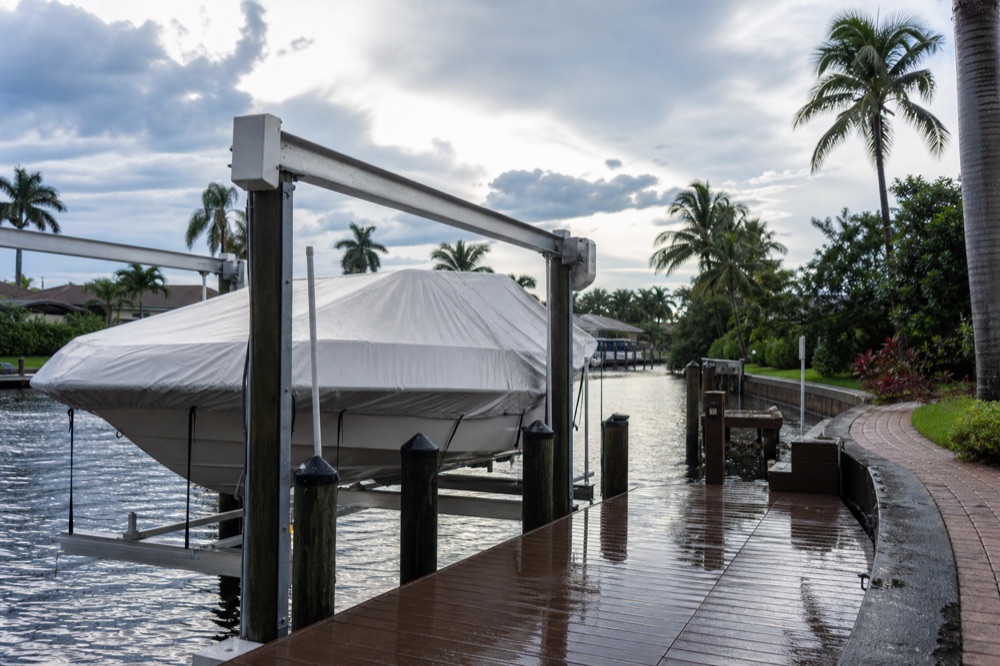
A full boat lift is a different animal: four pilings, cables on each corner, and a cradle the boat settles into. It spreads the load across the canal bottom and holds the boat rock-steady, which is why it scales from a small skiff up to a heavy offshore boat. The four styles of lift are broken down in our guide to types of boat lifts.
When do davits beat a full boat lift?
Davits win for small, light boats on a tight budget or a narrow lot — dinghies, tenders, jon boats, small skiffs, and PWCs where a four-post lift is overkill. They shine when you don’t have room, weight, or reason for a full cradle.
Davits make sense when you have:
- A small, light boat — a dinghy or tender, a jon boat, a small aluminum skiff, or a personal watercraft
- A tight seawall lot or narrow canal where a four-post footprint won’t fit or would crowd the channel
- A sound seawall already in place to mount to, with no room or need for a four-piling field
- Occasional use — a shore tender or second boat you drop in the water a few times a month
- A lower up-front budget — fewer parts and no pilings to drive means a smaller number
Because there’s no four-piling field and far less hardware, davits generally cost less than a full cradle lift. For reference, a four-post lift for a typical bay boat or center console runs $8,000–$13,500 (see our boat lift cost guide); davit pricing depends on your boat and your wall, so we quote it free on-site.
When should you skip davits and get a boat lift?
Choose a cradle lift for anything heavy, anything exposed to wind, or anything you use most days. Davits are light-duty and let the hull hang, so they fall short exactly where a real boat needs support.
- Weight. Davits are rated light. A loaded center console or bay boat is thousands of pounds and belongs on a four-post lift. Push davits past their working load and you bend arms or part a strap — size them honestly with our guide to what size davit your boat needs.
- Wind exposure. A boat hanging in straps sways. On an open basin, a wide canal mouth, or a lot that catches the sea breeze, that swing beats up your hull and hardware. A cradle holds the boat still.
- Daily use. Every launch on davits is a crank-and-swing operation at two points. For a boat you run several times a week, a four-post lift is faster, easier, and supports the hull the same way every time.
- Storm security. Through hurricane season (June–November), a boat cradled low on a four-post lift with proper bracing is far more secure than one hanging from two arms.
Davits vs. boat lift: quick comparison
Here’s the decision at a glance. Light-duty capacities vary by model, so we confirm the rating on site.
| Factor | Boat davits | Four-post boat lift |
|---|---|---|
| Best for | Dinghies, tenders, jon boats, small skiffs, PWCs | Center consoles, bay boats, cruisers, offshore |
| Capacity | Light-duty (confirm the rating) | 7,000–24,000 lb+ |
| Mounts to | Seawall or dock edge, no piling field | Four pilings |
| Footprint | Compact — fits tight lots and narrow canals | Needs slip width and four sound pilings |
| Hull support | Straps or sling — boat can sway in wind | Full cradle on bunks/beams — held steady |
| Cost | Lower; quoted free on-site | $8,000–$13,500 for a typical bay boat |
| Everyday use | Occasional or light | The regional workhorse |
Do davits and lifts hold up the same in salt water?
Only if both are built to marine spec. Salt eats cheap hardware on either one, so davits and lifts alike need marine-grade aluminum, 316 stainless cable and fasteners, and sealed components.
A davit’s strap or sling and winch parts take a beating from salt spray and UV, and a strap that stiffens and chafes will fail — so replace it before it lets go. A lift’s submerged metal needs sacrificial zinc anodes to take the galvanic corrosion instead of your frame. Whichever you choose, spec it for the Gulf coast, or the salt wins in seasons instead of decades. For a PWC, don’t force either one — a purpose-built jet-ski lift is the cleaner fit.
Which should you choose?
The short version: if your boat is small and light, your budget is tight, or your seawall lot is narrow, davits are a smart, low-footprint way out of the salt. If it’s heavy, exposed to wind, or in the water most days, put in a four-post cradle lift.
The real answer comes from your boat’s loaded weight, your seawall, and your canal — which is exactly what a free on-site look is for. Florida Lifts & Docks has built lifts and davit setups across Southwest Florida since 2008 with our own local crew, never subbed. See everything we build on our boat lifts page, book a free on-site estimate in Cape Coral or anywhere on the coast, or call (239) 397-3400.